


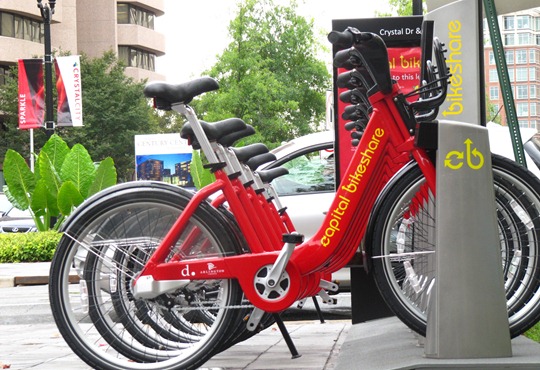
All photos by James D. Schwartz / The Urban Country
The District of Columbia expanded its Capital Bikeshare program last week to 1,100 BIXI-style bicycles scattered around the D.C. area at 110 stations – stretching as far as Arlington, Virginia.
Although a wonderful step in the right direction, the program falls short by trying to cover too large an area with too few stations and bikes.
The most important prerequisite for success in a BIXI-style bike sharing program is to have stations every few blocks so the users can conveniently run their errands without having to stress over finding a station.
The bikes aren’t equipped to be locked up without a bike sharing station, so it’s critical that stations aren’t sparsely dispersed.
Montreal BIXI’s success stems from the fact that they chose a limited downtown area, and they started with 3,000 bikes – while adding another 2,000 bikes in their first year – bringing the total to 5,000 bikes.
Compared to Montreal, Capital Bikeshare stations are few and farther between, and trips often require the user to study the map to know where to find a station.
Economically, Capital Bikeshare’s membership is very reasonably priced – only $50 a year (limited time special – normally $75/year), $25 for a month, or $5 a day. A membership entitles you to 30 minutes of free usage of a bicycle with additional charges for trips longer than 30 minutes.
I took Capital Bikeshare out for a test drive over the two days I spent in Crystal City (Arlington) last weekend (prior to attending a technology conference in the fabricated-lavish-overly-gentrified-fantasy-land called National Harbor, Maryland.)
The bike itself is the same as the Montreal’s original BIXI bikes – 3 speed with enclosed parts, an adjustable seat and built-in front and rear lights. The third gear can be a bit slow at times – especially riding downhill, but overall the ride was a positive experience.
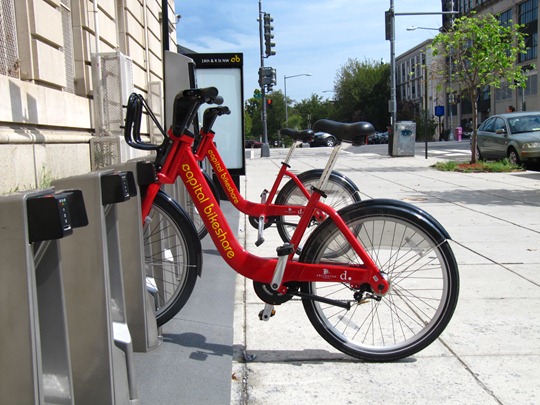
On Saturday evening I used Capital Bikeshare to transport myself from my hotel to a restaurant and a pub. On Sunday I took a Bikeshare bicycle from Crystal City to DC (roughly 7km) and rode around downtown DC.
After arriving in DC, I expected to see Bikeshare stations at tourist destinations such as Capitol Hill, the Lincoln Memorial, the Washington Monument, the White House, and the Smithsonian museums. I was disappointed that there wasn’t a single station near any of these historic landmarks.
Thus, I continued on my quest to find a station so I could return my bike without paying additional usage fees. I cruised along the new Pennsylvania Ave dedicated bike lanes and along several other downtown streets with bicycle facilities trying to find a station.
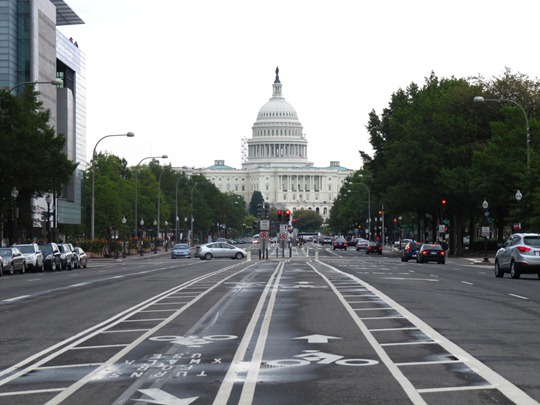
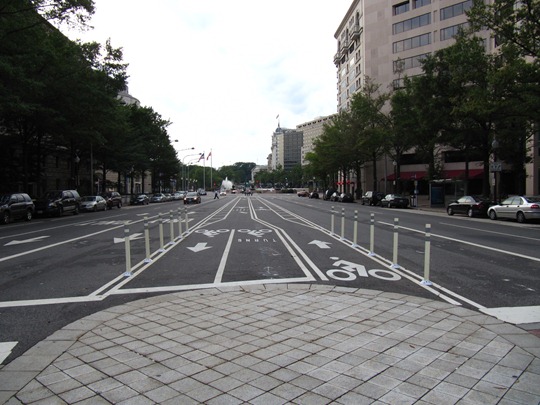
After 40 minutes of hopelessly searching for a station – which saw me touring an impoverished area – I asked a woman on a regular bike if she knows of any Bikeshare stations nearby. She remembered seeing a station near 14th st and U st – quite a distance away.
En route to 14th & U, I finally stumbled upon a Bikeshare station near 14th st and P st, and studied the map to prevent any further mishaps. As it turns out, the closest station to the tourist sites is at 9th St and E St – but it is frankly irritating to have to leave the bike there and walk to the museums or to Capitol Hill.
I ended up walking most of the rest of the day – ending the day in Georgetown.
This map shows how few stations there are within the vicinity of the tourist destinations:

I spoke to Jeff Peel – the League of American Bicyclists’s State and Local Advocacy Coordinator about the lack of stations. Jeff explains,“the system here is still quite new, and not all the stations in place. New stations are added literally every day thanks to a very hardworking team at the city DOT and with the bike share system.”
He agrees that it’s a shame the city wasn’t able to install bike stations in the tourist areas – due to that land being controlled by the Federal government and National Park Service.
Jeff also told me that there is currently a federal funding grant application in to double the size of the system (Georgetown would be the first on my list to be outfitted with several bike share stations).
Bike sharing programs are a great way for locals and tourists alike to get around the city – to get to work, go shopping, visit a tourist attraction, or go out to a restaurant without relying on public transportation or sitting in traffic in an automobile.
One issue with bike share systems is they are at risk of not expanding if enough people don’t use them. But plenty of people won’t use bike share systems unless they are convenient and stations are frequent.
A key difference between Capital Bikeshare and Toronto’s upcoming BIXI program is that Toronto has chosen a very small radius for its initial deployment of 1,000 bikes. This will help to make it easier to find a station within this radius – however, it will also make the system useless to people who need to travel outside the radius.
The key learning here then is that there needs to be enough bikes for the program to succeed – and expanding the system shouldn’t be contingent upon a large number of users in the first phase – or it risks failure.
It’s like building a highway that suddenly ends at a river, but not building a bridge over the river until enough people use the highway.
Time will tell if the city of the District of Columbia and the City of Toronto are willing to make the investment to “build the bridge” – to expand the system to make it extremely convenient for everyone.
Washington DC has great weather for bicycles and some wonderful infrastructure for both recreation and for transportation. Bike sharing systems can only help to increase ridership through both visibility and convenience.
DC’s Capital Bikeshare program is still in its infancy, but has great potential for changing the urban landscape in the nation’s capital. I’m looking forward to visiting DC again to revisit Capital Bikeshare in the future.
James D. Schwartz is the editor of The Urban Country. You can contact James at james.schwartz@theurbancountry.com.
Related Articles:
- BIXI Coming to Town (Aug 2010)
- BIXI: Montreal’s Bicycle Sharing System (July 2009)
- Bike Sharing in Car Capital of the World? (Jan 2010)
I didn’t notice a basket on the bike. This was very handy in Paris. Also, I’m surprised it’s $5 for the day … only 1 euro in Paris … allowing you to be much more spontaneous. And Paris also did it right with the number of bikes and bike stations … all near tourist destinations.
The new bike share is really designed for locals to take short trips, not for tourists to spend the day exploring by bike. Rental bikes are available at 12th and Pennsylvania Ave and also at Union Station and come with helmet, lock, and map included. Thats the way to go if you are a tourist interested in spending the day biking the mall or visiting the museums…and the cost is about half…
According to my reading of Greater Greater Washington, you have the National Park Service to thank for the absence of stations in so many important parts of the city.
-Michael
Dave, there is somewhat of a rack/basket on the front of the bike, equipped with bungie cords. You can probably fit a shopping bag or two in them. But I agree, I love having a big basket on my bike in Toronto.
Beth, I understand that these bikes aren’t meant to be taken out for an entire day. But it would be nice if a local (or a tourist) could hop on a bike and go to a museum and lock the bike up outside the museum. Then hop on another bike and ride a couple miles to go shopping in Georgetown, and lock the bike up there. Then ride another bike back to their hotel or apartment downtown. These are only a couple examples of trips that wouldn’t come close to going beyond the free 30-minute time period and would be very useful for both locals and tourists.
PS: The $5 cost helps the program be more self-sustaining rather than requiring significant government subsidization. The more the government needs to invest, the more likely it is to be cut out of the budget or criticized by naysayers. It’s different in Paris because people are more open to government subsidization for something that is positive for the city. Not so much in the US.
Funny how Bixi got the scale right in Montreal, but it is too spread out in DC, and conversely going to be too compact an area in Toronto’s roll-out. Both cities’ errors are the fault of local conditions – Park Service or City of Toronto ambivalence – but Bixi, as a brand, has to insulate itself from failures: they should refuse to be involved in something so much worse planned than the Montreal roll-out. Not only to protect their business, but if it fails it gives more ammunition to the haters.
Re: the station density, right now, just over 50 stations in DC (and 14 in Crystal City) are up and running. The remaining buildout in this first phase will increase the density in many of the areas with current stations include 3-4 stations in Georgetown, and many more stations downtown, including near (but not on) the National Mall.
Several of these downtown stations are being converted from the old SmartBike sharing system, which only had 10 stations, spread far out.
The spread of the stations in DC is most definitely due to local politics, as each ward got at least a few stations. Even when all 100 DC stations are up and running, the density won’t be close to that in Paris or Montreal, but the DC government and several other local governments have applied for a $12 million federal grant that, if approved, would roughly double the density of stations in DC and expand into several neighboring cities and towns.
Here’s a link with most of the stations…construction should be finished by Halloween.
http://maps.google.com/maps/ms?ie=UTF8&hl=en&msa=0&msid=110890939472002896459.00048bbe9ee325b514b03&source=embed&ll=38.893972,-77.02446&spn=0.095795,0.154324&z=13
Here’s my take: the system rolled out last week, without all of the stations up and running. Too bad, but it was also good to get something on the street before the weather turns cold.
DC, with 69 square miles, is geographically the smallest city in the US with bike share, and will have the most bikes. No, we are not Montreal (yet), but 1,000 bikes at 100 stations is a pretty great start.
I have used the bike four times in the past week, once to work, twice to go to the park, and once to visit a friend. What I found is that the bikes are super easy to use, and it is way faster and much more fun than taking the bus, and sometimes it is even faster than the subway.
As a (former) non-bicyclist and a non-driver, I have to say that the experience of using bikeshare has made DC feel much more accessible to me than before. It makes me appreciate all of the bike lanes and related infrastructure that has been put on the streets in the past few years. And it gives me a slight sense of exhilaration while riding.
I hope that there will be many more bikes and many more stations in the near future.
I think only a fraction of the stations are in place. There will be many more
This comment has been removed by the author.
Yeah um, shouldn’t we wait like, oh say, a few YEARS, before really reviewing how our system compares to more mature systems in other cities?? Just a thought.
We should also wait until we have the entire currently planned system in place to review it. I have experience with Paris’ system, and from a solely bicycle standpoint this one compares beautifully to the Parisian version. I hope that ours grows to the same density per person per square mile that Paris currently has (one every 300 meters), but it will take a long time, just as it did in Paris.
@David: The one issue with Velib (Paris) and Barclay’s Bike Share (London) is that they have limited function for tourists who arrive from countries that don’t have “smart chips” in their credit cards. Both Velib and Barclay’s require chip-and-PIN technology to borrow a bike, which locks out almost all tourists from the United States and Canada.
But the higher cost does allow Capital Bikeshare to be more-or-less self-sustaining, one of the critical knocks against Velib. Barclay’s has a similarly steep pricing scale to CB, as its goal is to be similarly self-sustaining.
I hope that CB works with the National Park Service to establish stations along The Mall, as that will increase the utility of the system. And I also hope that the various business improvement districts (BIDs) work to increase the density of bike station placement throughout DC. Georgetown could certainly use a few stations, though they would need sidewalk real estate that isn’t plentiful (perhaps a “bubble out” that replaces a street parking spot or two?).
@Rudi. I just received a new Visa in the mail a few weeks ago and it had a pin. I live in Canada. I assume the rollout is happening in the US as well.
@CriticallyUrban – I tested out the DC system a week after it launched, and I tested out the Montreal system 2 months after it launched. It sounds like Capital Bikeshare is headed in the right direction, and I agree it’s a fabulous start. But as I said, for these systems to be successful in the long run, you need lots of stations. Time will tell how it will fare in DC.
Pingback: DC’s CaBi Out-Styles World of Bike Sharing ← The Urban Country
Pingback: BIXI Toronto And The Public Bike System Company ← The Urban Country