


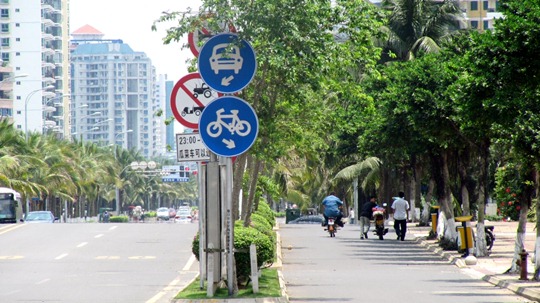
Separated bike lane in China (2010). Photo by James D. Schwartz / The Urban Country
Only in countries without an established bicycle culture would you have bicycling advocates who would lobby *against* bicycle infrastructure because they feel our culture is so dismissive of bicycles as a legitimate means of transportation that it’s impossible for the infrastructure to ever be built properly.
I disagree with the notion that we can’t have proper infrastructure and that we would be better served by promoting vehicular cycling in order to grow bicycling.
Yes, vehicular cycling skills are important because there will always be situations where people on bicycles will be mixed with automobiles.
I agree with Mighk Wilson on many things, and I think his bicycle training program is great for promoting bicycling. But I don’t believe lobbying against bicycle infrastructure is helpful to our common cause, and is in fact detrimental to making progress.
I believe that bicycles should primarily mix with automobiles on calm streets in the city, but I think main arterial roads with busy traffic are better served with separated bicycle infrastructure.
Great infrastructure doesn’t appear overnight, but we can improve on our infrastructure incrementally over time – and several cities in North America are making progress.
Here in Toronto, even a painted bike lane – as imperfect as a painted bike lane is – is a step up from sharing a lane with automobiles on arterial roads. Vehicular cycling on arterials can be stressful – especially during the mad rush to and from the office. From drivers squeezing you to the curb, to them becoming angry when you take the lane, to getting stuck in a long line of traffic congestion with no space to proceed while breathing in the idling exhaust fumes.
At the very least, a painted bike lane lets you proceed beyond long lines of automobiles that sometimes move slower than walking speed – thus providing an incentive for people to use a bicycle. Most people I talk to here in Toronto tell me they use a bicycle to get around because it’s the fastest (and most inexpensive) way to get around the city.
In addition to pushing for improving our infrastructure, I do agree with Mighk that it is important to make bicycling seem normal and predictable. That means dressing in normal clothes, being predictable to motorists, and not making bicycling more complicated than it needs to be.
Mighk claims that the culture needs to come before the infrastructure.
I say the infrastructure can help build the culture, and the culture can also help build the infrastructure. They aren’t mutually exclusive goals and both can be nurtured in parallel.
A commenter recently remarked that bicyclists shouldn’t have their own traffic signals because they won’t obey it anyway, and that they disagree with contra-flow lanes. Nor should people be allowed to ride two-abreast, they said.
Here is another wonderful video from markenlei that in 3 minutes and 41 seconds shows that great bike infrastructure is achievable, that bicyclists can ride two abreast, that helmets aren’t necessary, and that talking on a cell phone while riding doesn’t have to be a big deal.
Or click to watch on YouTube
It is possible to design proper bicycle infrastructure that creates a comfortable, calm ride for people on bicycles. Here in Toronto we have at least one good bike path in the city for commuting from the west end.
Now all we need is more and more.
James D. Schwartz is the editor of The Urban Country. You can contact James at james.schwartz@theurbancountry.com
Related Articles:
- Bicycle Infrastructure Ignorance (Jan 2011)
- Ghettoize Me, Please (Jan 2011)
- Motorists Against Bicycle Infrastructure (Oct 2010)
- New York Bike Lanes Explained (Nov 2010)
- Dreaming of Segregated Bicycle Facilities (Dec 2010)
Not sure it is just in America, James. The UK has its fair share of this kind of pessimism too.
Agreed – and lest we forget Australia. Revised the opening paragraph to not exclude other countries that lack a bicycle culture 🙂
At times while on roads without cycle lanes, I feel rushed with cars whizzing by and waiting behind me. I’m fairly comfortable riding with traffic, but it still can get stressful. I can only imagine what it’s like for someone starting out or thinking of cycling.
I would say along with bike lanes, we need to look at speed limits. Residential streets IMO should have slower speed limits.
When I was in Welland last year, I was pleased to see some streets (even main ones) with speed limits of 30 and 40 km/h. It actually made riding slightly more enjoyable.
It’s less common in St. Catharines, where the speed limit is pretty well 50 on every road.
As for those who say cyclists don’t deserve separate cycle lanes or lights because they don’t obey the traffic law…same can be said about pedestrians and motorists, yet we never question new roads and laugh at the idea of not putting sidewalks in.
Mark tells me that this is merely the “cutting room floor” version of the Rotterdam video. He’s working on a proper version which will appear in a few days with a blog post to go with it. Not that this detracts from this also being rather a good video, showing all that you’ve noticed.
And I agree with Estudio… The UK has spent far too long looking across the Atlantic for inspiration when they ought to be looking across the North Sea.
David,
Excellent. Looking forward to the even better version of the video in the coming days.
Cheers,
James
1. Good point that complementary goals must be nurtured in parallel. It’s inefficient to insist on either cyclists/culture before infrastructure or infrastructure before cyclists/culture. Both have to grow together or else we’ll probably never get where we’re going.
2. If there wasn’t pessimism out there, then I would wonder if our goals aren’t high enough or worth it. But there is because they are. Human nature. It can be productive to accept it as part of the work to be done and address it (as you’ve done here) whenever it raises its head.
Good post, James.
We posted something similar about this false dichotomy.
We have the same problem here in Australia. My wife and I were yelled at for not instantly moving to the left on a small bikeway to allow two faster – albeit, overweight and very amateur – racing cyclists go by. All they could do is mutter a few words of aggression and shake their heads as they passed. They gave us no warning.
Instead of directing their anger at us, I hope in future they direct it to those responsible for the inadequate infrastructure. The bidirectional path was only 1.5m wide…
We also look to the USA for ‘best practice’ ideas for bicycle infrastructure – and public transport would you believe – when the gold standard for many of these things lies elsewhere (EU, Japan, etc). I think Australian’s have a problem when taking advice from Europeans… we always seem to ‘know better’ and that ‘this is Australia’… blah blah.
The reality is that 90% of the population live in urban areas (despite our massive land mass); most trips are done by car 98% and 70% of those are less than 10km.
We also look to the US for ugly roads and freeways and boy do we have plenty of them and they keep building the damn things… I see they’re going ahead with plans for another runway at Brisbane’s airport – talk about investing in a future that isn’t going to exist! Fools…
Pessimism towards infrastructure and lobbying against it are two different things. And it would be hypocritical for either extreme to point the finger and declare that “the other side” exaggerates or misrepresents or has a biased view of the world.
In North America, I think that the pessimism is deserved. We have plenty of substandard facilities to demonstrate it. But it is also the case that there are positive improvements that — hold your breath — can be labeled a facility.
There are lots of reasons why there is a disconnect between otherwise smart folks that enjoy cycling. If forced to put my finger on one element, it would be the true uncertainty with what we call knowledge. From my perspective, people are simply far to accepting of observations, assertions, theories, data, and so on that confirms what they want to believe and wildly skeptical of contradictory evidence. Consequently, we have people arguing against a bike lane/shoulder on a very fast road in Albuquerque — http://tinyurl.com/46blxs6 — but not even blinking an eye at contraflow cycletracks in areas with lots of intersections.
Anyway, if it matters to anyone, by far the biggest improvement for cyclists, IMO, would be some movement towards strict liability and a general consensus to slow motorized traffic on local streets.