


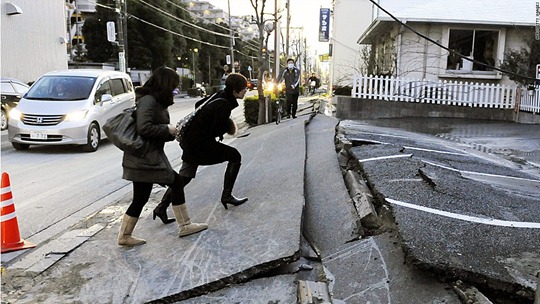
Photo courtesy of Toshifuni Kitamura, Getty Images / March 11, 2011
In the aftermath of the massive earthquake and ensuing tsunami that hit Japan on Friday afternoon, millions of people were left stranded at their workplace and tens of thousands displaced from their homes with few options to transport themselves to safety.
Those who were unlucky enough to have an automobile at their disposal ended up in bumper-to-bumper traffic congestion – unable to get anywhere. Others who were able to leave the cities encountered impassable roads left in ruins.
Those who took trains to work that day had few options to transport themselves home – many of them started walking along the unused train tracks.
Early this morning I first started seeing reports through Marc (@amsterdamized) that CNN was reporting on bike shops being sold out in Tokyo as people scrambled to figure out how to get home to reunite with their family and friends.
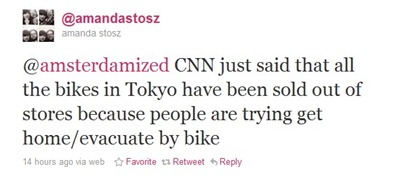
Bicycles offer freedom and mobility that you often can’t get with automobiles, and speed and efficiency that you can’t achieve by walking.
Richard Masoner of Cyclelicious pointed out earlier today that the average commute in Tokyo is 26km – not exactly a “walk in the park”. He also made some other interesting observations in his article:
The average commute distance in Tokyo is 26 kilometers (16 miles). Stranded commuters waited in long lines for taxi cabs and buses, while thousands of others booked hotel rooms.
While tens of thousands began walking home, others tried to buy bicycles. Tweets from Tokyo By Bike say bike shops are doing a brisk business selling bicycles to stranded workers. He reports that at least one bike shop has sold off its entire inventory, including high end bikes that run ¥300K (or 30万円, about US$3700).
And you know those fancy automated electronic bike parking facilities in Japan? They don’t work after an earthquake. Johan in Nippon walked home after he couldn’t retrieve his bike from the bicycle parking machine. This might be something to think about with the electronic badge access bike stations we have in the SF Bay Area.
Boing Boing also published a report on the disaster written by a correspondent who also took to his bicycle to explore the aftermath of the disaster.
Here are a few photos highlighting the chaos amidst the aftermath of the earthquake:
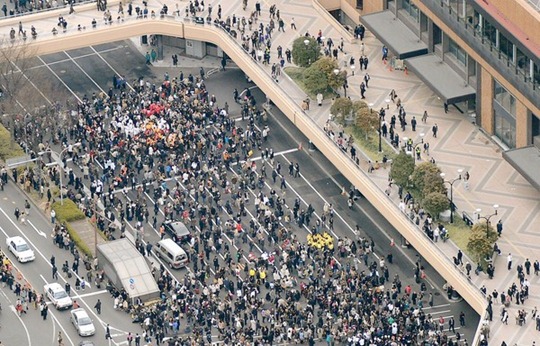
People evacuating train station – photo courtesy of Reuters/Kyodo / March 11, 2011
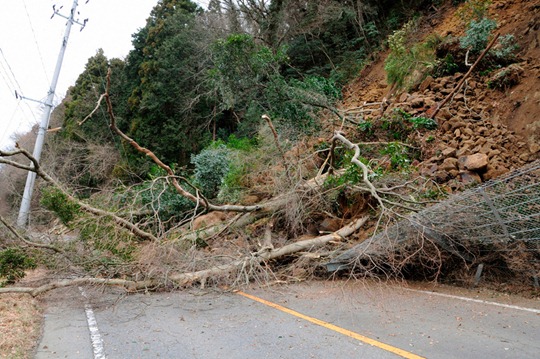
Aftermath of Japan quake – March 11, 2011 – Photo courtesy of REUTERS/KYODO
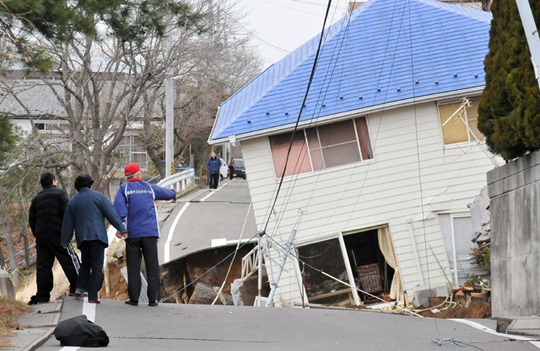
Residents check the damage done to a road and house in Sukagawa city, Fukushima prefecture, in northern Japan on March 11, 2011.(FUKUSHIMA MINPO/AFP/Getty Images)
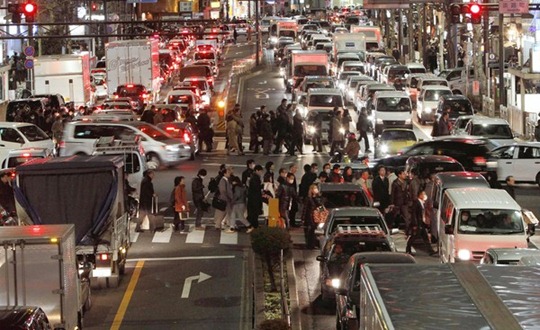
Tokyo traffic chaos – photo courtesy of Toru Hanai, Reuters / March 11, 2011
Historically, bicycles played a role in providing transportation for people who were affected by other tragedies – including both world wars when fuel was being carefully rationed to be used for fighting the enemy. Bicycles even played a role in transporting troops in some some battles throughout both World Wars.
I’ve lived an extremely fortunate life, so I haven’t suffered tragedy like the Japanese are currently enduring.
However, during the G20 summit in Toronto last June my bicycle provided me the mobility required to cover the summit and move around in ways that would have been impossible in a car and inefficient by foot.
My sincere thoughts and condolences go out to those who have suffered, are suffering, and will suffer as a result of this disaster.
Stay safe, and keep your bicycle nearby. You never know when it might save you.
To support the disaster relief from this terrible tragedy, please donate generously to the Red Cross.
James D. Schwartz is the editor of The Urban Country. You can contact James at james.schwartz@theurbancountry.com.
Related Articles:
- Critical Mass Carnage (GRAPHIC VIDEOS) (Feb 2011)
- 2004 Tsunami Video (Dec 2004)
- 2004 Tsunami Death Toll Nearing 60,000 (Dec 2004)
- New Orleans is Sinking Man And I don’t Want To Swim (Sept 2005)
Wishing I had ridden to work yesterday in Tokyo, but I was more fortunate than most in Tokyo with a 12km walk home, and far more fortunate than those nearer the epicentre…
Now if that nuke plant blows… I want a jet!
Mr. S/James, I was hoping I would hear from you. Glad you are safe man – that is some scary shit going on with the nuclear reactors.
Stay safe, and feel free to keep us updated to make sure you are safe as the gov’t works to defuse the situation.
Winds are out to sea, so that’s something… The biggest worry is the Japanese nuclear agency has a history of lying through its teeth, and though I love this country, the culture has serious issues with improvisation in crisis. Local news is telling much less than international as the local media self-sensors. I doubt I am the only foreigner considering buying flights out.
I’ve heard many people scoff at the idea, but bikes can also be a realistic way to get relief efforts quickly underway to damaged areas. It’s not a complete solution of course — trucks, boats and air transport all play a part in our complex society.
Fer instance: my old man was a VP for Motorola in Japan when the 1995 Kobe earthquake killed 6000 people. He and his team were among the first outside aid workers to arrive on the scene. They hauled tents, water, food, sat phones and portable cellular base stations as far as they could on the trains. They already knew a lot of transportation infrastructure was demolished so they brought bike with them. After the trains stopped, they cycled the rest of the way into Kobe with each of them carrying something like 60 kg of supplies on themselves and on their crappy mamachari bikes, and once they got into Kobe they just gave the bikes away to whoever. It’s a pretty cool story.
@Yokota Fritz, your old man is one of the angels. Too bad the %$#@wits nominally in charge let a few thousand people die in the Kobe rubble (I was in Kanto during ’95).
Winds are offshore from Fukushima for now (do not believe the Japanese news about emissions!). For those readers in Japan or Korea, in case the winds shift from the Fukushima nuke-plants, make sure you locate some potassium-iodide. My longer explanation is here, and I included product pictures: http://hanlonsrzr.blogspot.com/2011/03/if-theres-meltdown-and-on-shore-winds.html
Sorry, @James D. Schwartz, great blog and thanks for the concern, but all is fine… for now.
Agree a bike is great for fleeing, except now I also have a 9-month old and wife and mother-in-law…
Yes, a bike can certainly offer a way to get to places other forms of transportation sometimes can’t.
I wonder how far the people in Tokyo have to cycle to get out of the city – the area must be huge.
@Mr S – My dad was furious at the government non-response in ’95.
Of course he was! Your father had something they lacked: a conscience! The only good outcome is better preparation now. This is going to have more than five times the casualties. I cannot imagine the suffering if it had happened before the lessons of ’95.
Pingback: Bicycle Commuting In Sandy’s Aftermath ← The Urban Country