


Photo by James D. Schwartz / The Urban Country
BIXI bike-sharing is scheduled to kick off on May 3rd in Toronto with 1,000 bicycles at 80 stations in the downtown core. BIXI is operated by the Public Bike System Company which is based in Montreal, Quebec.
Public Bike System Company is a privately held company that was founded in 2008, just prior to launching Montreal’s BIXI bike-sharing program in 2009. BIXI later spread to Minneapolis, London, Washington DC, Melbourne, and now Toronto. As a result of the proliferation of BIXI bicycles around the world, the Public Bike System Company has recently announced that they surpassed their net income predictions by more than 40%.
Toronto’s BIXI program will offer memberships for $5 a day, $40 a month, or $95 a year. With a membership, you are free to take a bicycle as often as you please – as long as you return the bicycle to one of the 1,500 docking points at the 80 stations in 30 minutes or less. BIXI is thus intended for short trips, and designed to maximize the number of trips a bicycle can facilitate each day.
This type of bike sharing program is great for public transit users, tourists, train commuters, business people traveling to meetings downtown, or people who live within the service area. Even if you already own a bicycle, BIXI can be convenient for one-way trips and allow you to more easily combine public transit with bicycling.
In 2009, after kayaking from Toronto to Montreal, I tested the BIXI system for several days – pointing out several flaws – many of which have since been fixed. Since that first trial in 2009, I have been intrigued by BIXI and how it can help contribute to shifting our cities to be more comfortable for people on bicycles.
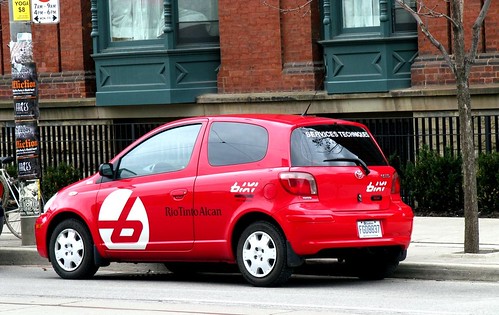
This morning I was delighted to see a BIXI “technical services” car with Quebec license plates briefly parked across the street from my home while the technician bought a coffee. With just over 1 week before BIXI Toronto launches, it’s great to see the technicians in town preparing for the launch.

Two weeks ago I visited the head office of the Public Bike System Company in the outskirts of Montreal to find out more about the company. The front-desk clerk handled escalated support calls from various cities where BIXI is operating. Most of her calls seemed to be coming from DC’s Capital Bikeshare program, often answering the phone: “Capital Bikeshare, how can I help you?”.
Given the time zone differences, I was told Melbourne handles their own support calls.
A BIXI employee told me DC’s Capital Bikeshare has been successful since launching last September, though there were a few reported incidents of stations freezing over the winter. Montreal shuts down its bike sharing program from November to April, so DC is the first to test the stations through a snowy winter.
I tested out DC’s Capital Bikeshare shortly after they launched to be disappointed by the lack of stations, but they have added more stations since I tested it out. Like DC’s system, Toronto will also operate year-round. However, Minneapolis closes down for the cold Minnesota winter.
The Public Bike System Company head office is located in an industrial complex near Montreal’s Trudeau airport. I was able to reach the head office by public transit using the subway and transferring to a bus. However, it seemed most people who work here drive to the office:

Photo by James D. Schwartz / The Urban Country
Beside the building is a BIXI bike sharing station with space for 3 BIXI bicycles:
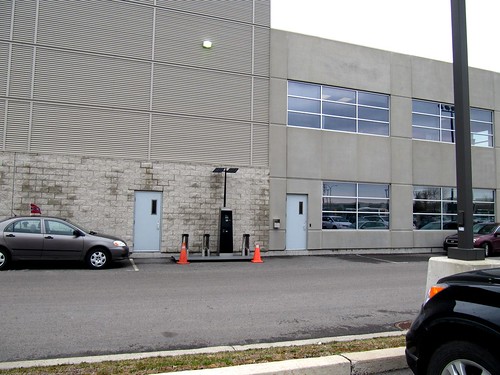
Photo by James D. Schwartz / The Urban Country
It is hard to say whether this station is actually for usage or if it is placed there simply for temporary storage, but inside the head office you will find another larger docking station which is used to showcase the bicycles and the station to prospective customers:

Photo by James D. Schwartz / The Urban Country
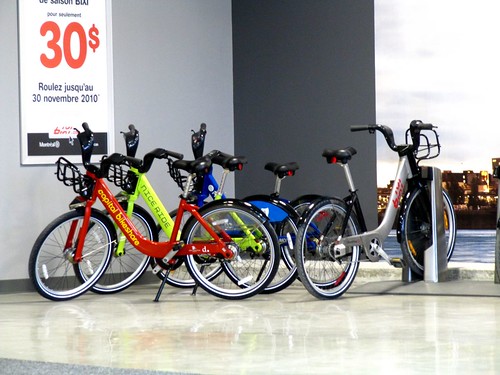
Photo by James D. Schwartz / The Urban Country
On the other side of the floor, you will find a London Barclay’s Cycle Hire station with a single bicycle on display:
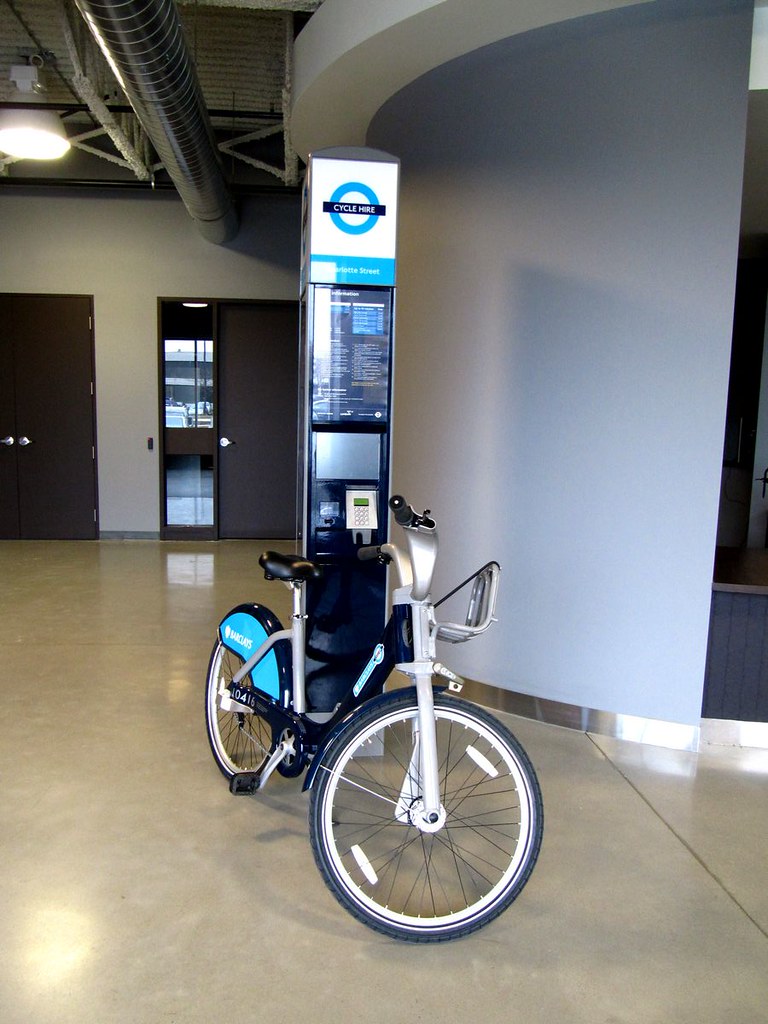
Photo by James D. Schwartz / The Urban Country
As well as what appears to be a rider on a prototype bicycle, with some photos hanging on the wall in the background:

Photo by James D. Schwartz / The Urban Country
Toronto had originally planned to launch BIXI in 2010 with 3,000 bicycles and 300 stations, but they delayed it by a year and reduced the number of bicycles to 1,000 at 80 stations.
The risk posed in Toronto is that the service area might be too small to make it useful for a wide range of potential users. The potential lack of usage may prevent it from expanding, and thus servicing more riders.
My hope is that BIXI in Toronto will expand incrementally regardless of its initial success due to the potential it has to service vast residential areas just outside of the initial service area.
BIXI told me there are 2 dedicated technicians from Quebec who are working with the City of Toronto to determine where to place the docking stations in the downtown service area. I suspect the photograph I took above is one of those two technicians.
With only one week and two days remaining, Toronto should start seeing docking stations being installed very soon. I have already pre-paid for an annual membership and plan to use BIXI in situations where it is more convenient than bringing my own bike.
James D. Schwartz is the editor of The Urban Country. You can contact James at james.schwartz@theurbancountry.com.
Related Articles:
- BIXI is ready for Toronto, is Toronto ready for BIXI? (Nov 2009)
- BIXI: Montreal’s Bicycle Sharing System (July 2009)
- DC’s Capital Bikeshare Falls Short (Sept 2010)
- Bike Sharing in Car Capital of the World? (Jan 2010)
- Protesting Helmet Legislation in Australia (July 2010)
Of course I want Bixi to succeed in Toronto, though I am living in Tokyo for the next few years, and the initial coverage area in Toronto would not serve me even if I were there. And yet… some bitter part of me would like to see it fail for no other reason than to revel in one more sign of Toronto’s suckage.
Fortunately, I have no influence on its success or failure, living abroad.
I really hope Bixi does well in Toronto, and expands to serve people in the Annex, Parkdale, and Riverdale. Choosing to start with only 1,000 bikes was a sign of true gutlessness.
@Mr. S, lol, thankfully you don’t have an influence on its success or failure, because I would hate to see BIXI fail just so you could revel in Toronto’s suckage 😛
@Barney, agreed, BIXI would be really useful in so many residential areas that are just outside of the current service area. Even if they had a single station setup at King and Strachan (for example), it would help alleviate one of the busiest streetcar stops in the city.
I’ve been riding the Barclays bikes here in London for the past week, and I can’t emphasize enough how useful and handy it has been! But…they have a great many stations. You don’t really need a station map… I find no matter where I am in the service area, I just have to walk around a couple of blocks and I’ll find a docking station. This really adds to the possibility of spontaneous use rather than having to remember to bring a docking station location map whenever you leave the house!
James, I agree I am being a sourpuss. Still, I think it might help Torontonians make Toronto become the city it could be, if more Torontonians realized how very second (third?) rate it is, and that it needs overhaul. That is where my revelling in suckage come from.
@Alexwarrior – they are setting up the stations here in Toronto now, and the stations are very frequent (as long as you stay within the service area of course). That’s the key – spacing them close enough so that you never need to look at a map to find a station. In DC I had trouble finding a station to return the bike to.
Mr. S., I think you’re right. Here is another project that Ford just killed yesterday: http://www.torontosun.com/2011/04/27/pedestrian-bridge-to-fort-york-latest-casualty-of-war-on-waste
Oh what Toronto could have been…
A beautiful bridge, but even this leftie can’t see many better uses for that kind of coin. A pedestrian bridge to the Toronto Islands comes to mind…
True enough, a pedestrian/cycling bridge to the islands would be amazing. Except it would have to connect through the island airport (otherwise it would be one hell of a long bridge, or one hell of a long bike ride if the bridge connected from Tommy Thompson park).
So in order to get across the airport runways and on to the island, it would need to be a tunnel. I know they are building a tunnel for airline passengers, but it would probably cost in the hundreds of millions to extend the tunnel beyond the airport runways to Hanlan point unfortunately.
Cherry Beach to Ward’s Island. At the very least a ferry there. Can’t see why all the traffic has to funnel through that horrible Queen’s Quay bottleneck (and why I rarely go). The Island locals may complain, but they stole that land anyway, so have no right to complain about extra pedestrian/bicycle traffic. They’d also get more reliable service to the city, if the city promised to retain the ferry also to Queen’s Quay.
I know. Never happen.
We are a moving company that is based on Toronto and we are more than willing to serve you anywhere in Canada to places around the country or overseas.
We are a moving company that is based on Toronto and we are more than willing to serve you anywhere in Canada to places around the country or overseas
Pingback: Do-It-Yourself Neighbourhood Bike Share ← The Urban Country
Pingback: xbox 360
Pingback: penis advantage scam
Pingback: truth about six pack abs review
Pingback: Rosalina Massetti
Pingback: penisadvantage
Pingback: edu backlinks
Pingback: hostgator coupon 2013
Pingback: free ipads
Pingback: best 42 inch led tv
Pingback: penis advantage reviews