


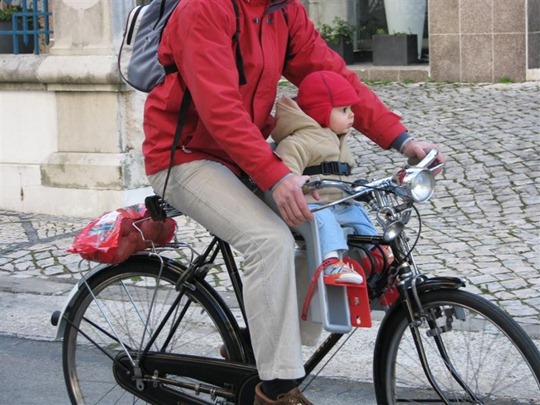
Photo courtesy of Jorge / via RateMyVelo.com
We spend a lot of time on here talking about improving bicycle infrastructure. Yes, bicycle infrastructure is important to help make bicycling in car-dominated cities more comfortable for people on bicycles.
But one issue that gets lost in the push for better infrastructure is the discussion of responsibility and accountability – two very important words that contribute to safety on our streets.
This topic came to the forefront of my mind when I was riding home last night from work. I was riding along an old rail line that has been converted into a multi-use pedestrian/bicycle trail. A toddler suddenly ran directly in front of my front wheel and I came less than 10 centimeters from running into the child.
But I wasn’t scared, the toddler wasn’t scared, and the mother wasn’t scared – because I adjusted my riding speed to the conditions around me. I anticipated that a toddler might run in front of me. I was going slow, so I only had to apply a slight brake in order to avoid hitting the child.
In this particular situation, the mother is accountable for protecting her child. But I was responsible for riding safely and adjusting to the conditions around me. I’m larger than the toddler. I understood that even though the mother might be at fault for letting her toddler run about on a path shared with numerous bicycles, I had an obligation to ride responsibly.
Too often, these words are lost upon us in our car-dominated society. Society too often makes excuses to absolve drivers from responsibility and accountability. If a pedestrian or bicyclist get hit by a car, the first question asked is “was the pedestrian or bicyclist obeying their signal?”. We first try to hold the pedestrian or bicyclist accountable.
If the pedestrian or bicyclist isn’t at fault, then we look to blame other factors such as weather conditions, alcohol or helmets. Was the driver under the influence of alcohol? Was the bicyclist wearing a helmet? Were the roads slippery at the time?
We ask questions that avoid the root cause of the problem. The question we need to ask ourselves is, was the driver driving responsibly? Was the person driving the larger vehicle adjusting their driving to the conditions of the road? Was the driver of the automobile anticipating something unexpected? Were they speeding? Turning too fast? Passing too close?
We skirt around these tough questions because it’s so much easier to blame it on alcohol, helmets or weather. We avoid getting to the root cause because as a society we are afraid that dealing with the real problem might add five minutes to our commute time. And we pretend the driver is rarely at fault because we want to believe that our choice of automobile dependency is superior to other modes of transportation.
If the photo at the beginning of this article makes you feel queasy, you need to ask yourself, why? Is it because you fear that too many drivers don’t drive responsibly, and that you fear for the child’s life? Do you feel queasy when you see a child inside an automobile? What about when a driver is driving 140km/h on the highway? Still not queasy?
Parents shouldn’t have to worry about bicycles running down their children. Just like pedestrians and bicyclists shouldn’t have to worry about cars running them down. Remember the days when children used to play on the streets and drivers were cautious to watch out for children? Does this happen any more? I don’t see it.
One way to hold people accountable and thus encourage them to be more responsible when they drive is to enact and enforce strict liability on our streets. In simple terms, with strict liability, the person in the larger vehicle is presumed to be at fault unless they can prove otherwise.
Here in Canada, even though the law implies strict liability, people are rarely held accountable because there are so many loopholes in our court system that favours drivers. This leaves very little incentive for people to drive responsibly, and there is plenty of evidence of dangerous and distracted driving in most cities I’ve visited in North America both statistically and anecdotally.
In the absence of enforced strict liability to make us more accountable for our actions, let’s all try to act a bit more responsibly. Try to think about the potential consequences of texting while driving, driving too fast, or passing too close.
You never know when someone on a bicycle might need to swerve to avoid a pothole. Expect the unexpected and adjust your driving to your surroundings.
I once heard someone say that drivers should drive as though their car is covered with bombs and the car would blow up on contact with any other object. It’s hard to go wrong with that mentality.
Be safe friends.
James D. Schwartz is the editor of The Urban Country. You can contact James at james.schwartz@theurbancountry.com.
Related Articles:
- Enough Excuses: Cars Cause Death (Dec 2010)
- Sympathizing Road Rage (March 2011)
- 25% Of Motorists Hate Their Commute (Jan 2011)
- Car Culture Bleeds Our Society (Aug 2010)
- Refusing To Be Herded Like Cattle (Aug 2010)
I think you need to turn the dial a bit further on the responsibilities of drivers. Was it necessary to use a car at all for the trip? Because, no matter how carefully you drive (or think you drive), actual accidents do sometimes happen, and the consequences (for others) when they happen in a car, are larger than they are using alternate forms of transport.
For example (all real-world examples), a moth could fly in through your window and hit you in the face, causing you to lose control and hit a tree (not me, a friend). The wheel could come off your car, and who knows what it might hit? Your fuel line could come loose downstream of your fuel pump (loss of power, gas vapors everywhere, freeway traffic). Your hood latch could fail at speed, and suddenly, you see nothing. Rarely, but repeatedly, you will hear some horrible story of someone driving their car over their own child, in slow-speed parking maneuvers. There’s a small but non-zero chance of something completely unexpected going wrong, and when it does, the plausible outcomes are worse in a car. What would be a bruise with a bicycle, becomes a trip to a hospital with a car, or worse.
If you can shift 10% of your commuting to a bicycle, that’s a 10% reduction in bad surprises. If that 10% also happens to be the travel that is most likely to put other people at risk (i.e., surface streets, neighborhoods) that’s even better.
If I used a chainsaw for all my woodworking, sooner or later, something bad would happen, and at that point, people would cluck their tongues and shake their heads, and the stupidity of someone who would gratuitously use such a dangerous piece of equipment when safer tools suffice. But that’s how most people use cars on this continent, almost all the time. (And at least in the US, we like to adjust our stereo and take calls on cell phones, while wood-working with a chainsaw.)
dr2chase – I agree that there is a chance that a collision is truly an accident (you gave a few examples of how this could happen). But the vast majority of deaths involving automobiles that I hear about are preventable (e.g. the driver was speeding, careless, distracted, negligent, intoxicated, etc.).
If we can eliminate unnecessary collisions and be left with “freak accidents”, I would say that’s a huge step forward.
Having said that, I do agree with you that the best way to improve safety for everyone is to not drive at all. Millions of people around the world die from automobile pollution too.
Cheers
James
Great post, James.
Too many people are inpatient in our modern world – and for no good reason. Small delays & concessions never really ruin our days – we’re just told they do… but they certainly improve the lives of others and, indirectly, our own lives.
Regarding the photo:
Perhaps another reason why we don’t consider children in cars driven dangerously more upsetting than that child on the bicycle (which I think is lovely and not common enough btw), is that we don’t ever really see the occupants of cars.
A bicycle is visible, the rider is visible, the HUMAN is visible (even more so when you don’t hide behind glasses, helmets, lycra). The rider’s vulnerability is obvious.
When people look at traffic, they see machines – dangerous, overpowered, potentially lethal machines. I don’t think people even consider that there is a human behind the wheel sometimes – not until their rage is out of control.
If all drivers were forced to be visible (drive convertibles?), I wonder how much calmer our streets would be? Removing all the equipment to protect the occupants might also help calm everyone down as well.
Safety features may make occupants of motor vehicles safer… at the expense of everyone else’s safety.
I don’t think debating whether or not using a car was necessary for a trip will do much to promote responsibility and accountability. Enforcement of the law and knowledge on the part of police officers and drivers alike of the law respecting sharing the road will. Lack of both from what I repeatedly read is a problem everywhere.
I still see a good deal of irresponsible cycling on the part of some cyclists where I live. Too many and too often actually. Mostly, I think they are college students who don’t have any other means of transport and probably don’t get around by bike when they are home with their family cars. The problems I repeatedly encounter with them are cycling in the wrong direction in the bike lane, biking wearing ear pods, and, the worst, cycling at night with no lights whatsoever. I can’t imagine that these cyclists don’t have near misses while biking and learn to view cycling as dangerous and risky. I suspect that as a result they’ll switch to back to driving as soon as they’re able because of bad experiences on their bikes. Other drivers and cyclists who witness their wreckless disregard for their own safety will likely also chalk it up to the usual “biking is dangerous” myth even though the problem is not doing so wisely.
I think the image of bicycling as a responsible choice will grow as we see more and more people cycling responsibly and being accountable for the choices they make while riding. As a cyclist I have the ability to make cycling look safe or not.
@Paul – Great points – cars are indeed far more anonymous and invisible than bicycles. I think Mikael’s recent post detailing a conversation with his 3 year old daughter sums it up nicely:
“When people are in cars, you can’t see them, can you?”
“No, you can’t”, said Daddy. “But you can see people on bicycles, can’t you? And people walking and those people on that motorbike.”
“Yeah… cars are silly, aren’t they, Daddy? You can’t see the people in them. That’s silly…”
@SheRidesABike: I agree that all road users should be responsible and follow the law. But there are some laws that just don’t make sense for bicyclists and should be altered. I find myself often crossing at certain pedestrian crossings because the automobile left turning lanes are too dangerous and stressful for a bicyclist. So in this case, I’m breaking the law, but I’m not putting myself or anybody else in danger.
I don’t like it either when a bicyclist is breaking the law and putting somebody else in danger, but if they are riding the wrong way on an empty one-way street, I don’t see the big deal (if they aren’t harming anyone else).
To be quite frank, I see far more motorists here putting other people’s lives at risk than I see bicyclists even mildly annoying others or putting them at risk.
I would much rather a bicyclist wear an iPod on her bike than a driver listening to loud music with his windows closed, unaware of everything going on around him. I just couldn’t see myself getting upset with a bicyclist wearing an iPod.
Riding at night without lights is different, because it puts themselves at risk and it puts others at risk.
Just read your April 13 post about responsibility. I rode as a bike courier for more than 20 years, never got a ticket for anything because like you I responded and rode to road conditions. In 2007 I had undergone surgery after being t-boned by a driver on Yonge St. The police charged her with unsafe turn, speeding, failing to yeild she to this day still fails to take responsibility for the “accident”. I’m returning to biking for the first time in 4 years next week. Hopefully things will be better now with everyone, drivers, pedestrians and fellow cyclist.
Even though the chain stores are full of bikes to choose from and their prices are sometime quite tempting, they may not be the best choice. These bikes are not always the best quality so if your child is going to be doing some distance riding with their mom and dad, then it would be best if you visited your local bike shop.
I think you need to dial a little more responsible driver. Was it necessary to use a car for the ride at all? Because, no matter how carefully you drive (or do you use), then the real accidents sometimes happen and the consequences (for others) when they occur in a car that is bigger than what they are to use alternative forms of transport.
I think you need to dial a little more responsible driver. Was it necessary to use a car for the ride at all? Because, no matter how carefully you drive (or do you use), then the real accidents sometimes happen and the consequences (for others) when they occur in a car that is bigger than what they are to use alternative forms of transport.
I think that helmets should always be worn when riding a motorbike or just a bike. Thanks.
I think that helmets should always be worn when riding a motorbike or just a bike. Thanks.
Always take precaution whenever you hit the road. Wearing the right materials can protect you in such accident.
wites & kapetan
Always take precaution whenever you hit the road. Wearing the right materials can protect you in such accident.
wites & kapetan
Pingback: Ignoring Careless, Dangerous Driving ← The Urban Country
Pingback: Toronto Taxi Drivers Resort To Victim Blaming ← The Urban Country
Pingback: Baby On Board: A Desperate Plea ← The Urban Country
Pingback: The Driver Privilege Checklist ← The Urban Country
Pingback: Traffic Calming A Waste Of Money? ← The Urban Country
Pingback: Time to Protect Cars From Reckless Pedestrians? ← The Urban Country
Pingback: ‘i share the road’ campaign ← The Urban Country
Pingback: Toronto Cyclists Are Selfish And Rude? ← The Urban Country
Pingback: External Airbags on Cars: Novel Idea? Or Band-Aid Solution? ← The Urban Country
Pingback: xbox 360
Pingback: does penis advantage work
Pingback: mike geary truth about abs
Pingback: Travis Herting
Pingback: penis advantage scam
Pingback: edu links
Pingback: hostgator coupons
Pingback: free ipad
Pingback: best 60 led tv
Pingback: penisadvantage
Pingback: high quality backlinks