


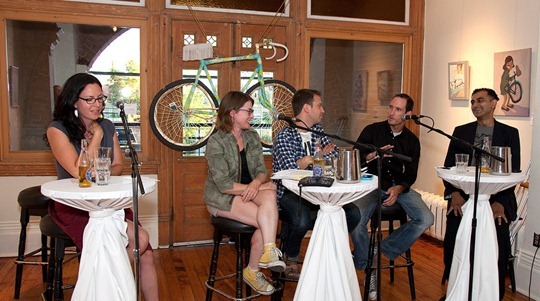
Bicycle Film Festival Panel Discussion at the Gladstone Hotel (Aug 10, 2011) – photo by Erin Simkin / Bicycle Film Festival Toronto
Last Wednesday I participated in a panel discussion for the Toronto Bicycle Film Festival. The title of the panel discussion was: “Building Bridges: How to tell good stories and win over non-cyclists at a dinner party”.
The premise of the discussion was interesting because we have all encountered non-cyclists who get us worked up when we aren’t able to get through to them when we express our point of view.
The discussion was moderated by Yvonne Bambrick, the former Executive Director of the Toronto Cyclists Union and now an Urban Cycling Consultant. In addition to myself, there were 3 other panellists who participated: Tammy Thorne (Editor in Chief, Dandyhorse Magazine), Dave Meslin (Founder, Toronto Cyclists Union), Shamez Amlani (Co-founder, Streets Are For People).
The discussion surfaced some ideas about how we can more effectively communicate with non-cyclists to share the benefits of bicycle transportation.
Each panellist was asked two questions before the floor was opened for questions/comments from the audience. The first question was:
Can you recall a time when you realized that how you were discussing or presenting “benefits of cycling transportation” was falling on deaf ears – when you could tell the person you were speaking to had stopped listening? What argument were you using? What have you noticed as ‘turn offs’ in this type of conversation?
And the second question:
Is there a particular moment that stands out of a time when you remember seeing a ‘lightbulb’ moment when in conversation with someone about this same topic… A time when you realized and felt that your points were having the intended effect and that you were really changing this person’s mind about the value of cycling transportation? What point were you making?
There were some very interesting and helpful points made by both the panellists and audience members. Tammy Thorne discussed the importance of keeping your cool when confronting a motorist and explaining to them in a nice way that they almost hit you.
Dave Meslin mentioned some common arguments used by motorists who argue against bike lanes (e.g. Why do you need a bike lane when you can bike three blocks to the next street with bike lanes?), to which he would ask the motorist why do we need car lanes on a particular street when they can drive a few blocks to another street.
Shamez discussed how preaching to non-cyclists is not an effective way to win them over (something which he says he has been guilty of in the past). He also mentioned that his world travels have left him inspired to make Toronto a better city for people instead of just catering to cars.
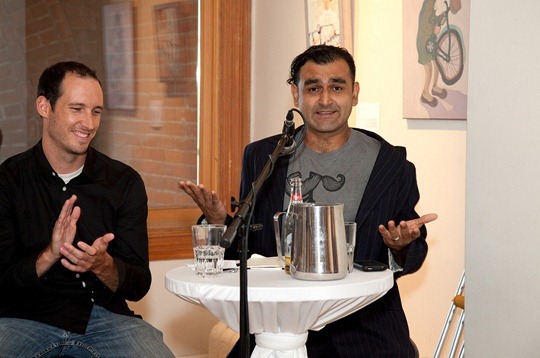
Bicycle Film Festival Panel Discussion at the Gladstone Hotel (Aug 10, 2011) – photo by Erin Simkin / Bicycle Film Festival Toronto
I highlighted how talking about sustainability and environmental issues taints the conversation and some people won’t listen to anything else you say.
I also mentioned a “lightbulb” moment that I experienced when I recently opened a civil, respectful dialog with a newspaper columnist who had written anti-cyclist rhetoric in a popular newspaper.
By engaging the columnist in a civil way, I was able to share my side of the story which led to him subsequently publish my point of view in his newspaper column.
I was also touched by his confession that he has personal reasons for showing the “cyclist” side of the story because his 11-year-old son has recently discovered the freedom of using a bicycle for transportation, so he worries about his safety.
Since the panel discussion catered to the “already converted” cycling advocates, we printed some flyers to help provide guidance to advocates trying to promote the benefits of bicycle transportation.
(Download the printable PDF version if you would like to print this flyer out and share these in your city).
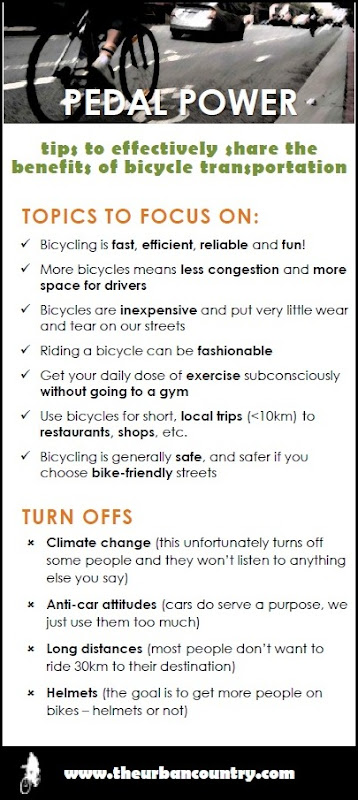
(Download the printable PDF version here)
Effectively communicating the benefits of bicycle transportation is important in car-centric societies where people generally think of bicycling as a recreational activity. In order to improve our cities by increasing bicycle transportation, we need to share the benefits without polarizing the issue by using terms such as “war on [fill in the blank]”.
Most cyclists are also drivers, and most drivers are potential cyclists. Dividing and alienating a particular group of road users will not improve conditions for anyone, so it’s important to be civil and try to empathize with the other people we are sharing our streets with.
Otherwise the message will fall on deaf ears and bicycling will continue to be viewed as merely a recreational activity instead of an effective and pragmatic means of transportation.
James D. Schwartz is a Transportation Pragmatist and the Editor of The Urban Country. You can contact James at james.schwartz@theurbancountry.com or follow him on Twitter.
Related Articles:
- The World Has Changed. So Can You. (April 2011)
- Motorists Against Bicycle Infrastructure (Oct 2010)
- The Fixer Gets It Right (July 2011)
- Bicycle Infrastructure Ignorance (Jan 2011)
- You’re Welcome Mr. Motorist (Jan 2011)
Great post, James! The flyer nails it.
Great post, James! The flyer nails it.
Awesome flyer. Can we use it?
Yes, of course! Go for it 🙂
Awesome flyer James, I love the reasons you include under the first check point. Those happen to be my main motivations. I admit to being a passionate advocate for environmental issues, but have realized that you can’t discount the marketing appeal for anything, if you want any success. Unfortunately, most people don’t care or care enough about environmentalism to want to do anything that would directly be a benefit to that. I love the way the Dutch and Danes market cycling to the masses. Of course they already have the infrastructure, culture and a flexible system to back up these claims completely. It’s always refreshing to read your posts, because I pretty much think along the same lines as you 🙂
Awesome flyer. Can we use it?
Yes, of course! Go for it 🙂
So, what is the message to non-cyclists?
We want to convert you non-cyclists to ride a bike and join us in the “eco-bike cult”. Imagine yourself “bike commuting” and selling your second car as your bike becomes a trusted “means of sustainable transportation” for you and your family. You can even “city ride” on the weekends with the other “already converted” cycling advocates in Toronto? The biking life style can be all yours.
Sorry. I just don’t see the masses jumping on the “life style” message. I don’t even see the majority of cyclists jumping on the cycling as a means of transportation life style cult message. Commuting by bike is just not practical for the vast majority of citizens and cars are still very fashionable.
Perhaps the only real message to convey is something like – look you will never ride a bike but try to respect those who do. When you’re in your nice climate controlled car with your tunes turned way up and Tim Hortons coffee at hand have pity on those poor bikers and just share the road. Be kind, give us a break, and everyone will get safely to where they’re going. By the way, what do you think about those gas and parking prices? So have a nice day, Cheers!
Not sure where you got “eco-bike cult” from. In the article, I specifically mentioned that talking about eco/environmental issues are detrimental to promoting bicycle transportation.
“Cycling as a means of transportation” and “commuting by bike” are not one in the same thing. People should have the ability to ride their bike to the store or a restaurant (e.g. transportation) without necessarily being able to commute by bike (though plenty of people here in the suburban areas could ride their bike to the train station and then take a train to work).
So, what is the message to non-cyclists?
We want to convert you non-cyclists to ride a bike and join us in the “eco-bike cult”. Imagine yourself “bike commuting” and selling your second car as your bike becomes a trusted “means of sustainable transportation” for you and your family. You can even “city ride” on the weekends with the other “already converted” cycling advocates in Toronto? The biking life style can be all yours.
Sorry. I just don’t see the masses jumping on the “life style” message. I don’t even see the majority of cyclists jumping on the cycling as a means of transportation life style cult message. Commuting by bike is just not practical for the vast majority of citizens and cars are still very fashionable.
Perhaps the only real message to convey is something like – look you will never ride a bike but try to respect those who do. When you’re in your nice climate controlled car with your tunes turned way up and Tim Hortons coffee at hand have pity on those poor bikers and just share the road. Be kind, give us a break, and everyone will get safely to where they’re going. By the way, what do you think about those gas and parking prices? So have a nice day, Cheers!
Good article! Perceived lack of safety is the number one reservation the non-cyclists I’ve talked to have against cycling on city streets. Also, a friend of mine who’s a dentist wouldn’t try it because he naturally must be clean-smelling for work – not sweaty at all.
Has the Toronto bike advocacy crowd promoted the CAN-BIKE program?
The Canadian Cycling Association’s web site lists the “CAN-BIKE program is a series of courses on all aspects of cycling safely and enjoyably on the road; it is oriented toward recreational and utilitarian cycling. The CAN-BIKE cycling safety program provides a nationally standardized set of courses that can be taught through a variety of organizations who are interested in education, safety and health.”
This seems to be widely promoted in Ottawa by the Responsible Cycling Coalition (RCC).
The RCC promotes the concept of “Vehicular Cycling” where cyclists act and are treated as drivers of vehicles based on John Forester’s books “Effective Cycling” and “Bicycle Transportation”. They oppose bike lanes and separate bike paths.
There doesn’t seem to be common ground even within the so called “bike community”.
CAN-BIKE courses are promoted within the bike community, but opposing bike lanes and bike infrastructure is strongly opposed generally here in Toronto (and for good reason). Vehicular cycling skills are good to have because in North America we will inevitably end up on the streets at one point or another, but vehicular cycling is no substitute for good bicycle infrastructure.
Good article! Perceived lack of safety is the number one reservation the non-cyclists I’ve talked to have against cycling on city streets. Also, a friend of mine who’s a dentist wouldn’t try it because he naturally must be clean-smelling for work – not sweaty at all.
Has the Toronto bike advocacy crowd promoted the CAN-BIKE program?
The Canadian Cycling Association’s web site lists the “CAN-BIKE program is a series of courses on all aspects of cycling safely and enjoyably on the road; it is oriented toward recreational and utilitarian cycling. The CAN-BIKE cycling safety program provides a nationally standardized set of courses that can be taught through a variety of organizations who are interested in education, safety and health.”
This seems to be widely promoted in Ottawa by the Responsible Cycling Coalition (RCC).
The RCC promotes the concept of “Vehicular Cycling” where cyclists act and are treated as drivers of vehicles based on John Forester’s books “Effective Cycling” and “Bicycle Transportation”. They oppose bike lanes and separate bike paths.
There doesn’t seem to be common ground even within the so called “bike community”.
CAN-BIKE courses are promoted within the bike community, but opposing bike lanes and bike infrastructure is strongly opposed generally here in Toronto (and for good reason). Vehicular cycling skills are good to have because in North America we will inevitably end up on the streets at one point or another, but vehicular cycling is no substitute for good bicycle infrastructure.
Not sure where you got “eco-bike cult” from. In the article, I specifically mentioned that talking about eco/environmental issues are detrimental to promoting bicycle transportation.
“Cycling as a means of transportation” and “commuting by bike” are not one in the same thing. People should have the ability to ride their bike to the store or a restaurant (e.g. transportation) without necessarily being able to commute by bike (though plenty of people here in the suburban areas could ride their bike to the train station and then take a train to work).
Awesome flyer James, I love the reasons you include under the first check point. Those happen to be my main motivations. I admit to being a passionate advocate for environmental issues, but have realized that you can’t discount the marketing appeal for anything, if you want any success. Unfortunately, most people don’t care or care enough about environmentalism to want to do anything that would directly be a benefit to that. I love the way the Dutch and Danes market cycling to the masses. Of course they already have the infrastructure, culture and a flexible system to back up these claims completely. It’s always refreshing to read your posts, because I pretty much think along the same lines as you 🙂