


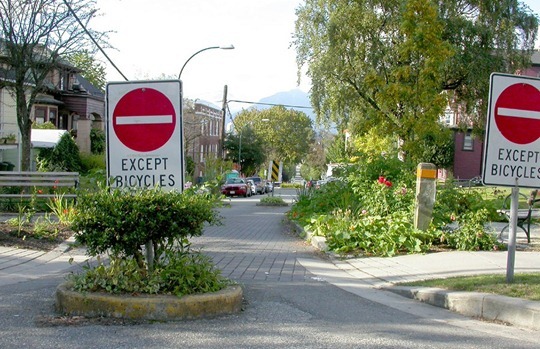
Toronto Traffic Calming Photo by Matthew Blackett / Spacing
The Canada Safety Council, a self proclaimed “independent, knowledge-based, charitable organization dedicated to the cause of safety” published an article chastising traffic calming measures, calling them “a sheer waste of taxpayers’ money”.
Somehow I doubt the person who wrote the article rides a bicycle on our streets. When I ride on a streets with traffic calming speed humps, I’m much safer as a result – and so are the people inside cars who have to slow down to below 40km/h in order to not feel the hump when they drive over it.
To call traffic calming measures a “sheer waste of taxpayers’ money” really makes me question the intent of the article and question the independence of the organization.
We shouldn’t be surprised however. For when you “follow the money” you’ll see that they are funded by representatives of the car industry, oil and gas industry, the transport/freight industry and the auto insurance industry.
The article, entitled “Traffic calming vs. safety” perpetuates common North American myths, but fails to use facts to back up its claims.
I will address each of the following myths that this article uses to argue against traffic calming measures:
Argument 1: Canada has different infrastructure, climate and transportation needs than Australia and Europe
Yes, Canada does have different infrastructure, climate and transportation needs than Australia and Europe. But how does that make it inappropriate to look at studies done in these continents?
There are plenty of examples of countries in Europe which have very similar climate to Canada – especially the Nordic countries. And these countries have some great examples of effective traffic calming measures.
Here is a great traffic calming safety measure in Denmark:
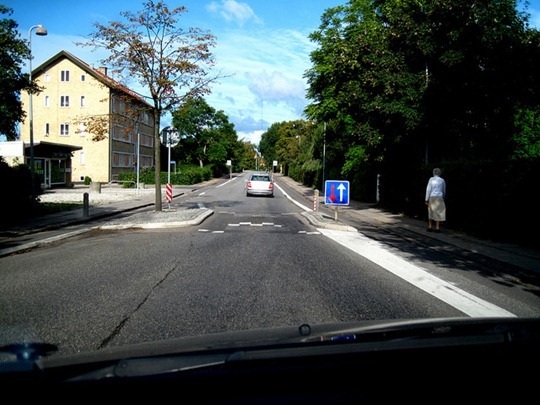
Photo by Mikael Colville-Andersen / Copenhagenize
The photo above was taken in Frederikssund, Denmark, whose climate is not all that different than Toronto’s climate. This particular traffic calming infrastructure only allows one direction of automobiles to pass at a time to calm traffic. It’s a very effective design and has minimal impact on a motorist.
Australia also has very similar public transit needs and travel distances to Canada. Canada ranked 26th out of 29 OECD countries in distance traveled by road vehicles per capita. The three countries ahead of Canada were: the United States, Luxembourg and Australia, so people in Australia actually drive further than Canadians.
Argument 2: Stop signs are useless because most drivers don’t stop anyway
The next argument used in the article is that stop signs have become meaningless because they were added to slow traffic in residential neighbourhoods and most drivers and cyclists treat them as yield signs.
I partially agree with this point. I personally think there are more effective ways to calm traffic than by using four-way stop signs. However, the reasoning behind their argument seems a bit strange. They are arguing that we should do away with these stop signs because “rolling stops have become a common practice for many drivers” which sets a bad example for our children. But they fail to offer any alternatives except to allow drivers to drive full steam ahead in residential neighbourhoods.
Replacing stop signs with more effective traffic calming measures would be a good alternative to address this. In the photo above from Denmark, cars are required to slow down but not make a complete stop when nobody is around, so this is a far more effective approach than forcing traffic to stop even if nobody is around.
Argument 3: Traffic calming increases emissions and fuel consumption due to congestion
The argument that traffic calming measures increase emissions is particularly disturbing. Removing traffic calming measures and speeding up cars not only makes our streets more dangerous for all road users, it also induces demand for those streets which will bring more traffic and more emissions, not less.
A pedestrian who is hit at 40mph (64km/h) is expected to die 85% of the time, while a pedestrian hit at 20mph (32km/h) dies 5% of the time. Study after study has shown the impact on vulnerable road users is drastically decreased as the speed of the car is lowered. Why would the Canada Safety Council argue to *speed up* traffic even more?
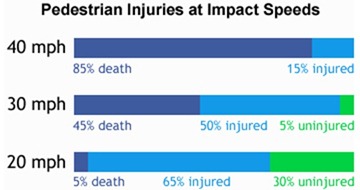
UK DOT statistics on vehicle/pedestrian collisions (via Streetsblog SF)
Furthermore, speeding up cars won’t reduce emissions or fuel consumptions in the long run. A study by Douglass B. Lee, Jr. found that increased capacity does indeed induce demand in the long run, assuming the rate of elasticity is not zero. In other words, if roads are at capacity, and there is additional demand for those roads, more people will use those roads if congestion is decreased.
Instead of arguing for faster car travel to “reduce emissions”, the Canada Safety Council should be arguing for traffic calming to keep pedestrians, drivers and cyclists safe, and they should be promoting alternate modes of transportation to reduce congestion and also to reduce emissions.
Argument 4: Traffic calming impedes snow clearing
The article claims that traffic calming measures impede snow clearing: “Snow clearing problems associated with blocked-off streets and other traffic calming obstructions will increase delays in winter, when many home fires and medical emergencies occur”
If snow clearing was such an issue, you would think it would be easy to find an article where the people who are doing the snow clearing would complain about traffic calming being such an impediment to getting their jobs done.
I can’t find a single article where snow clearing crews have complained about traffic calming measures having a significant negative effect on their jobs, so I don’t know where this statement stems from.
Argument 5: Traffic calming impedes emergency vehicles
The article then uses hyperbolic arguments to claim that traffic calming measures can prevent emergency vehicles from saving a life. They use statements such as “a criminal can escape the scene o a crime in less than a minute” or “in one minute, a fast-burning fire can destroy a building” to support their argument against traffic calming.
And once again, I’m not able to find any evidence that there is a significant public safety issue of emergency vehicles not being able to fulfill their duties due to traffic calming measures.
Last I checked, emergency vehicles primarily used arterial roads to reach their destination quickly. The police aren’t travelling across the entire city on residential streets to reach an emergency. And it’s not too often you see a police car driving under the speed limit anyway, so reduced speed limits to calm traffic wouldn’t impede an emergency vehicle.
Argument 6: Traffic calming breeds dangerous drivers
The article argues that “in our fast-paced society, slow traffic aggravates drivers”. It claims that parents who are transporting their children around have deadlines to meet, and will thus “take chances”.
They argue that traffic calming measures actually force drivers to break the law because they are frustrated, claiming “drivers swerve around speed bumps into bicycle lanes to avoid damage to their vehicle” and “frustrated motorists make dangerous turns or run red lights”.
Trying to blame traffic calming measures for the dangerous risks that parents take while driving with children in their car is merely an attempt to shift the blame and absolve drivers of any accountability and responsibility.
A more extreme example of this argument would be to say that we should remove all traffic signals in the city because red lights “aggravate motorists” and causes frustrated drivers to run them.
The argument doesn’t hold up and once again there are no facts to support their claim that removing all traffic calming measures would do anything to improve drivers’ frustrations or cause drivers to suddenly not take chances or drive dangerously.
Argument 7: Children shouldn’t be playing on the street in the first place
Another argument against traffic calming in residential areas is that “children shouldn’t be playing in the streets in the first place”.
Who has the right to say that children shouldn’t be playing in the streets? Children have played on the streets for over a hundred years, and it wasn’t until recent decades that it became an issue of public safety due to our dangerous driving behaviour.
Another extreme example of this argument would be to say that cyclists shouldn’t be on the street in the first place, or pedestrians shouldn’t be walking on our sidewalks or streets in the first place.
Sure, a kid might be safe from getting hit by a car if they stay inside their home and play video games, but they might end up with a disease that results from a sedentary lifestyle. Kids playing on their quiet residential neighbourhood street should be a normal thing to do. It allows parents to keep an eye on their kids from their home (instead of sending them to a park where they can’t easily watch over their kids).
Argument 8: Studies show traffic calming reduces traffic volume & speeds and reduces crashes
This is one argument we can agree on. Except the article then goes on to imply that traffic was probably diverted to other streets, so collisions probably increased on those other streets.
This is an example of taking a fact, then downplaying it without backing it up with any other facts.
Argument 9: Increased enforcement is the solution
The article then concludes that increased enforcement is the solution. Except this is a fallacy because there isn’t enough police staff to enforce traffic calming across the entire city. Furthermore, police generally stick to the “easy” speed traps on highways and arterial roads. Traffic calming is primarily on residential streets.
The article also implies that speed limits should be increased and police should “strictly enforce” those “realistic” speed limits.
Increasing speed limits is not a solution that Canada “Safety” Council should be promoting if safety truly is its primary interest.
—
In conclusion, this Canada Safety Council article is clearly designed to promote a hidden agenda and has nothing to do with improving safety.
By perpetuating these myths, the Safety Council is ignoring the root cause of the true danger of our streets, and is actively lobbying to increase the danger of motor vehicles so that a parent can make their “deadlines” without having to break the law.
My twitter friend Ben Mueller-Heaslip puts it aptly:
“People like to think their convenience has a moral foundation. People who buy SUVs keep more factory workers employed than cyclists”.
The Canada Safety Council has convinced itself that many of the issues we face in the world can be solved by simply improving convenience of motorists and removing any restrictions on their movements.
This couldn’t be further from the truth.

Thanks to Herb from i bike TO for originally posting a link to the Canada Safety Council article.
James D. Schwartz is a Transportation Pragmatist and the Editor of The Urban Country. You can contact James at james.schwartz@theurbancountry.com or follow him on Twitter.
Related Articles:
- Responsibility & Accountability On Our Streets (April 2011)
- Ignoring the Real Problem On Our Streets (Nov 2009)
- Enough Excuses: Cars Cause Death (Dec 2010)
- Car Culture Bleeds Our Society (Aug 2010)
I think one of the best examples for climate, is Oulu. Colder and snowier then most parts of Urban Canada.
Argument 5 made me think of this video I recently saw.
A firetruck couldn’t access where it was going in downtown Montreal because of traffic, so it took the separated bike lane. http://www.youtube.com/watch?v=2Mhibv2N6Rc
Argument 6 is a major annoyance of mine…This whole “deadline” nonsense. There is such a thing as planning out your day/commute!
It is beyond me why people who have to get to work by 9am and their kids to school by 8:45, wake up at 8:20, then wonder why they have no time!? This was Hudak’s reasoning as to why the Mid-Penn highway needs to be built.
I know exactly how long it will take me to get around St. Catharines at different times throughout the day, and I plan so accordingly. In the winter I always leave 10-20 minutes extra for ‘snow delays’. If I have to wait a few minutes, then so be it.
Argument 7 really gets me thinking. I was fortunate to grow up directly across from a school, so that is where I’d play baseball, hockey and countless other physical fun activities. Even in the early 90’s roads weren’t all that safe to play in, HOWEVER, there were fewer cars on the road then, that most people had little issue with doing the Wayne’s World “CAR!” to move out of the way.
Argument 9: I’m not to sure about more police enforcement. In Niagara they target the wrong people, which I found out first hand earlier in the year when I was pulled over and questioned what I had in my front basket and why I had a camera. All the while we were directly in front of an intersection, where I saw two vehicles speed through red lights.
I also live on a busy street and see the NRP sit watching people go by. Despite seeing people going 10kph over the speed, they just sit there and do nothing.
You’ve got to realize who the “Canadian Safety Council” is. Their membership is on their website: http://canadasafetycouncil.org/our-members
Included:
Canadian Freightways Limited
RBC Foundation
Mercedes Benz Canada Inc
Ontario Trucking Association
Syncrude Canada Limited
Transport Canada
Scotiabank
and so forth… corporate types who aren’t exactly people who cotton to the idea that the roads–especially urban streets where the traffic calming measures are usually installed–are public spaces and should be safe for pedestrians, cyclists, skateboarders, everyone, as well as automobile drivers and (especially) truckers. I think Schwartz’s article demolishes most of their argument against traffic calming. (I too worry about drivers rolling [fast!] through stop signs, and think we should have roundabouts at every intersection.)
They aren’t what I’d call an grossly evil organization — they advocate for some sensible things, like bringing back photo radar (fat chance in BC!). But their perspective is what has been the dominant one in Canada for the past 50 years… the Car is King so get out of the way! That way of thinking is what we are fighting, and I think we are making some progress.
Neale
I think one of the best examples for climate, is Oulu. Colder and snowier then most parts of Urban Canada.
Argument 5 made me think of this video I recently saw.
A firetruck couldn’t access where it was going in downtown Montreal because of traffic, so it took the separated bike lane. http://www.youtube.com/watch?v=2Mhibv2N6Rc
Argument 6 is a major annoyance of mine…This whole “deadline” nonsense. There is such a thing as planning out your day/commute!
It is beyond me why people who have to get to work by 9am and their kids to school by 8:45, wake up at 8:20, then wonder why they have no time!? This was Hudak’s reasoning as to why the Mid-Penn highway needs to be built.
I know exactly how long it will take me to get around St. Catharines at different times throughout the day, and I plan so accordingly. In the winter I always leave 10-20 minutes extra for ‘snow delays’. If I have to wait a few minutes, then so be it.
Argument 7 really gets me thinking. I was fortunate to grow up directly across from a school, so that is where I’d play baseball, hockey and countless other physical fun activities. Even in the early 90’s roads weren’t all that safe to play in, HOWEVER, there were fewer cars on the road then, that most people had little issue with doing the Wayne’s World “CAR!” to move out of the way.
Argument 9: I’m not to sure about more police enforcement. In Niagara they target the wrong people, which I found out first hand earlier in the year when I was pulled over and questioned what I had in my front basket and why I had a camera. All the while we were directly in front of an intersection, where I saw two vehicles speed through red lights.
I also live on a busy street and see the NRP sit watching people go by. Despite seeing people going 10kph over the speed, they just sit there and do nothing.
Re #5: “It claims that parents who are transporting their children around have deadlines to meet, and will thus “take chances”.”
Parents won’t be spending all their time transporting their children around juggling deadlines if it’s safe enough for children to be transporting themselves around. In the Netherlands children cycle and walk, unaccompanied, from age 8 or 9. (Of course, in addition to totally safe cycling conditions, NL has less crime generally and less of a “stranger danger” culture than the English-speaking world, which might be part of the issue.)
Re stop signs and enforcement: people don’t do what their told, and enforcement is a pretty inefficient way of making them do what their told. If you build a road that looks like it should be 50mph, people won’t want to drive at 20mph on it, and it’s the enforcement that then really “frustrates” drivers and leads to bad driving. You need to make the road the *feel* like you should be driving slowly and carefully — make it uncomfortable to drive fast. Not just a few impotent commands or even scattered obstacles, but actually making the whole road visibly narrower, taking space away from moving vehicles.
Re #5: “It claims that parents who are transporting their children around have deadlines to meet, and will thus “take chances”.”
Parents won’t be spending all their time transporting their children around juggling deadlines if it’s safe enough for children to be transporting themselves around. In the Netherlands children cycle and walk, unaccompanied, from age 8 or 9. (Of course, in addition to totally safe cycling conditions, NL has less crime generally and less of a “stranger danger” culture than the English-speaking world, which might be part of the issue.)
Re stop signs and enforcement: people don’t do what their told, and enforcement is a pretty inefficient way of making them do what their told. If you build a road that looks like it should be 50mph, people won’t want to drive at 20mph on it, and it’s the enforcement that then really “frustrates” drivers and leads to bad driving. You need to make the road the *feel* like you should be driving slowly and carefully — make it uncomfortable to drive fast. Not just a few impotent commands or even scattered obstacles, but actually making the whole road visibly narrower, taking space away from moving vehicles.
Hi, James;
We were truly shocked to see that such arguments would eminate from the Canada Safety Council, of all groups. I think most Canadians have at least heard of the organization and trust that they act in the interests of safety for whomever is most at risk. In this case they seem to be advocating for putting the more vulnerable parties (pedestrians, cyclists, kids in the street) into a position of greater risk. It doesn’t make sense!
Unfortunately we couldn’t get the link to the article (first paragraph) to work, so couldn’t read it for ourselves.
Hi, James;
We were truly shocked to see that such arguments would eminate from the Canada Safety Council, of all groups. I think most Canadians have at least heard of the organization and trust that they act in the interests of safety for whomever is most at risk. In this case they seem to be advocating for putting the more vulnerable parties (pedestrians, cyclists, kids in the street) into a position of greater risk. It doesn’t make sense!
Unfortunately we couldn’t get the link to the article (first paragraph) to work, so couldn’t read it for ourselves.
Wow, this report is nonsense. Were any statistics included with any of these arguments? It sounds like a report that a high school-er would write, and not a report for policy making. But then again, evidence-based policy is making its way out of the “Harper Government(TM)”.
Wow, this report is nonsense. Were any statistics included with any of these arguments? It sounds like a report that a high school-er would write, and not a report for policy making. But then again, evidence-based policy is making its way out of the “Harper Government(TM)”.
Such nonsense.
Now what, kid should not play on the streets because some a$$holes drivers are out of control. What next? Women will have to wear chastity belts if they don’t want to be raped as the mere sight of them aggravate rapists?
“- It claims that parents who are transporting their children around have deadlines to meet, and will thus “take chances”.”
Leave earlier! If they lived closer to everything, they would not need to haul their kids around so much.
“- They argue that traffic calming measures actually force drivers to break the law because they are frustrated”
Suspend these people’s licences and send’em to jail should they continue.
Such nonsense.
Now what, kid should not play on the streets because some a$$holes drivers are out of control. What next? Women will have to wear chastity belts if they don’t want to be raped as the mere sight of them aggravate rapists?
“- It claims that parents who are transporting their children around have deadlines to meet, and will thus “take chances”.”
Leave earlier! If they lived closer to everything, they would not need to haul their kids around so much.
“- They argue that traffic calming measures actually force drivers to break the law because they are frustrated”
Suspend these people’s licences and send’em to jail should they continue.
Just got a reply from the CSC’s Communications Coordinator. They cite three studies:
1) “Ottawa-Carleton Traffic Calming Evaluation Study” by Synectics Consulting. (p.33 here)
2) “Evaluating Traffic Calming Benefits, Costs and Equity Impacts”, by Todd Litman of the VPTI (here)
3) “Guide to Neighbourhood traffic Calming: December 1997” by the
Transportation Association of Canada (you can buy it here)
The first is a 1999 evaluation of some pilot traffic calming measures done in the city of Ottawa. Key findings are that traffic calming measures for Local and Collector roads are effective and acceptable (with the only exception street ‘squeezes’ that endanger cyclists). The main negatives are speedbump-based traffic calming on four Ottawa regional roads, specifically delays to emergency vehicles and impacts on Wheel-Trans buses.
The second is a 1998 analysis framework for traffic-calmed street design. Its only relevant claim is that design features can be selected to balance benefits and costs of traffic-calming.
The third is a Canadian Traffic Calming design manual from 1998 that “presents guidelines for the planning, design and implementation of traffic calming measures”. It’s for sale for $145.
Nowhere in the first two citations do I find anything that backs up the CSC’s claims. The third citation doesn’t seem very promising either.
Is the third citation even reputable? It’s published by the Transportation Association of Canada, previously a highway-construction lobbying alliance for commercial freight. Their mission is narrowly focused, to raise “awareness of the importance of transportation to Canada’s economic and social well-being”. Side-effects to health, quality of life, pollution, and external costs are not in their mission statement.
It would be interesting to see if the board of directors of the TAC agree that their design manual says all the things the Canadian Safety Council claims it does.
tl:dr conclusion: The CSC’s report is opinion, not evidence-based, and should be ignored.
Thank you for doing the legwork. I’m thinking the CSC is particularly lazy. You’d think if they wanted to buttress their anti-traffic calming view they’d at least make it look a bit more like they actually did research.
I’m imagining the Communications person was scrambling to find anything on the internet with the words “traffic calming” and then email it to you as “evidence”. Whew! We were almost on to them!
You’ve got to realize who the “Canadian Safety Council” is. Their membership is on their website: http://canadasafetycouncil.org/our-members
Included:
Canadian Freightways Limited
RBC Foundation
Mercedes Benz Canada Inc
Ontario Trucking Association
Syncrude Canada Limited
Transport Canada
Scotiabank
and so forth… corporate types who aren’t exactly people who cotton to the idea that the roads–especially urban streets where the traffic calming measures are usually installed–are public spaces and should be safe for pedestrians, cyclists, skateboarders, everyone, as well as automobile drivers and (especially) truckers. I think Schwartz’s article demolishes most of their argument against traffic calming. (I too worry about drivers rolling [fast!] through stop signs, and think we should have roundabouts at every intersection.)
They aren’t what I’d call an grossly evil organization — they advocate for some sensible things, like bringing back photo radar (fat chance in BC!). But their perspective is what has been the dominant one in Canada for the past 50 years… the Car is King so get out of the way! That way of thinking is what we are fighting, and I think we are making some progress.
Neale
I have my doubts about the objectivity of these “safety” organisations. Concerning cycling, they tend to stress the risks and barely mention the benefits. They certainly will not reveal the truth that cycling is (all risks considered) far safer than driving. These sites also seem to exaggerate the benefits of helmets, far beyond current estimates, and the need for them.
“Safety tips” for drivers never include the suggestion that they walk or cycle instead, to be safer. Yet this would cut their overall risk by a far greater amount than the seatbelts, etc. that are mentioned.
I have my doubts about the objectivity of these “safety” organisations. Concerning cycling, they tend to stress the risks and barely mention the benefits. They certainly will not reveal the truth that cycling is (all risks considered) far safer than driving. These sites also seem to exaggerate the benefits of helmets, far beyond current estimates, and the need for them.
“Safety tips” for drivers never include the suggestion that they walk or cycle instead, to be safer. Yet this would cut their overall risk by a far greater amount than the seatbelts, etc. that are mentioned.
Thank you for doing the legwork. I’m thinking the CSC is particularly lazy, you’d think if they wanted to buttress their anti-traffic calming view they’d at least make it look a bit more like they actually did research.
I’m imagining the Communications person was scrambling to find anything on the internet with the words “traffic calming” and then email it to you as “evidence”. Whew! We were almost on to them!
=v= Traffic Calming is an approach, not an obstacle course of traffic-control devices. For example, it would mean deploying speed humps, not speed bumps, onto a street where other visual cues would encourage slower speeds. The CSC’s speeding cars that “swerve around speed bumps” scenario isn’t about traffic-calming at all.
It’s true that some mediocre traffic engineers have misused the term, but the CSC really should know better.
=v= Traffic Calming is an approach, not an obstacle course of traffic-control devices. For example, it would mean deploying speed humps, not speed bumps, onto a street where other visual cues would encourage slower speeds. The CSC’s speeding cars that “swerve around speed bumps” scenario isn’t about traffic-calming at all.
It’s true that some mediocre traffic engineers have misused the term, but the CSC really should know better.
Argument 7: What audacity for the CSC to make such a statement. Children shouldn’t be playing on the streets? So what should they be doing? Planning video games and eating junk food at home most of the time, being spoon fed mostly-useless information at school in a system that largely teaches kids how to listen only and not think? Now that’s beginning to sound very much like a robotic lifestyle to me… Gosh, maybe we should build ladders and monkey bars above all pedestrian crossings so that no one on foot every gets in the way of a driver.
I agree that following the money will say it all. It’s all about profits and special interest. Unless safety somehow beings to bring in more money to the powers that be, it’s not going to get top priority, beyond empty words or promises. And a well-informed public that demands any changes to the status quo is certainly not going to make their jobs any easier. It’s already quite clear from the article that they don’t like obstacles of any kind. A population of citizens living robotic-like, mundane lives would certainly keep their job easy and keep the profits rolling in for big corporations. Remember the society in Wall-E?
Argument 7: What audacity for the CSC to make such a statement. Children shouldn’t be playing on the streets? So what should they be doing? Planning video games and eating junk food at home most of the time, being spoon fed mostly-useless information at school in a system that largely teaches kids how to listen only and not think? Now that’s beginning to sound very much like a robotic lifestyle to me… Gosh, maybe we should build ladders and monkey bars above all pedestrian crossings so that no one on foot every gets in the way of a driver.
I agree that following the money will say it all. It’s all about profits and special interest. Unless safety somehow beings to bring in more money to the powers that be, it’s not going to get top priority, beyond empty words or promises. And a well-informed public that demands any changes to the status quo is certainly not going to make their jobs any easier. It’s already quite clear from the article that they don’t like obstacles of any kind. A population of citizens living robotic-like, mundane lives would certainly keep their job easy and keep the profits rolling in for big corporations. Remember the society in Wall-E?
Is traffic calming a waste of money? Well it depends on what price you put of the lives of others. I get the impression that for North American driver that price is very low. Hence the need to had an armour-plated tank in order to venture unto the roads over there.
Is traffic calming a waste of money? Well it depends on what price you put of the lives of others. I get the impression that for North American driver that price is very low. Hence the need to had an armour-plated tank in order to venture unto the roads over there.
I laughed when I read number 7. I’m in Germany right now, and every city has it’s “Spielstraße”, or play streets, which are essentially (usually) cobble-stone streets where the speed limit is really low, and where kids playing games, cyclists, pedestrians, and drivers must co-exist at a very slow speed. It tells a lot when a country has “playing streets” in every neighbourhood of every town! And meanwhile back home in Canada…
I laughed when I read number 7. I’m in Germany right now, and every city has it’s “Spielstraße”, or play streets, which are essentially (usually) cobble-stone streets where the speed limit is really low, and where kids playing games, cyclists, pedestrians, and drivers must co-exist at a very slow speed. It tells a lot when a country has “playing streets” in every neighbourhood of every town! And meanwhile back home in Canada…
I never knew there was such a big hullaballoo over this topic. Personally, I don’t think traffic calming is an issue, but you made some good points here. You made me rethink the whole situation. Hahaha.
I never knew there was such a big hullaballoo over this topic. Personally, I don’t think traffic calming is an issue, but you made some good points here. You made me rethink the whole situation. Hahaha.
I never knew there was such a big hullaballoo over this topic. Personally, I don’t think traffic calming is an issue, but you made some good points here. You made me rethink the whole situation. Hahaha.
I never knew there was such a big hullaballoo over this topic. Personally, I don’t think traffic calming is an issue, but you made some good points here. You made me rethink the whole situation. Hahaha.
I think that some traffic calming measures are better than others.Personnaly I do not like speed hump but I recently discover speed cushion.Then, I think that in most cases it might be a good solution.If you want to learn more about speed cushion go visit our website.
http://www.sinoconcept.com/2012/01/06/speed-humps-speed-cushions/
Argument 10: Traffic calming increases risk taking and J-walking by pedestrians. Studies show J-walking is higher as traffic speeds go below 30 mph. That is often the goal, however.
“traffic calming” is another Orwellian traffic term – it produces frustration and road rage.
Argument 10: Traffic calming increases risk taking and J-walking by pedestrians. Studies show J-walking is higher as traffic speeds go below 30 mph. That is often the goal, however.
“traffic calming” is another Orwellian traffic term – it produces frustration and road rage.
Fantastic! this is one of the most informative traffic calming articles I have read in a long while!
Fantastic! this is one of the most informative traffic calming articles I have read in a long while!