


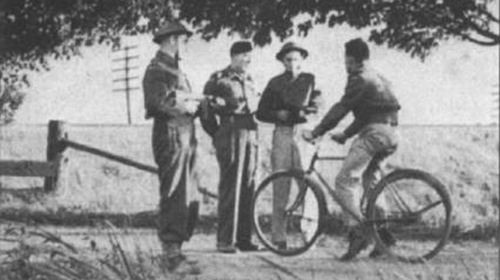
Agents practising being interrogated. The rural situation of camp X can be glimpsed from the background. (From the Pelham-Burn collection, reproduced by courtesy of Lynn-Philip Hodgson)
On 6 December 1941, just one day before the Japanese attacked Pearl Harbor, a British spy training camp opened in Whitby, Ontario, some 50 kilometres east of Toronto. The training camp STS 103 – also known as Camp X – was so top secret that the Prime Minister of Canada wasn’t even aware of its existence until 1945.
Camp-X provided “invaluable help” to Colonel William J. Donovan in the creation of the Office of Strategic Services (OSS) in 1942 – the predecessor to the Central Intelligence Agency.
The purpose of the camp was twofold: 1) To train men recruited in Canada to become spies in German-occupied countries (e.g. French Canadians), and 2) To allow the British to provide assistance to the Americans to build their foreign intelligence service (something which wasn’t allowed to be done on American soil while the United States remained neutral).
My interest in the topic was first piqued in 2001 when I read the book Almost, a story of a 20-year-old Canadian with Hungarian heritage who trained at Camp X before being dropped into Hungary in 1944 only to be captured and tortured by the Germans shortly after his arrival. James Bond author Ian Fleming had also trained at Camp X, providing inspiration for his novels.
The Special Operations Executive Secret Operations Manual used for training the spies was published long after the war ended. The training manual covers a variety of topics ranging from silent killing to sabotage to the art of disguise. I picked a copy of the manual in 2007 for academic study and personal interest.
Among other things, the training manual highlights the usefulness of bicycles as a tool for covert operatives to remain inconspicuous when performing their duty in occupied countries.
Bicycles allowed operatives to stay relatively under the radar in German-occupied countries where train stations were closely monitored and motor vehicles were frequently stopped or had to pass through check points.
Although bicycles were indeed used by the military during the war, the SOE training manual highlights the civilian use of bicycles as a mode of transportation to elude officials and avoid suspicion.
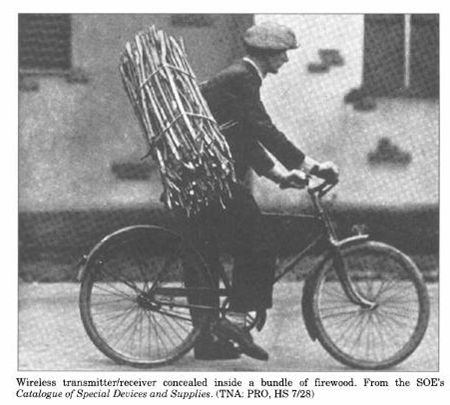
Here are a few excerpts from the training manual pertaining to bicycles:
Escape Procedures
(Editor’s note: The escape procedures section explains techniques that can be employed by the operative to escape from occupied territory)
5. Travel Across Country
b) Some of the means of travel and comment upon them
- Travel by foot makes it relatively easy to avoid many controls – taking remote paths, crossing fields, etc.
- Travel by bicycle has proved relatively safe.
- Buses are less subject to check than trains but more crowded – passengers more subject to prying conversation and questions. General suggestions for those using either bus or train are:
- Don’t take bus or train from terminal; terminals generally watched carefully. Some escapees suggest that terminals should be avoided entirely – even if it means leaving train some fifteen miles from terminal, walking past it, and boarding another train some fifteen miles beyond.
- Take locals and travel by roundabout routes when “Things are hot” Leave train or bus before it reaches border. One escapee recommends round-trip ticket to near border. Almost all borders and coasts under German control are not restricted or forbidden zones – special German army permits needed.
- If one purchases single tickets for short distances, he can at any time pretend he is making only a local trip – either to depopulate a given town or to get work
- Avoid any but necessary conversation. Appear sleepy or use the tobacco chewing trick.
- The pretense of sleep and showing whole mass of documents (passport, permits, ration cards, ticket, etc.) at inspector at once makes him careless in checking them.
- Avoid secluded corners in stations; the police give them special attention.
- Controls sometimes can be avoided by entering or leaving station through a lavatory with exit into adjoining hotel (St. Charles R.R. Station in Marseilles – similarly in Toulouse).
- In some stations controls are enforced only during the period shortly after train arrival. Going to restaurant or library before leaving station frequently means to avoid controls entirely.
- Sometimes controls can be escaped by riding the steps of the train.
Surveillance
(Editor’s note: The surveillance section explains methods and techniques for performing surveillance on target subjects)
3. PLANNING
a) Cover
Following is rarely done by single person, more frequently by combination of several with various types of cover, E.g.:
- Taxicab driver with vehicle (Largely “blown”.)
- Tradesman’s van with driver
- Tradesman or messenger with bicycle
- Shoppers, house or apartment-hunters
- Man with girl
- Woman with baby carriage
General Movement by Day (Minor Tactics)
(Editor’s note: This section explains how movements can be traced by officials or by the operative)
6. Footprints
e) Tire Tracks. Most important consideration is which way they are going. Most certain way is by crossing or overlapping of front wheel tracks by rear wheels. Over a bump tracks will momentarily broaden out at the far side, as the tire takes the downward bump of the chassis. Position of the tracks on the road are also an indication, especially when cornering. In the case of a bicycle, direction is more easily distinguishable, as rear wheel more often crosses or obscures front wheel, especially uphill as the forward position of the rider causes more wobble. The faster the travel the straighter the line.
Not only were bicycles useful for secret agents, they were also the most practical way for civilians to get around when motor vehicles were parked due to fuel shortages and rationing. My Grandmother – who was 9-years-old when the war broke out – rode her bicycle on the rims due to a shortage of rubber tires in the Netherlands under Nazi-occupation.
The bicycle certainly wasn’t the deciding factor in the war, but it had a pragmatic appeal to transport both secret operatives and civilians in occupied territory.
James D. Schwartz is a Transportation Pragmatist and the Editor of The Urban Country. You can contact James at james.schwartz@theurbancountry.com or follow him on Twitter.

Related Articles:
- My Dutch Family History (Feb 2011)
- Japan Earthquake & Tsunami: Role of the Bicycle (March 2011)
- Roads Weren’t Built For Cars (July 2011)
- The World Has Changed. So Can You. (April 2011)
Further reading:
Rigden, Denis – How to be a Spy: The World War II SOE Training Manual.
Toronto, ON, CAN: Dundurn, 2004
SOE Secret Operations Manual. Boulder, Colorado, USA: Paladin Press, 1993
People who like this report will find Jim Fitzpatrick’s book, The Bicycle in Wartime, an interesting read. It covers bike use in war from the Boer war to Vietnam. You can probably get it from Jim himself via his website, Starhill studio.com.au. I’ve only dipped into my copy but it seems packed with little know info.
People who like this report will find Jim Fitzpatrick’s book, The Bicycle in Wartime, an interesting read. It covers bike use in war from the Boer war to Vietnam. You can probably get it from Jim himself via his website, Starhill studio.com.au. I’ve only dipped into my copy but it seems packed with little know info.
The idea that the direction taken by a bicycle can be determined by observing the crossing of the tire tracks was first put forward by Conan Doyle in the Sherlock Holmes story “The Priory School.”
The premise was challenged and disproved by his readers almost straight away. The back tire crosses the path of the front the same way no matter which way the bicycle is oriented. The only way to tell which way a bicycle was going by its tracks is to follow them to the bicycle.
Doyle admitted that the idea had come to him as an inspiration while writing the story, rather than by actual observation, and that he had made a rare silly error. It is easy to be fooled into thinking it true by other clues giving a reason to presume the direction, such as which side of the street the tracks are on, or by finding the bicycle.
I think it would make sense that the cyclist would wobble more while climbing a hill than when going down a hill, thus determining the direction of travel based on the tire tracks. But a cyclist could of course wobble on the way down the hill just as easily in order to throw off someone trailing him. It would be hard to keep the tires completely straight when climbing a steep hill however.
Oh, there are certainly inferences that one can reasonably make from an examination of tracks. For instance, standing to sprint or climb will transfer weight onto the front wheel and cause it to make a deeper imprint in the right sort of surface.
It is also possible, of course, to identify a particular bicycle by peculiarities of its track.
As you note, however, one must be careful of such inferences in cases where there might be a deliberate attempt to deceive. In the same Holmes story horses are shod to leave cow tracks rendering the passage of mounted people across grazing land “invisible.”
It might also be worth noting that there are now technological means of nullifying many of the methods used by the spies and underground of WWII. These things never remain the same as strategies and counter strategies strive against each other.
On the other hand sufficiently archaic methods can become new again when neglected by the other side.
“Coded messages written on bits of paper? Damn! We never expected that. How did they transfer them? Nooooo. Is that even possible? Well **** me sideways. We would have got away with it if it weren’t for those meddling old farts.”
The idea that the direction taken by a bicycle can be determined by observing the crossing of the tire tracks was first put forward by Conan Doyle in the Sherlock Holmes story “The Priory School.”
The premise was challenged and disproved by his readers almost straight away. The back tire crosses the path of the front the same way no matter which way the bicycle is oriented. The only way to tell which way a bicycle was going by its tracks is to follow them to the bicycle.
Doyle admitted that the idea had come to him as an inspiration while writing the story, rather than by actual observation, and that he had made a rare silly error. It is easy to be fooled into thinking it true by other clues giving a reason to presume the direction, such as which side of the street the tracks are on, or by finding the bicycle.
I think it would make sense that the cyclist would wobble more while climbing a hill than when going down a hill, thus determining the direction of travel based on the tire tracks. But a cyclist could of course wobble on the way down the hill just as easily in order to throw off someone trailing him. It would be hard to keep the tires completely straight when climbing a steep hill however.
In the Star Trek:Voyager episode “The Killing Game”, the character Neelix rode a bike in a French village under German occupation, whilst secretly carrying important items. http://webspace.webring.com/people/qs/starshipaccess/Star_Trek_Images/The_Killing_Game/kgame14.jpg
In the Star Trek:Voyager episode “The Killing Game”, the character Neelix rode a bike in a French village, secretly carry important items in a baguette. http://webspace.webring.com/people/qs/starshipaccess/Star_Trek_Images/The_Killing_Game/kgame14.jpg
Oh, there are certainly inferences that one can reasonably make from an examination of tracks. For instance, standing to sprint or climb will transfer weight onto the front wheel and cause it to make a deeper imprint in the right sort of surface.
It is also possible, of course, to identify a particular bicycle by peculiarities of its track.
As you note, however, one must be careful of such inferences in cases where there might be a deliberate attempt to deceive. In the same Holmes story horses are shod to leave cow tracks rendering the passage of mounted people across grazing land “invisible.”
It might also be worth noting that there are now technological means of nullifying many of the methods used by the spies and underground of WWII. These things never remain the same as strategies and counter strategies strive against each other.
On the other hand sufficiently archaic methods can become new again when neglected by the other side.
“Coded messages written on bits of paper? Damn! We never expected that. How did they transfer them? Nooooo. Is that even possible? Well **** me sideways. We would have got away with it if it weren’t for those meddling old farts.”