


Pedaling in Haikou, Hainan, China – Photo by James Schwartz / The Urban Country
Last Sunday afternoon I hopped on my Giant folding bicycle and headed from where I am living in the “suburbs” and headed into downtown (a 5 kilometre jaunt). What ensued was a thrilling ride among a myriad of other two-wheeled travelers making their way to and from the downtown core.
I am currently living in a city called Haikou – located on Hainan island in southern China. In Chinese, Hai means “Sea”, so Haikou’s literal meaning is “Mouth of the sea”. Haikou has 2 million inhabitants in four districts, and boasts the highest rated air quality in all of China. It also features 2,000 hectares of green spaces with trees lining 40 percent of Haikou’s roads.
Despite this, Haikou’s air quality is declining. Automobile ownership has increased drastically in the last few years, with a clearly visible increase in traffic congestion from my two other visits – first in 2007 and 2010. As soon as I stepped off the airplane ten days ago I was greeted by a cluster of shiny new, luxurious car dealerships (BMW, Toyota, Nissan, ford, Infinity, Lexus and Mazda).
When I first visited Haikou in 2007 most cars were from the 1980’s – including entire police vehicle fleets. Just 4 years later it is now common to see police officers in brand new Audi A5’s. Car culture is sweeping over China, and it’s not pretty.
An ex-pat friend of mine living in Shanghai told me he met a Chinese man at Starbucks yesterday who told him that he paid more than $100K USD for his BMW – which converts to more than 630,000RMB with the current exchange rate. An average salary in China is less than 4,000RMB per month.
When the topic of rent came up, my friend told the BMW owner that he pays 3,600RMB/month for rent. The man who paid more than 630,000RMB for a car that will depreciate year after year told my friend that he’s wasting his money and paying far too much for rent. Clearly the BMW owner doesn’t see the irony in his criticism of my friend “wasting his money”.
Cars are that important here now – it has almost become religious.
Down here in Haikou I’m told by residents that a few years ago the Chinese government rescinded a 200% tax on car purchases. This – along with a rapidly growing economy – opened the floodgates to tens of thousands of Chinese who had previously found car ownership to be unaffordable.
Now instead of the dusty old 1980’s cars, shiny new imports are everywhere. Those 1980’s cars are all but extinct in 2012.
With the influx of automobiles in this city, traffic is now grinding to a halt – with rush hour automobiles traveling slower than walking pace. Those who could afford cars prior to the government scrapping the 200% tax are wishing the tax still existed – for no other reason than to restore their freedom of mobility.
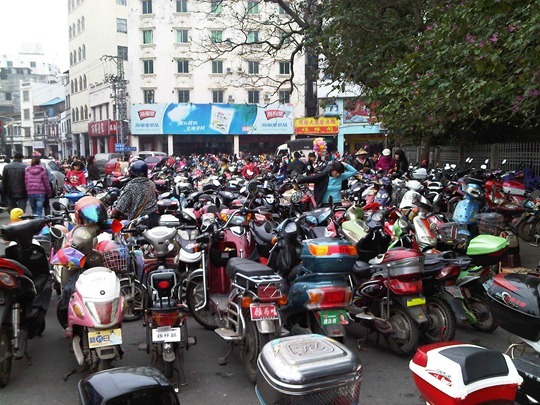
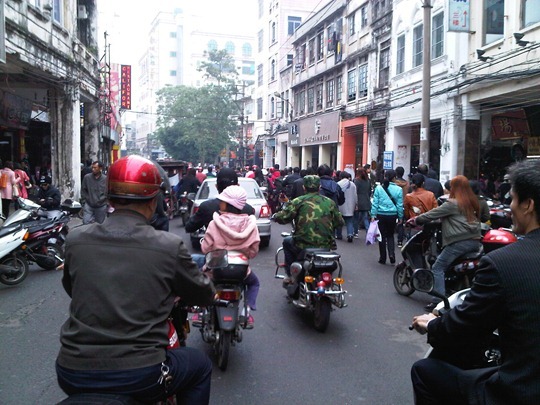
Despite the massive growth in car ownership, two-wheeled traffic still seemingly comprises the largest modal share among the available modes of transportation here.
I use my bicycle 7 days a week, and each time I take it out I am delighted to share the wide bike lanes with thousands of other people sporting two-wheeled vehicles – with electric scooters being the most common choice here.
The following photos show my grand entrance from the suburbs into the downtown core on that Sunday afternoon – highlighting one particular bottleneck that gets quite nasty at times.
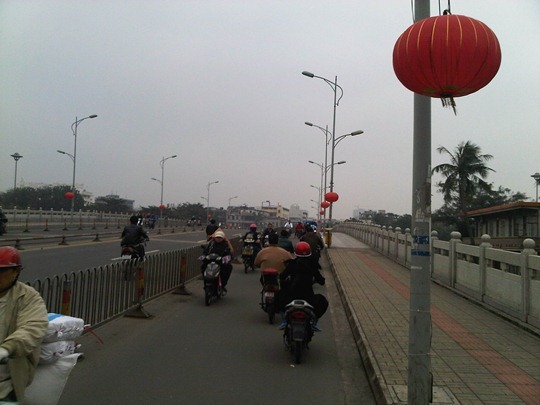
Pedaling in Haikou, Hainan, China – Photo by James Schwartz / The Urban Country
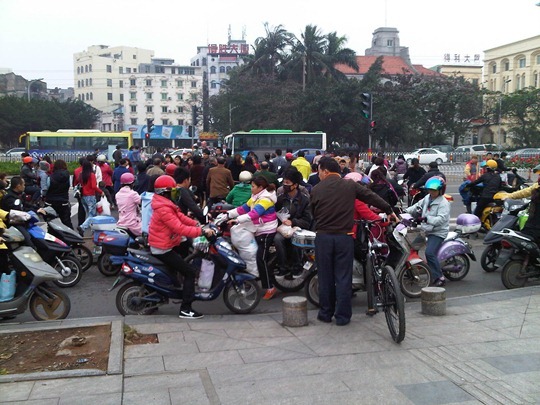
Pedaling in Haikou, Hainan, China – Photo by James Schwartz / The Urban Country
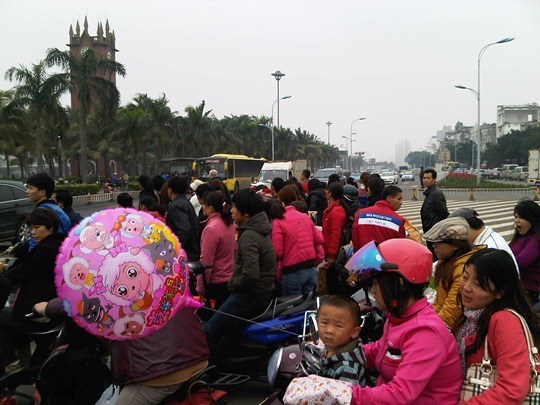
Pedaling in Haikou, Hainan, China – Photo by James Schwartz / The Urban Country
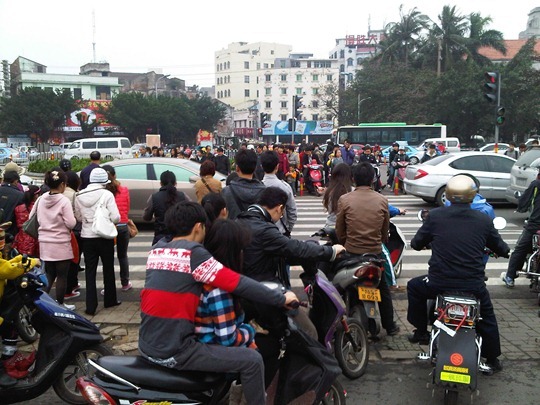
Pedaling in Haikou, Hainan, China – Photo by James Schwartz / The Urban Country
Pedaling in Haikou, Hainan, China – Photo by James Schwartz / The Urban Country
Pedaling in Haikou, Hainan, China – Photo by James Schwartz / The Urban Country
While cars are starting to become immobile in Haikou, two wheeled vehicles keep the city moving – conveniently passing congested traffic in the wide separated two-wheeled lanes.
I am keenly interested to see how Chinese cities will evolve and address this massive influx of car ownership.
Until next time – keep your feet on those pedals.
James D. Schwartz is a Transportation Pragmatist and the Editor of The Urban Country. You can contact James at james.schwartz@theurbancountry.com or follow him on Twitter.
Related Articles:
- Democracy Is Good, But… (Jan 2012)
- The Chinese Car Obsession (Nov 2011)
- The Bicycle as a Status Symbol in China (Sept 2011)
- Only the poor ride bicycles in Shanghai (Sept 2010)
- Pedaling Haikou City, China (May 2010)
Those motorbikes in the pictures aren’t helping the air quality at all either, unless they’re all electric. It’s well-known these days that motorcycles pollute more than cars do.
There are very few gas-burning two-wheeled vehicles here nowadays. I think the government banned them because they are a rare sight nowadays.
Those motorbikes in the pictures aren’t helping the air quality at all either, unless they’re all electric. It’s well-known these days that motorcycles pollute more than cars do.
“Those motorbikes in the pictures aren’t helping the air quality at all either, unless they’re all electric.”
You will find the answer to this by reading the article.
“It’s well-known these days that motorcycles pollute more than cars do.”
It’s well known in the state of California. Other places it’s well known that they don’t necessarily and that this . . .
“Motorcycles and scooters are, on average, about twice as fuel efficient as cars. Compact and lightweight, their internal-combustion engines do a better job of converting fuel into energy that makes the vehicle move. But extracting more energy from the fuel has a downside. It produces greater amounts of a smog-forming emission called oxides of nitrogen.”
. . . is pure nonsense. It’s author ought to be sentenced to taking Physics for Poets and maybe a bit of basic logic.
You cannot extract more energy from a fuel by converting less of it to energy.
It is also well known these days that electric vehicles do not reduce pollution, they merely displace it. Important to the air quality of a city, but not to The Planet. Depending on the fueling process they may even increase total pollution.
I agree with you that electric vehicles don’t solve the problem and they merely shift it outside the city and typically into the countryside where the electricity generating stations exist (which are often fossil fuel burning plants here in China and in much of the United States).
However, I think it’s fair to say that a small, lightweight electric scooter would create far less pollution from its electricity generation than what an automobile would generate from both its exhaust pollution and fossil fuel extraction, refining, shipping, etc. I’ve seen families of 4 or 5 people on a single electric bicycle (or scooter) and it would be hard to argue that these electric scooters are more harmful to the earth than a mid-size automobile. It’s certainly not a perfect solution, but if everyone in China lived like us Canadians (or Americans), we’d be in much bigger trouble…
” . . .it would be hard to argue that these electric scooters are more harmful to the earth than a mid-size automobile.”
Perhaps, although perhaps not for all of the reasons you think; and of course, as you imply, better is not the same thing as good.
Something to consider: What is the affect on the vehicle of transporting 4 or 5 people when it is designed to accommodate 1 or 2?
” . . .if everyone in China lived like us Canadians (or Americans), we’d be in much bigger trouble…”
And yet China is the world’s number one polluter, at least in part because of ways in which they do not live like us, bearing in mind that a certain amount of China’s pollution is actually our pollution displaced . . . and around we go.
“Those motorbikes in the pictures aren’t helping the air quality at all either, unless they’re all electric.”
You will find the answer to this by reading the article.
“It’s well-known these days that motorcycles pollute more than cars do.”
It’s well known in the state of California. Other places it’s well known that they don’t necessarily and that this . . .
“Motorcycles and scooters are, on average, about twice as fuel efficient as cars. Compact and lightweight, their internal-combustion engines do a better job of converting fuel into energy that makes the vehicle move. But extracting more energy from the fuel has a downside. It produces greater amounts of a smog-forming emission called oxides of nitrogen.”
. . . is pure nonsense. It’s author ought to be sentenced to taking Physics for Poets and maybe a bit of basic logic.
You cannot extract more energy from a fuel by converting less of it to energy.
It is also well known these days that electric vehicles do not reduce pollution, they merely displace it. Important to the air quality of a city, but not to The Planet. Depending on the fueling process they may even increase total pollution.
“Those motorbikes in the pictures aren’t helping the air quality at all either, unless they’re all electric.”
You will find the answer to this by reading the article.
“It’s well-known these days that motorcycles pollute more than cars do.”
It’s well known in the state of California. Other places it’s well known that they don’t necessarily and that this . . .
“Motorcycles and scooters are, on average, about twice as fuel efficient as cars. Compact and lightweight, their internal-combustion engines do a better job of converting fuel into energy that makes the vehicle move. But extracting more energy from the fuel has a downside. It produces greater amounts of a smog-forming emission called oxides of nitrogen.”
. . . is pure nonsense. It’s author ought to be sentenced to taking Physics for Poets and maybe a bit of basic logic.
You cannot extract more energy from a fuel by converting less of it to energy.
It is also well known these days that electric vehicles do not reduce pollution, they merely displace it. Important to the air quality of a city, but not to The Planet. Depending on the fueling process they may even increase total pollution.
“Those motorbikes in the pictures aren’t helping the air quality at all either, unless they’re all electric.”
You will find the answer to this by reading the article.
“It’s well-known these days that motorcycles pollute more than cars do.”
It’s well known in the state of California. Other places it’s well known that they don’t necessarily and that this . . .
“Motorcycles and scooters are, on average, about twice as fuel efficient as cars. Compact and lightweight, their internal-combustion engines do a better job of converting fuel into energy that makes the vehicle move. But extracting more energy from the fuel has a downside. It produces greater amounts of a smog-forming emission called oxides of nitrogen.”
. . . is pure nonsense. It’s author ought to be sentenced to taking Physics for Poets and maybe a bit of basic logic.
You cannot extract more energy from a fuel by converting less of it to energy.
It is also well known these days that electric vehicles do not reduce pollution, they merely displace it. Important to the air quality of a city, but not to The Planet. Depending on the fueling process they may even increase total pollution.
My apologies for the double post, the first gave me a system error message, but it appears to have taken anyway. I cannot clean it up from my end. James, would you be so kind?
My apologies for the double post, the first gave me a system error message, but it appears to have taken anyway. I cannot clean it up from my end. James, would you be so kind?
I agree with you that electric vehicles don’t solve the problem and they merely shift it outside the city and typically into the countryside where the electricity generating stations exist (which are often fossil fuel burning plants here in China and in much of the United States).
However, I think it’s fair to say that a small, lightweight electric scooter would create far less pollution from its electricity generation than what an automobile would generate from both its exhaust pollution and fossil fuel extraction, refining, shipping, etc. I’ve seen families of 4 or 5 people on a single electric bicycle (or scooter) and it would be hard to argue that these electric scooters are more harmful to the earth than a mid-size automobile. It’s certainly not a perfect solution, but if everyone in China lived like us Canadians (or Americans), we’d be in much bigger trouble…
There are very few gas-burning two-wheeled vehicles here nowadays. I think the government banned them because they are a rare sight nowadays.
” . . .it would be hard to argue that these electric scooters are more harmful to the earth than a mid-size automobile.”
Perhaps, although perhaps not for all of the reasons you think; and of course, as you imply, better is not the same thing as good.
Something to consider: What is the affect on the vehicle of transporting 4 or 5 people when it is designed to accommodate 1 or 2?
” . . .if everyone in China lived like us Canadians (or Americans), we’d be in much bigger trouble…”
And yet China is the world’s number one polluter, at least in part because of ways in which they do not live like us, bearing in mind that a certain amount of China’s pollution is actually our pollution displaced . . . and around we go.
One compromise to counteract the enthusiastic embrace of motorcycles would be mopeds and especially, electric bikes. Certainly my partner in Taipei area and Changzhi, did see use of motorcycles more heavily there than in our big North American cities.
See his blog posts here in: http://www.thirdwavecyclingblog.wordpress.com
However there is hope, that already some other Asian cities have made some great strides in certain areas of their cities for cycling infrastructure, Seoul and Changwon.
One compromise to counteract the enthusiastic embrace of motorcycles would be mopeds and especially, electric bikes. Certainly my partner in Taipei area and Changzhi, did see use of motorcycles more heavily there than in our big North American cities.
See his blog posts here in: http://www.thirdwavecyclingblog.wordpress.com
However there is hope, that already some other Asian cities have made some great strides in certain areas of their cities for cycling infrastructure, Seoul and Changwon.
China’s growing economy has allowed its people to have a greater appreciation of their individual purchasing power so much so that they don’t understand the repercussions they are creating in the process in terms of their credit and financial system. They opt for brand new expensive western cars, for instance, when they can actually only realistically afford second hand cars derby.
This is such a bicycle culture that can only be found in China. For some reason, I don’t find it chaotic at all. I hope this is something that can be adopted by ford salford as well at least here in the Central region.
This is such a bicycle culture that can only be found in China. For some reason, I don’t find it chaotic at all. I hope this is something that can be adopted by ford salford as well at least here in the Central region.
Pingback: Want to Get Rich? Open a Gas Station in China ← The Urban Country
Pingback: Sunday Afternoon Ride ← The Urban Country
Pingback: Shanghai Cyclist Hit By Driver Caught On Video ← The Urban Country