


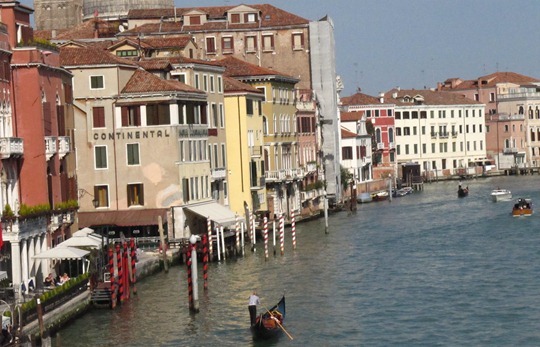
A Venetian gondola being paddled through the waterways of Venice – Photo by James Schwartz / The Urban Country
All around the world, humans rely on machines that require non-renewable resources to power them. In this article, we look at parts of the world where human power reigns.
In three weeks I will be returning to Canada after a journey that has taken me across two continents where I have embraced different cultures, languages, and reflected on the culture and society that has defined me as a person.
As a Caucasian Canadian citizen, I have had many privileges bestowed upon me during my travels that would not be extended to people who were not fortunate enough to be born in the same part of the world as I.
On a train entering Switzerland the customs agents seemingly targeted passengers with dark skin, demanding to see their passports, while the rest of us were given a free pass and not required to even show our passports. Here in China I am treated as a special “guest of honour” both within groups of people whom I know and by random strangers.
With my Canadian passport I can travel in most countries in the world with little or no paperwork and with few questions asked by customs agents.
It is important, I feel, to not take these privileges for granted and when possible use my privileges to benefit society. In my case, I hope to share my experiences with readers on this blog to help make our cities better places by showing how other people do things in their corners of the earth.
As readers of this blog know, I am profoundly fascinated by human power and I thoroughly enjoy observing how people around the world embrace non-motorized machines to help them efficiently perform their daily tasks, such as getting around their city, or fulfilling their job duties.
In Venice I met a remarkably kind man named Claudio, a school teacher with a daughter whom he paddles to school each morning in his classic non-motorized Venetian boat. Claudio also does his groceries in his boat, and uses it as his primary mode of transportation.
The absence of cars in Venice was a delightful departure from most other cities in Europe we visited that were car-clogged, noisy and marginally polluted. Claudio’s decision to use a human powered boat rather than a motor boat is wonderfully refreshing.
When Claudio talked about his daily commute to the school where he teaches, his eyes lit up. He absolutely loves his commute, and why wouldn’t he? It’s efficient, healthy, and fun! How many drivers in a big city in America or Canada can genuinely say they enjoy sitting in traffic jams on their way to work each day?
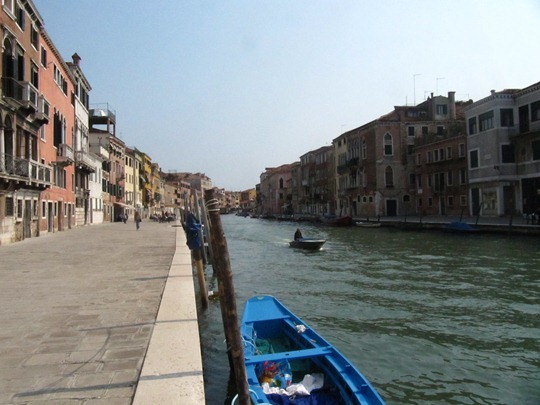
Claudio’s boat in Venice, Italy – Photo by James Schwartz / The Urban Country
In a recent article, I pointed out how parents in Amsterdam embrace human power by using bicycles to pick up their kids at school. Unlike schools in my native Canada, parents in Amsterdam seem to enjoy their time waiting for their children – as they socialize with other parents and teachers – and their ride home with their children is also enjoyable and efficient.
Over in Asia, I took a trip to a small village in China’s Hubei province this past weekend. The village is a few hours from Hubei’s capital, Wuhan – a city of 10 million people. There were numerous examples of residents in this village embracing human power.
Unlike Claudio in Venice, and those parents in Amsterdam choose to embrace human power, the Chinese villagers are largely embracing human power not by choice, but out of necessity.
Most people who live in the village don’t have the economic means to afford large motorized vehicles, but given China’s stage in development they would no doubt jump on the opportunity to embrace motorized vehicles if they had the economic resources.
But I am fairly certain that if I spent my life in poverty struggling just to feed my family and put a roof over our heads, I would jump at the opportunity to embrace motorized vehicles too.
While hiking through a farmer’s field we met a villager on a paddle boat who was patrolling a lake for illegal fishing. He took us on his boat for a ride and when I asked him if I could paddle, he complied.
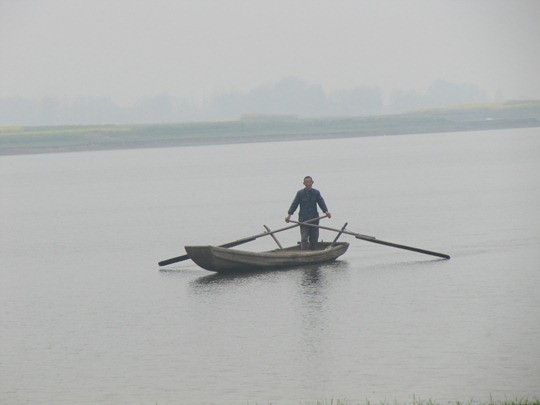
A Chinese man patrolling a lake for illegal fishing – Photo by James Schwartz / The Urban Country
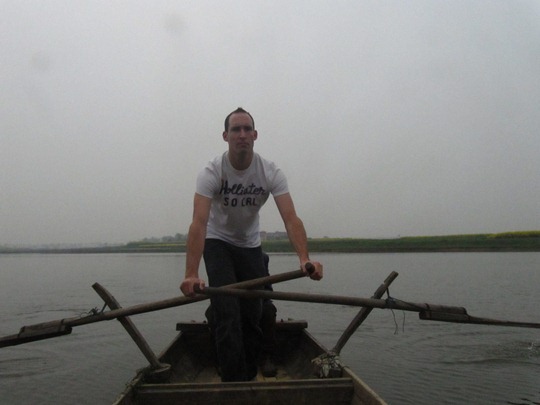
The Urban Country’s James Schwartz patrolling the lake for illegal fishing – Photo by James Schwartz / The Urban Country

A Chinese man patrolling a lake for illegal fishing – Photo by James Schwartz / The Urban Country
Near the lake were numerous farmer’s fields. One noticeable difference between western farms and farms in the countryside of China is the lack of large machinery in China. Many of the farms in the village I visited were using water buffalo to plough their fields.
Although a water buffalo is not nearly as efficient as a large combustion-engine-machine, it does make for a pleasant, quiet atmosphere. The lack of motorized vehicles made the lakes and farmer’s fields more serene than what you might see in Canada with loud motor boats speeding through our lakes, and large farm machinery on our farms.
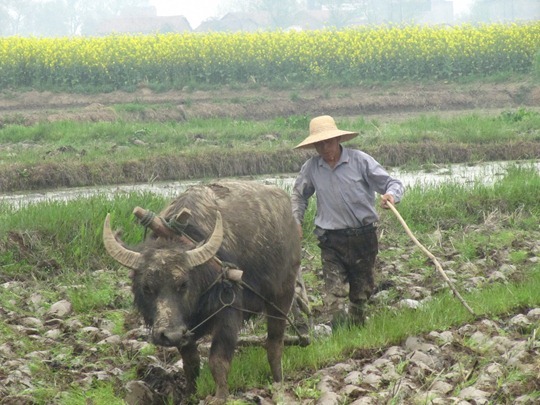
A Chinese farmer ploughing a field with a water buffalo – Photo by James Schwartz / The Urban Country
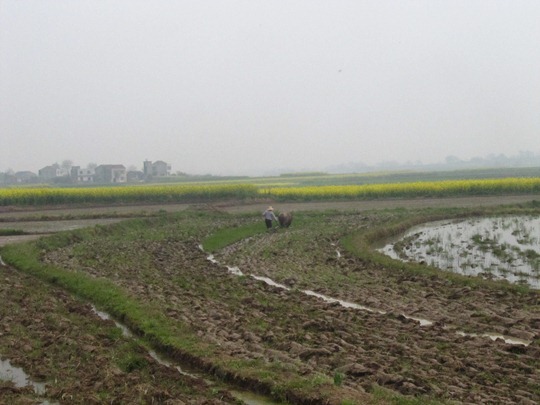
A Chinese farmer ploughing a field with a water buffalo – Photo by James Schwartz / The Urban Country
Of course, we can’t overlook the effectiveness of bicycles in the countryside. Bicycles seem to be widely used in the village we visited to transport families and workers. However, the primary mode of transportation for most people in the village is motorcycles.
Following is a photo of a bicycle that I spotted on a fruit farm that a worker rode to her work site.
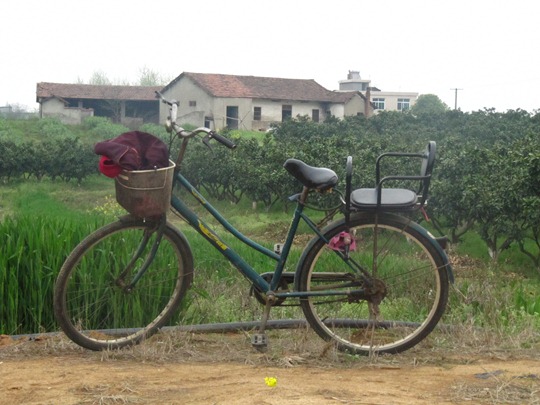
A Chinese farmer’s bicycle – Photo by James Schwartz / The Urban Country
Human power is being leveraged in both developed and developing countries. There is still hope for the human race that we will further embrace human power and appreciate the simple pleasures that it bring to our lives, while reducing our dependency on harmful machines and depleting resources.
James D. Schwartz is a Transportation Pragmatist and the Editor of The Urban Country. You can contact James at james.schwartz@theurbancountry.com or follow him on Twitter.
Related Articles:
- Algonquin 2011: The Serenity of Human Power (Aug 2011)
- When School’s Out in Amsterdam (March 2012)
- Rural Bike Infrastructure in the Netherlands (March 2012)
- Awkward Moments In China’s Car Culture Frenzy (Feb 2012)
- Sunday Afternoon Traffic in China (Jan 2012)
“The Urban Country’s James Schwartz patrolling the lake for illegal fishing – Photo by James Schwartz / The Urban Country”
Nice!… except how did you manage to take the photo and be in the photo?
Magic!
“The Urban Country’s James Schwartz patrolling the lake for illegal fishing – Photo by James Schwartz / The Urban Country”
Nice!… except how did you manage to take the photo and be in the photo?
Two interesting rowboats in this piece – I remember noticing that the Venetian gondolas are curved along the keel, making the hull sort of ‘D’ shaped, presumably to compensate for the gondolier always having to paddle on one side. And the Chinese rowboat with the crossed oars with the paddler facing forward – big improvement on our rowboat, where you have to face backwards, but maybe not as good as the canoe or kayak. Worst design I ever saw was the English punt – a big square-cut boat with a long pole instead of an oar, which makes it useless in water deeper than a few feet.
Two interesting rowboats in this piece – I remember noticing that the Venetian gondolas are curved along the keel, making the hull sort of ‘D’ shaped, presumably to compensate for the gondolier always having to paddle on one side. And the Chinese rowboat with the crossed oars with the paddler facing forward – big improvement on our rowboat, where you have to face backwards, but maybe not as good as the canoe or kayak. Worst design I ever saw was the English punt – a big square-cut boat with a long pole instead of an oar, which makes it useless in water deeper than a few feet.
Excellent post. I am always fascinated by our capacity to get the job done with what resources allow. As an American, I feel insulted by the arguments of some (most status quo conservatives) who insist that Americans won’t give up their cars – as if they are even being asked to give up their cars at all. This argument is constant used to justify denying adequate funding to public transit and bike and pedestrian infrastructure even as more and more of us cannot afford car ownership. I was convinced long ago that learning to live without a car or depending on it far less was a necessity if I wanted to keep up with the cost of living. I know plenty of people who would like to be able to bike or walk to work but can’t because 1) their job is not located close to where they live and 2) their route to work lacks the necessary infrastructure to make those options workable, espcially if they have kids. Here in Arizona, many cyclists feel like moving target and that drivers who hit cyclists face little to no consequences (unless they happen to be intoxicated, of course).
In any case, I’d find it mighty refreshing if instead of focusing on what we can’t or allegedly won’t we, we start addressing what we can do. Looking at how other cultures, even if they are quite different from our own is a great place to start. No, we don’t have the density of Europe but city planners across the country face enormous push back in their efforts to increase density where it can be implemented.
Excellent post. I am always fascinated by our capacity to get the job done with what resources allow. As an American, I feel insulted by the arguments of some (most status quo conservatives) who insist that Americans won’t give up their cars – as if they are even being asked to give up their cars at all. This argument is constant used to justify denying adequate funding to public transit and bike and pedestrian infrastructure even as more and more of us cannot afford car ownership. I was convinced long ago that learning to live without a car or depending on it far less was a necessity if I wanted to keep up with the cost of living. I know plenty of people who would like to be able to bike or walk to work but can’t because 1) their job is not located close to where they live and 2) their route to work lacks the necessary infrastructure to make those options workable, espcially if they have kids. Here in Arizona, many cyclists feel like moving target and that drivers who hit cyclists face little to no consequences (unless they happen to be intoxicated, of course).
In any case, I’d find it mighty refreshing if instead of focusing on what we can’t or allegedly won’t we, we start addressing what we can do. Looking at how other cultures, even if they are quite different from our own is a great place to start. No, we don’t have the density of Europe but city planners across the country face enormous push back in their efforts to increase density where it can be implemented.
Magic!
Pingback: Urban Car-Free Camping ← The Urban Country
I fail to see how a commute in Venice could be healthy or pleasant. I have never seen a place so filthy or that smells so strongly of faeces. I do like your idea though! For example commutes via kayak in Sydney or Vancouver would be a glorious way to get to work.
WHY NATIONS RICH ???
WHY NATIONS POOR??
These farmers income is in the range of 200-800 US dollars.
80% of chinese people are farmers living in villages.
2% of people in 1st world nations are farms.
TWO PERCENT.
NO ONE FARMS ANY LONGER… TWO PERCENT.
Why china poor poor poor so long..
Why china never went beyond farming???
Why stuck on the farm so long
WHY NATIONS RICH ???
WHY NATIONS POOR ???
Move from 3rd world to 1st world.
Study Europe, USA Japan, Korea Canada, Singapore or other 1st world Nations.
Move from 3rd to 1st world Nations.
Farms to Industry (Factory) to Information/Digital/Cloud computing Age.
We Now live in Information/Internet Age now…
Information/Data moves at the Speed of light.
Get off the Farm/Move to Information Age/Digital Age