


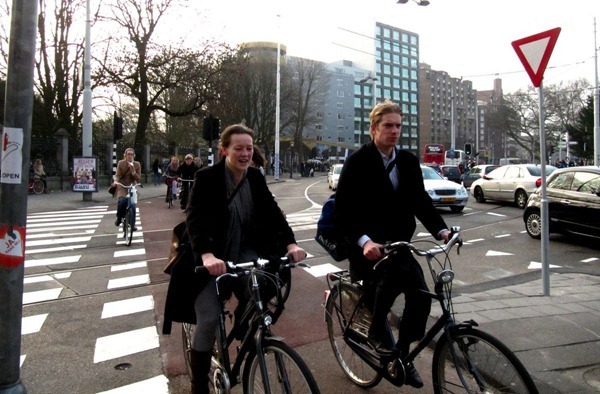
Bicycles in Amsterdam – Photo by James Schwartz / The Urban Country (March 2012)
On Monday 47-year-old Toronto resident Joseph “Maverick” Mavec died after his bicycle tire jammed in a streetcar track and he fell on his head. This tragic and unfortunate incident has prompted a discussion about navigating a city full of streetcar tracks by bicycle.
As someone who lives on a major arterial road with streetcar service in downtown Toronto I am well acquainted with navigating streetcar tracks on my bicycle. I ride virtually every day through intersections with webs of streetcar tracks turning in all directions.
Streetcar tracks require a level of caution while navigating them by bicycle. It isn’t difficult to hit the tracks at the wrong angle and lodge your tire into the tracks. My friend Herb over at iBikeTO posted some solid tips for crossing streetcar tracks.
In my 10 years of bicycling in the city, I have been fortunate enough not to be knocked off my bike at the hands of streetcar tracks, but my rear tire has occasionally been caught in the track, causing a brief slide and an drastically increased heart rate – but no fall.
Toronto isn’t alone in the annoyance, and sometimes danger caused by streetcar tracks. In Seattle, bike crashes as a result of streetcar tracks led to a lawsuit, and in San Francisco streetcar tracks have been known to cause spills.
The conflict with streetcar tracks can largely be eliminated by proper bicycle facility design.
Just like Seattle, San Francisco and Toronto, Amsterdam has a network of LRT vehicles running throughout the city on surface-level tracks on roads shared by motorists and people on bicycles.
You might even say Amsterdam’s tram system is fairly comprehensive:

Amsterdam Tramnet photo courtesy of Wikipedia upload
The key difference in Amsterdam is that bicycle facilities exist that often direct people riding bicycles to cross streetcar tracks at safe angles.
In Toronto, it is very common to be forced to cross streetcar tracks at dangerous angles by parked or right-turning cars. In Amsterdam the danger has largely been eliminated by properly designed bicycle facilities.
Below is a typical junction with streetcar tracks in Amsterdam. Notice how the bicyclists are directed to cross the streetcar tracks at close to a 90 degree angle:
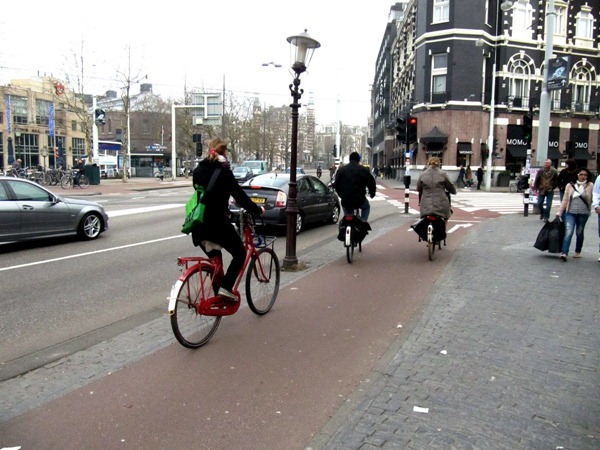
Bicycles in Amsterdam – Photo by James Schwartz / The Urban Country (March 2012)
Here is a closer shot of that same Amsterdam junction:
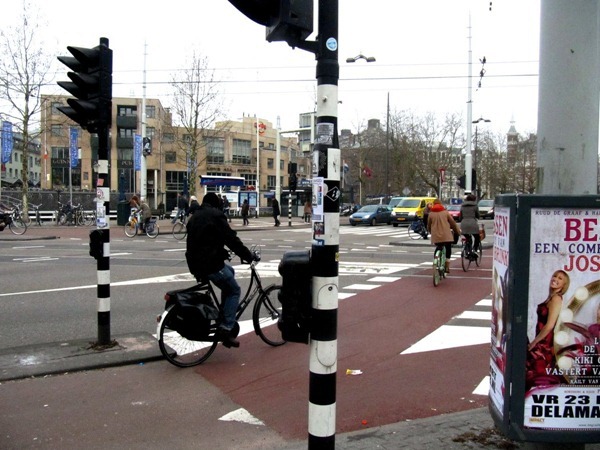
Bicycles in Amsterdam – Photo by James Schwartz / The Urban Country (March 2012)
Here in Toronto it is common to ride alongside streetcar tracks and be forced to merge into the streetcar tracks.
The Dutch largely ensure this won’t happen because they provide bike lanes that keep cyclists safely away from streetcar tracks:
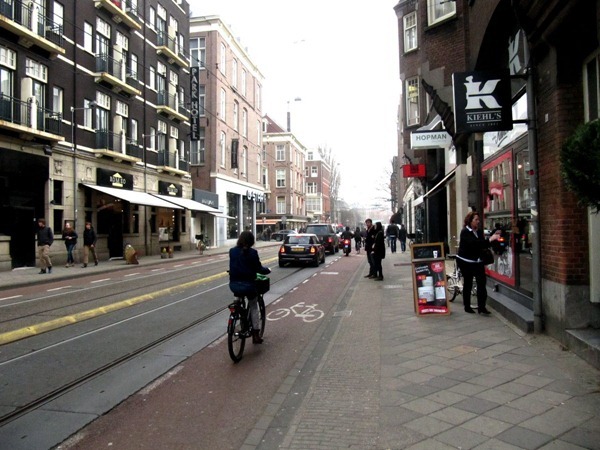
Bicycles in Amsterdam – Photo by James Schwartz / The Urban Country (March 2012)
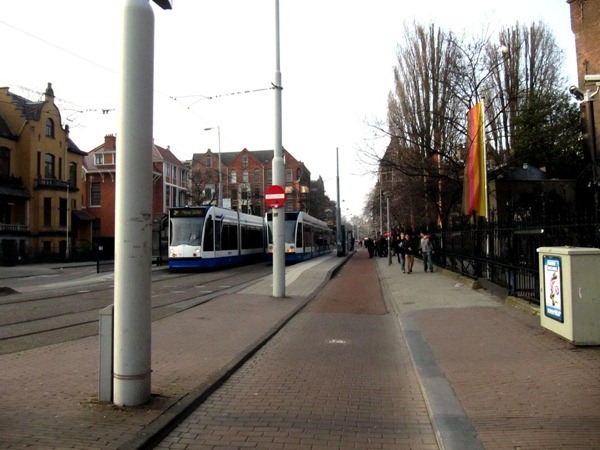
Bicycles in Amsterdam – Photo by James Schwartz / The Urban Country (March 2012)
Although the streetcar track conflict has largely been eliminated by dedicated bicycle infrastructure, you can still find examples in the Netherlands where bicyclists need to navigate streetcar tracks (as pointed out by reader Hars Davids).
Below is a Google Street View photo of Nieuwe Binnenweg in Rotterdam – a street that often requires cyclists to navigate streetcar tracks (as illustrated by the truck parked in the photo below):
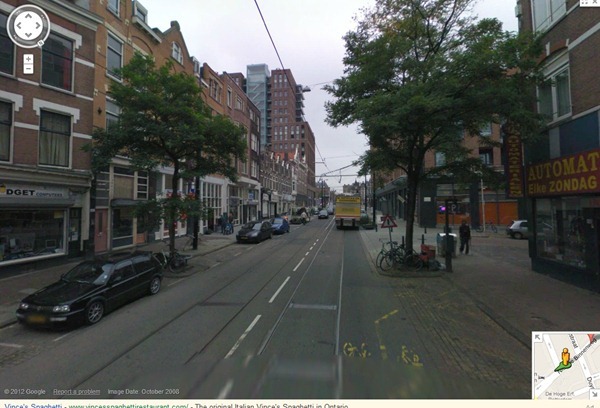
Photo courtesy of Google Street View
It should also be pointed out that the speed limit on this street is 30km/h. The streets in downtown Toronto with streetcar tracks that I navigate on a daily basis have a speed limit of 50km/h with cars often driving at speeds exceeding 50km/h outside of peak hours when traffic is less congested.
Perhaps a healthy combination of bicycle infrastructure, rider education and lower speed limits is the solution to avoid unfortunate incidents like this one.
Although it has yet to be determined if Mr. Mavec’s death was caused by his head injury, the debate about helmets has also resurfaced as a result of this incident (he was not wearing a helmet).
My friend Lloyd Alter over at Treehugger is reconsidering the value of bicycle helmets after this tragedy and another recent incident involving a helmeted bicyclist.
Lloyd had asked for my thoughts about the helmet issue. My thoughts on helmets were summarized in this 2010 article and I welcome readers to comment on the helmet issue in that article. I fully support Lloyd whether or not he chooses to wear a helmet.
My sincere condolences go out to Joseph’s family for their loss. I hope the discussions that result from his death may help somebody else avoid a similar fate.
Note: Article updated on August 10th at 8:41AM to redirect helmet debate to 2010 article and to illustrate places in the Netherlands where bicyclists are also required to navigate streetcar tracks.
James D. Schwartz is a Transportation Pragmatist and the Editor of The Urban Country. You can contact James at james.schwartz@theurbancountry.com or follow him on Twitter.

Related Articles:
- Dear Bicycle Helmet (June 2012)
- Bike Helmets Not Warranted (Sept 2010)
- Barriers to Cycling: Debunking the Myths (Nov 2009)
- 10 Observations About Bicycling in Amsterdam (March 2012)
- Preventable Deaths: Asking All The Wrong Questions (June 2012)
Still a helmet Libertarian eh? That is too bad… Aren’t you starting to feel a bit of shame after all the wise-guy helmet mocking. I think you’re right, motorists actually could be wearing helmets. What was the point there again? Because people in cars don’t wear certain safety gear we are relieved of our duty too? The playing field out there isn’t level in case you failed to notice. Helmets will prevent some suffering and even save a life. How are you SO sure that a helmet won’t help somebody you know? Some study read on the internet? Pictures of Amsterdam? How relevant are those things to Toronto, today. It is time to do your own searching for something meaningful and quit harping about helmets. There are greater barriers to popularizing cycling than making somebody put on a helmet.
Please direct all helmet comments to:
https://www.theurbancountry.com/2010/09/bike-helmets-not-warranted.html
And make sure to address each point in that article…
Still a helmet Libertarian eh? That is too bad… Aren’t you starting to feel a bit of shame after all the wise-guy helmet mocking. I think you’re right, motorists actually could be wearing helmets. What was the point there again? Because people in cars don’t wear certain safety gear we are relieved of our duty too? The playing field out there isn’t level in case you failed to notice. Helmets will prevent some suffering and even save a life. How are you SO sure that a helmet won’t help somebody you know? Some study read on the internet? Pictures of Amsterdam? How relevant are those things to Toronto, today. It is time to do your own searching for something meaningful and quit harping about helmets. There are greater barriers to popularizing cycling than making somebody put on a helmet.
James, the right way to deal with the helmet issue would have been to mention it, and also state that you’d delete all comments on it, as there are plenty of other places online people can spew; however, once you have dedicated several paragraphs to it, that option isn’t fair.
Too bad, because there are fewer posts on streetcar tracks and lane design, about which you wrote well. There is a fundamental difference in Denmark and Holland compared to English countries: they believe in society. They also have little domestic oil and automotive industry.
I have gone down on streetcar tracks at least once, to no injury. It isn’t the tracks or falling I worry about, it’s the typical Toronto **** following too closely who will hit me, even if he’s paying attention.
Agreed, I prefer to keep the helmet debate contained to my 2010 article so that people can comment on the list of points I made in that article. I re-worded the post slightly to direct people to the 2010 article.
James, the right way to deal with the helmet issue would have been to mention it, and also state that you’d delete all comments on it, as there are plenty of other places online people can spew; however, once you have dedicated several paragraphs to it, that option isn’t fair.
Too bad, because there are fewer posts on streetcar tracks and lane design, about which you wrote well. There is a fundamental difference in Denmark and Holland compared to English countries: they believe in society. They also have little domestic oil and automotive industry.
I have gone down on streetcar tracks at least once, to no injury. It isn’t the tracks or falling I worry about, it’s the typical Toronto **** following too closely who will hit me, even if he’s paying attention.
Agreed, I prefer to keep the helmet debate contained to my 2010 article so that people can comment on the list of points I made in that article. I re-worded the post slightly to direct people to the 2010 article.
It’s not all right-angle crossing over here, people, plenty of times I’ve to make a little slalom around double-parked cars and other obstructions in my area. For a nice example, check Nieuwe Binnenweg in Rotterdam; an old, narrow street with plenty of traffic and shops. I never had any problem with this little manoeuvre and I can only imagine falling when trying to force the wheel out of the track without coming to a stop first. Maybe this tragic accident was an avoidable one.
Thanks Hars – I updated the post to include a photo of Nieuwe Binnenweg with a parked truck that forces bicyclists to merge into the streetcar tracks.
Cheers!
James
I know it looks hellish, but quite a few people cycle along this road, even with kids, even though there are a lot of parallel streets. I guess most motorists over here are a bit more civilised than they are in the rest of the world, so we don’t consider it very daring to travel the Binnenweg, which is the quickest route from Rotterdam West to the Centre.
Suggestion: no more helmet-talk, please. Hardly anyone here wears one, and the number of deaths amongst cyclists because of accidents is very small, proving that the promotion of helmets is a ruse by politicians who lack the will to invest money in decent cycle-infrastructure.
It’s not all right-angle crossing over here, people, plenty of times I’ve to make a little slalom around double-parked cars and other obstructions in my area. For a nice example, check Nieuwe Binnenweg in Rotterdam; an old, narrow street with plenty of traffic and shops. I never had any problem with this little manoeuvre and I can only imagine falling when trying to force the wheel out of the track without coming to a stop first. Maybe this tragic accident was an avoidable one.
Please direct all helmet comments to:
https://www.theurbancountry.com/2010/09/bike-helmets-not-warranted.html
And make sure to address each point in that article…
I started using fat tires (2.35″) some years ago to help deal with potholes, and a lovely side effect is that they don’t fit in most cracks in the road. I don’t know if that would have helped here or not, because streetcar slots can be pretty wide. They don’t fit in sewer grates, and that is nice. As “safety” devices go, much less annoying than a helmet.
Note that well-made non-knobby fat tires have lower rolling resistance than skinny tires, and “rotational weight” only counts double and only when you are changing speed. At lower speeds where wind resistance is not too much of an issue, they are the best choice.
I started using fat tires (2.35″) some years ago to help deal with potholes, and a lovely side effect is that they don’t fit in most cracks in the road. I don’t know if that would have helped here or not, because streetcar slots can be pretty wide. They don’t fit in sewer grates, and that is nice. As “safety” devices go, much less annoying than a helmet.
Note that well-made non-knobby fat tires have lower rolling resistance than skinny tires, and “rotational weight” only counts double and only when you are changing speed. At lower speeds where wind resistance is not too much of an issue, they are the best choice.
Thanks Hars – I updated the post to include a photo of Nieuwe Binnenweg with a parked truck that forces bicyclists to merge into the streetcar tracks.
Cheers!
James
Hello James,
A salient point in your linked article is that unfortunately, Mr Mavek had groceries hanging from his handlebars. That is really dangerous. Please, use a backpack, or better, get a set of panniers or a basket.
Friends in Rotterdam (who cycle) tell me that the infrastructure for cyclists isn’t as good as in Amsterdam, Utrecht or other major Dutch cities. Perhaps because the city was rebuilt with a “modern” (car-centric) grid after Second World War destruction (unlike some other wrecked cities such as Cologne, that rebuilt much of the old street plan.
I love that plan of the Amsterdam tram grid. The tramline coverage is just as impressive as the cyclability, in terms of sustainable urban transport. There are very, very few collisions between trams and Amsterdamers, but unfortunately there are a few with tourists unused to how to safely cross tram tracks. A leaflet, “Cycling safely in Amsterdam” insists on this point. No mention of helmets, of course… 😉
Hello James,
A salient point in your linked article is that unfortunately, Mr Mavek had groceries hanging from his handlebars. That is really dangerous. Please, use a backpack, or better, get a set of panniers or a basket.
Friends in Rotterdam (who cycle) tell me that the infrastructure for cyclists isn’t as good as in Amsterdam, Utrecht or other major Dutch cities. Perhaps because the city was rebuilt with a “modern” (car-centric) grid after Second World War destruction (unlike some other wrecked cities such as Cologne, that rebuilt much of the old street plan.
I love that plan of the Amsterdam tram grid. The tramline coverage is just as impressive as the cyclability, in terms of sustainable urban transport. There are very, very few collisions between trams and Amsterdamers, but unfortunately there are a few with tourists unused to how to safely cross tram tracks. A leaflet, “Cycling safely in Amsterdam” insists on this point. No mention of helmets, of course… 😉
I know it looks hellish, but quite a few people cycle along this road, even with kids, even though there are a lot of parallel streets. I guess most motorists over here are a bit more civilised than they are in the rest of the world, so we don’t consider it very daring to travel the Binnenweg, which is the quickest route from Rotterdam West to downtown.
In The Star report, it said when paramedics arrived, the cyclist was having a cardiac arrest. Does anyone know if the arrest started before, or after the fall?
Also, I have yet to see what the cause of death was. It’s quite possible it was due to the arrest
In The Star report, it said when paramedics arrived, the cyclist was having a cardiac arrest. Does anyone know if the arrest started before, or after the fall?
Also, I have yet to see what the cause of death was. It’s quite possible it was due to the arrest
hello,my friend,how are you
Pingback: The Cost of Toronto’s First Cycle Track ← The Urban Country
Pingback: Bicycle Infrastructure Continuity ← The Urban Country
Pingback: xbox 360
Pingback: penis advantage
Pingback: truth about six pack abs
Pingback: Rosalina Massetti
Pingback: how to get edu backlinks
Pingback: hostgator discount
Pingback: free ipads
Pingback: best led tv
Pingback: penis advantage scam
Pingback: quality backlinks