


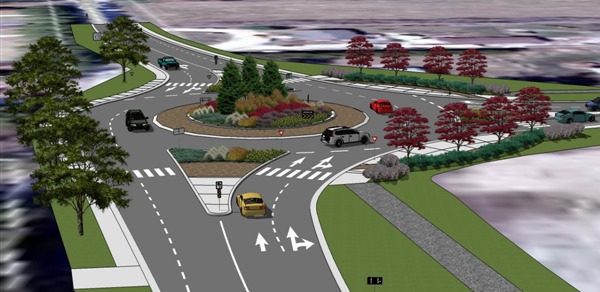
Collingwood, Ontario roundabout design – Photo courtesy of the Town of Collingwood
We have all dealt with “stop and go” traffic. Drivers accelerate quickly, then slam on their brakes when they hit a red light. Then accelerate quickly again, and repeat.
This harmful style of driving wastes gas, creates unnecessary pollution, and creates unsafe conditions for motorists, pedestrians and cyclists, and is bad for our stress levels and overall health.
The intention of traffic signals was to calm traffic, but it instead sometimes has the opposite effect of creating drivers who are racing to “beat the red”. Un-timed traffic signals result in inefficient traffic flow, leaving scores of cars sitting idle and scores of other cars racing to make the green.
In smaller towns, traffic signals become a burden, slowing down fast-moving highway traffic. To rectify this, the government spends hundreds of millions of tax dollars to build massive concrete bridges to keep cars moving unimpeded.
While heading to Collingwood, Ontario to go skiing on my Christmas break last week I encountered several roundabout junctions that weren’t there the last time I had visited Collingwood several years ago.
These roundabouts were recommended in a 2007 Environmental Assessment that was completed on behalf of the Town of Collingwood. They were recommended to ensure “future traffic volumes can be adequately accommodated”, while also increasing safety and reducing environmental impacts.

Collingwood roundabout under construction – Photo courtesy of the Town of Collingwood
When the space warrants roundabouts, they can be a great way to preclude the limitations discussed above that are inherent with traffic signals.
Furthermore, the cost to build a roundabout pales in comparison to the exorbitant costs of building an overpass. The Collingwood roundabouts cost about $600,000 each, while an overpass can cost anywhere between $4 million to $12 million, depending on the configuration.
When there is enough space to construct them, roundabouts are an extremely efficient way to keep traffic moving while also improving safety for pedestrians and bicyclists when designed properly.
A Dutch study of 181 intersections that were converted to roundabouts found a reduction of 73% in pedestrian crashes. The National Cooperative Highway Research Program (NCHRP Report 572) found a 67% overall reduction in collisions following the implementation of roundabouts at 26 multi-lane intersections.
From the Town of Collingwood website:
“Vehicles operating in a roundabout result in lower environmental impacts, by keeping traffic moving at a more consistent lower speed and reducing idling. The shorter delays and “rolling” approach to roundabouts generally reduce fuel and energy consumption, greenhouse gas emissions, the carbon footprint, as well as a reduction in noise to the surrounding community. The longer delays and the start and stop approach to signalized intersections will generally have a more demanding impact on the environment.”
To take our Canadian roundabouts one step further, we need only to look at the Dutch for inspiration. Watch this video from our friend Mark over at Bicycle Dutch, showing a modern roundabout in the Netherlands. Notice how bicyclists have the right of way to drivers. But despite this, cars still seem to flow fairly well through the roundabout.
Mark also has a wonderful write-up on the evolution of the Dutch roundabouts on his blog.
It is great to see pragmatic traffic design solutions popping up in Canada rather than reverting to the old thinking of building stop signs, traffic signals or overpasses at every junction.
James D. Schwartz is a Transportation Pragmatist and the Editor of The Urban Country. You can contact James at james.schwartz@theurbancountry.com or follow him on Twitter.
Related Articles:
- Snow Traffic-Calming Measures (March 2011)
- No Cars. No Traffic Signals. No Deaths. (June 2011)
- Pragmatism Eludes Politicians (Feb 2010)
- Rural Bike Infrastructure in the Netherlands (March 2012)
- My Ideal World (Aug 2012)
Roundabouts are also safer – you must slow down and change direction to get through one whereas a stoplight does not necessarily require that depending on what colour the light is.
We have seen some major roundabouts installed in Calgary and surrounding areas over the last few years. The City is also using them along some of our onstreet bikeways, including the new bikeways being installed as part of the new West LRT line bicycle integration.
I think we’ll see more cities and towns going this direction due to lower installation costs and lower maintenance costs over the long term.
Roundabouts are also safer – you must slow down and change direction to get through one whereas a stoplight does not necessarily require that depending on what colour the light is.
We have seen some major roundabouts installed in Calgary and surrounding areas over the last few years. The City is also using them along some of our onstreet bikeways, including the new bikeways being installed as part of the new West LRT line bicycle integration.
I think we’ll see more cities and towns going this direction due to lower installation costs and lower maintenance costs over the long term.
I find them truly scary on a bike, you have no idea if the cars coming actually are going to give you right of way like they should or go right through you. There is so much trust involved, thinking that Canadians know how to use these things.
I think it depends on the design. I find the Dutch junctions work well because they minimize the point of conflict for bicyclists and pedestrians. The points where bicyclists cross the motor vehicle lanes are directly in front of cars so drivers don’t need to check their blind spots to see bicyclists – they are directly in front.
What did you think of the YouTube video? I know it’s not realistic to think that Canadian drivers would be willing to yield to bicyclists, so I can understand how this might not be as graceful if implemented in Canada.
I find them truly scary on a bike, you have no idea if the cars coming actually are going to give you right of way like they should or go right through you. There is so much trust involved, thinking that Canadians know how to use these things.
I think it depends on the design. I find the Dutch junctions work well because they minimize the point of conflict for bicyclists and pedestrians. The points where bicyclists cross the motor vehicle lanes are directly in front of cars so drivers don’t need to check their blind spots to see bicyclists – they are directly in front.
What did you think of the YouTube video? I know it’s not realistic to think that Canadian drivers would be willing to yield to bicyclists, so I can understand how this might not be as graceful if implemented in Canada.
Upon my arrival in Canada, and throughout the decade since, I’ve found roundabouts to be the most glaring omission from our infrastructure… so glad its finally beginning to change
Upon my arrival in Canada, and throughout the decade since, I’ve found roundabouts to be the most glaring omission from our infrastructure… so glad its finally beginning to change
Heading to Collingwood next week actually. I’ll keep an eye out.
There are roundabouts hereabouts, but only in Ancaster. Not a one in Hamilton proper.
From this and other observations I am lead to think that it’s affluent communities who get them.
There are problems with roundabouts that this article does not address:
– Smooth traffic flows make crossing roads more difficult for pedestrians.
– Roundabouts tend to gum up in heavy traffic flows, and in some cases of flows with a strong unidirectional bias.
A safer (and potentially more environmentally friendly) solution for heavy, strongly unidirectional traffic flows are “Green Wave” systems [1].
[1] https://en.wikipedia.org/wiki/Green_wave
There are problems with roundabouts that this article does not address:
– Smooth traffic flows make crossing roads more difficult for pedestrians.
– Roundabouts tend to gum up in heavy traffic flows, and in some cases of flows with a strong unidirectional bias.
A safer (and potentially more environmentally friendly) solution for heavy, strongly unidirectional traffic flows are “Green Wave” systems [1].
[1] https://en.wikipedia.org/wiki/Green_wave
Perth in Western Australia has hundreds of roundabouts. Unfortunately they differ from the examples in Ontario and The Netherlands. While they do slow motor vehicles in most cases, our traffic laws and the way our roundabouts are designed has created a situation where pedestrians and cyclists are much worse off. Our road designers have been using roundabouts for there efficiency of keeping traffic moving but it has been at the expense of the vulnerable road users. It will be better for Canada to follow The Netherlands and not Australia. I have done a post on my blog to elaborate.
http://bicycleperth.blogspot.com.au/2013/01/roundabouts-australian-perspective.html
Perth in Western Australia has hundreds of roundabouts. Unfortunately they differ from the examples in Ontario and The Netherlands. While they do slow motor vehicles in most cases, our traffic laws and the way our roundabouts are designed has created a situation where pedestrians and cyclists are much worse off. Our road designers have been using roundabouts for there efficiency of keeping traffic moving but it has been at the expense of the vulnerable road users. It will be better for Canada to follow The Netherlands and not Australia. I have done a post on my blog to elaborate.
http://bicycleperth.blogspot.com.au/2013/01/roundabouts-australian-perspective.html
As a cyclist and a pedestrian I can’t say I’m a big fan. There is a major multi-lane roundabout near my home. I frequently observe motorists zipping through at high speed, especially when exiting the intersection. High school students have considerable difficulty in getting motorists to pay attention to pedestrian crossings in order to cross. I personally was struck on my bike by a motorist who elected to use the left lane to execute a right turn. Because of the legal ambiguity surrounding these intersections the police were unable to charge the motorist.
As a cyclist and a pedestrian I can’t say I’m a big fan. There is a major multi-lane roundabout near my home. I frequently observe motorists zipping through at high speed, especially when exiting the intersection. High school students have considerable difficulty in getting motorists to pay attention to pedestrian crossings in order to cross. I personally was struck on my bike by a motorist who elected to use the left lane to execute a right turn. Because of the legal ambiguity surrounding these intersections the police were unable to charge the motorist.
Dutch-style roundabouts – yes!
UK-style roundabouts, where bikes and motor vehicles are mixed? No, no, no!
The two designs are similar, but very different beasts for people walking or riding bikes.
Roundabouts in the UK are awful – my partner refuses to use them on a bike, and often there’s no crossing for people walking.
Roundabouts in the Netherlands are wonderful – we rode across many without even realising it! And there are nearly always pedestrian crossings on the roundabout arms.
Dutch-style roundabouts – yes!
UK-style roundabouts, where bikes and motor vehicles are mixed? No, no, no!
The two designs are similar, but very different beasts for people walking or riding bikes.
Roundabouts in the UK are awful – my partner refuses to use them on a bike, and often there’s no crossing for people walking.
Roundabouts in the Netherlands are wonderful – we rode across many without even realising it! And there are nearly always pedestrian crossings on the roundabout arms.
Curious to read a post that links to one on which I commented almost 2 years ago. In the Autumn of 2010 I visited the Netherlands and was quite taken with the “sharks teeth” indication. They worked very well to ensure that right of way was clear but also to minimize the unnecessary waiting for everyone. These indications and roundabouts together ensure that we have to think, engage our surroundings, and use good courtesy on the roads. Traffic lights, on the other hand, treat us like cattle. Stop now. Go now. No consideration of circumstance or intelligence.
Curious to read a post that links to one on which I commented almost 2 years ago. In the Autumn of 2010 I visited the Netherlands and was quite taken with the “sharks teeth” indication. They worked very well to ensure that right of way was clear but also to minimize the unnecessary waiting for everyone. These indications and roundabouts together ensure that we have to think, engage our surroundings, and use good courtesy on the roads. Traffic lights, on the other hand, treat us like cattle. Stop now. Go now. No consideration of circumstance or intelligence.