


Photo by Marc van Woudenberg / Amsterdamize
North Americans are becoming increasingly aware of the bicycle culture that comes out of the best bicycling country in the world – the Netherlands – thanks largely to the photography and advocacy from our friends Amsterdamize and A View From the Cycle Path in the Netherlands, and Copenhagenize and Copenhagen Cycle Chic in Denmark.
But I’m still occasionally asked what makes a bicycle a “Dutch-style” bicycle, so this article will explain the anatomy of a Dutch bicycle.
First, a tidbit of history.
The Dutch didn’t invent the bicycle or even develop the earliest bicycles. In the late 19th century, England, Germany and France were leading bicycle manufacturing – and in fact, the first Dutch bicycles largely copied from English bicycles (thus, many of the features of a Dutch bicycle came from the original English design).
Due to the flat landscape of Holland, Dutch bicycles are generally heavy and sturdy and used for transport, and prior to the Second World War, it was very uncommon to have gears on Dutch bicycles.
If I were to describe a typical Dutch-style bicycle with a few adjectives, I would say they are sturdy, comfortable, low maintenance, practical, pragmatic, stylish and heavy.
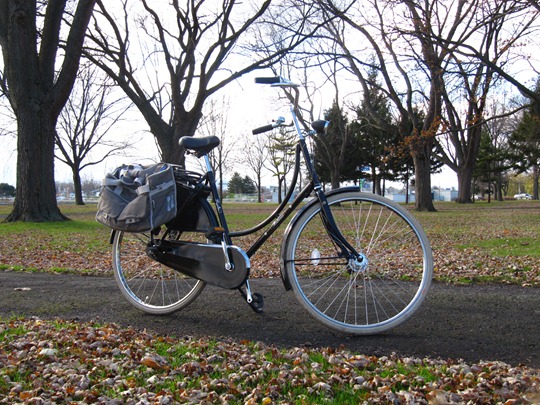
Photo by James D. Schwartz / The Urban Country
Dutch bicycles are upright or “sit-up” style – with taller frames than typical bicycles. This position allows for very good visibility and great comfort.
A popular form of Dutch bicycles is the Omafiets (translates to Grandma’s bike). The Omafiets are traditionally black, with a step through frame, upright position, mudguards and a skirt guard.
Although historically Dutch bicycles were largely single-speed or 3-speed, the Dutch are becoming more demanding for more gears. The Omafiets bike I recently purchased came equipped with 7 speed hub gear.
It’s common for Dutch bicycles to use coaster brakes and many of them come with both front roller brakes and rear coaster brakes. Although coaster brakes are somewhat uncommon in North America, you may remember using them as a kid – you pedal backwards and it engages the rear brake.
Another staple feature of Dutch bikes is the varnished chain cover, mudguard and skirt guard. These features keep the rider clean and dry, and the chain guard keeps the chain protected from the weather elements. To ride a Dutch bike, you need nothing other than your regular clothes. This is why you will rarely see anyone wearing bicycle “gear” in the Netherlands.
And with a sealed chain case on a Dutch bike, you only need to oil your chain once or twice a year.
They are built to last, and they don’t require a lot of maintenance.
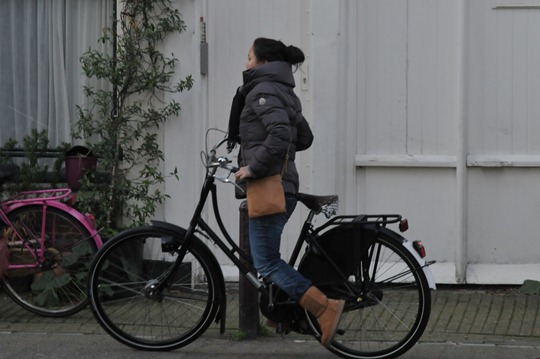
Photo by Marc van Woudenberg / Amsterdamize
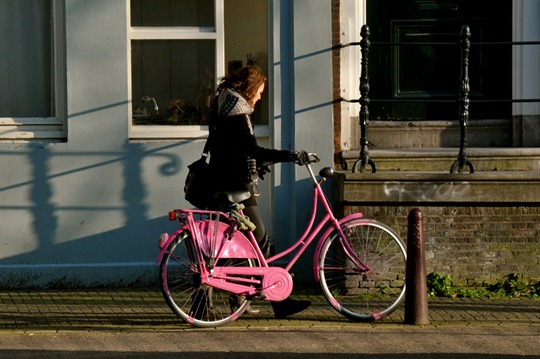
Photo by Marc van Woudenberg / Amsterdamize
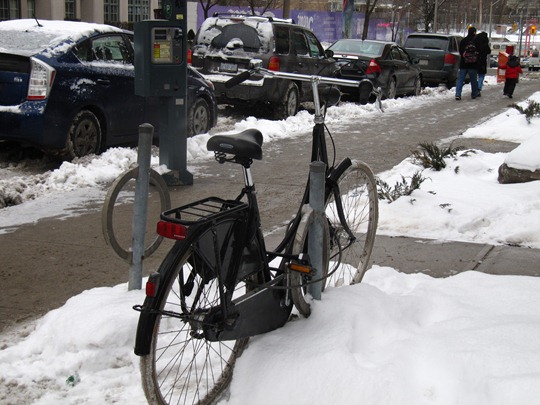
Photo by James D. Schwartz / The Urban Country
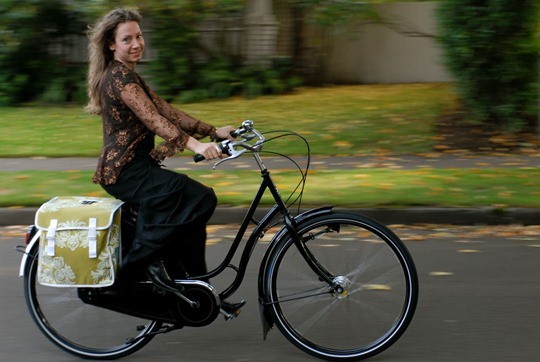
Photo by Todd Fahrner
Perhaps the most distinct feature of a Dutch bicycle is the handlebars. Dutch handlebars curve in towards the rider to make for a more comfortable, relaxing ride.
It takes a bit of getting used to, but you won’t want to go back to North American handlebars once you’ve “gone Dutch”.
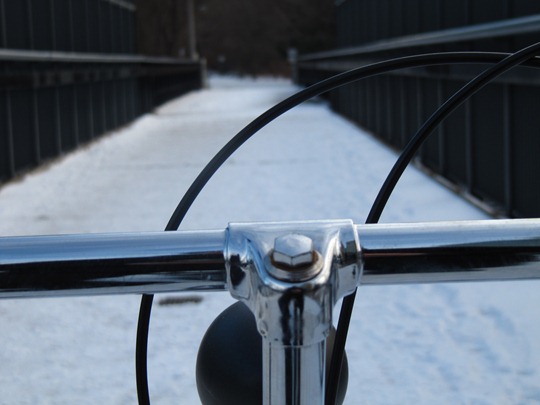
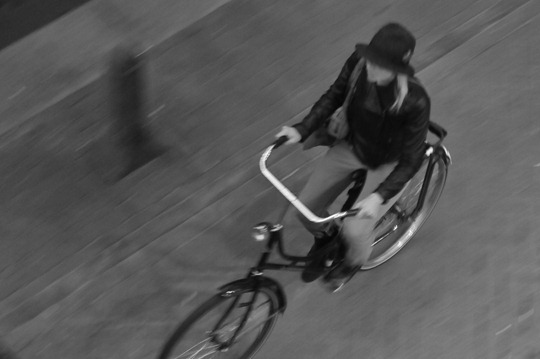
Photo by Marc van Woudenberg / Amsterdamize
For additional safety, many Dutch bikes also come equipped with a large, round headlight on the front:
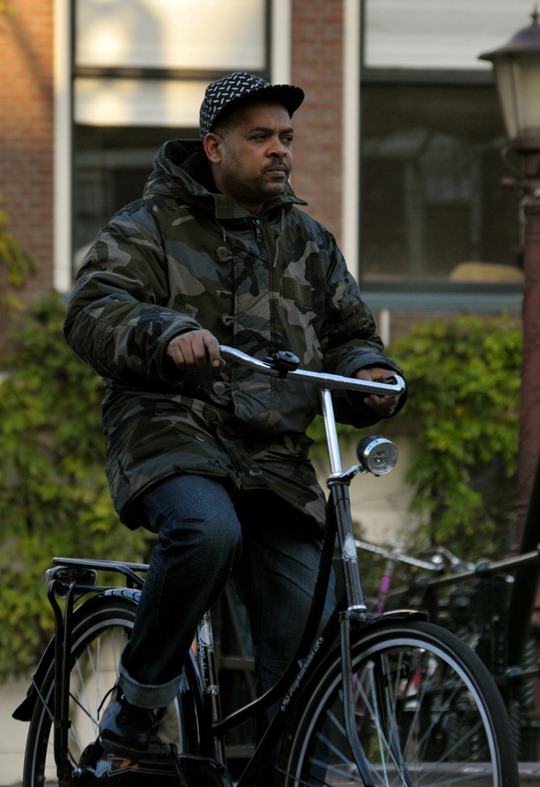
Photo by Marc van Woudenberg / Amsterdamize
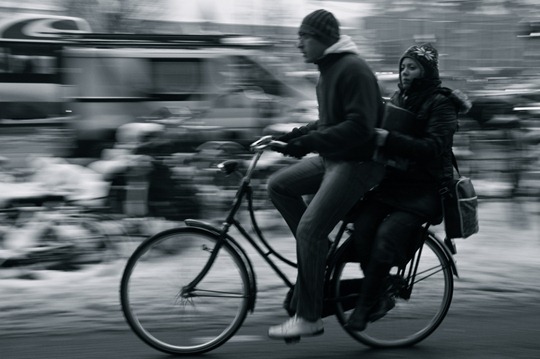
Let’s not forget the sturdy rear racks on the back of the Dutch bicycle (updated January 21st). As Green Idea Factory pointed out in his comment:
As far as I call tell among EU states the Netherlands is the ONLY country which allows this officially (people still do it in other countries, but many provided racks in e.g. Germany are quite flimsy and often used for cheap and ugly baskets)
Another key feature that sold me on the Dutch bike is the fact that they can be stored outside year-round without rusting.
This is important in a country like the Netherlands because there is limited space to bring bicycles indoors, so Dutch bicycles need to withstand the rain and snow.
We have received a fair amount of snow here in Toronto this year, and I have yet to do any maintenance on my Dutch bike. In comparison, last year I was oiling my chain every 2 days because of the rain, snow, and salt.
Last but not least is the convenient rear wheel lock. The key stays inserted in the wheel lock until you lock it, then you take the key with you. This is *extremely* convenient for short visits to a store – you don’t need to worry about someone riding your bike away – and we all know that nobody would be foolish enough to carry a Dutch bicycle 😉 (updated January 21st)
If I still haven’t sold you on a Dutch bike, then you might just have to take one out for a test ride and see it for yourself.
David Hembrow has a good post on Dutch bicycles with additional details for your viewing pleasure.
James D. Schwartz is the editor of The Urban Country. You can contact James at james.schwartz@theurbancountry.com.
Related Articles:
- Living in a Dutch Fantasy Land (Dec 2010)
- Dutch Cycle Chic – Toronto Style (Dec 2010)
- Doctor Busted on a Bike (Nov 2010)
- Bicycling in the Winter (Nov 2010)
While it’s true that something which set apart proper Dutch bicycles from cheap copies is the paint finish which allows them to spend decades outdoors, not all bikes are left outside. Some homes in the Netherlands don’t have storage for bikes, but most that have been built in the last 50 years do it. Bicycle storage has been a requirement of planning permission here for two decades, and was part of the design of most homes for some time before that.
I previously posted more details of what makes for a reliable everyday Dutch bicycle.
Nice summary and great pictures of a few Dutch bikes! I’m of course a little biased, being the proud owner of my own Omafiets. They are a great, sturdy, bike. It is true though that even here in Chicago I wouldn’t want a single-speed version. Mine has 8 gears and front and rear roller brakes. I don’t think I would want coaster brakes for city riding. My WorkCycles Oma is the smoothest riding bicycle I’ve ever had, and I haul a ton of stuff. And with those fenders, chainguard, and skirtguard, I have not gotten muddy or grimy this winder. Go Oma!
Nice post. A bit commonplace, even though interesting.
I have an exception for these Dutch bikes: hilly areas, like such I live in. This kind of bicycles doesn’t work on climbs nor on toboggans.
Well, I must recognise that hilly urban areas are not the best for cyclists, but, since they exist, they must be considerated.
The main success of Northern Europe is to be flat. This condition makes things easier in order to encourage people to cycle.
Congrats once again for this blog from Pamplona (Spain).
Eneko
http://bicicletasciudadesviajes.blogspot.com/
Nice post 🙂
Nice post and pics. As a Torontonian who rides an omafiets to/from work daily (even today despite the gloomy, slushy winter), it’s great to see someone else appreciate the secret behind great Dutch bikes: they’re comfortable all year round.
Interesting to see at least one pic with a dude riding an omafiets. Mine is occasionally called a “girls bike” — usually by some slack-jawed yokel who hasnt been on two wheels for decades!
Well, the specific picture you show as a contrast to “North American” handlebars are rather, ummmmm, North American. Not a particularly Dutch style at all.
They make them in Kentucky.
I have nothing against Dutch bikes, I own one (although it’s a 10 speed “racer”: Oh, the irony). I do take a certain objection to the modern trend of focusing on the Dutch as if that’s where sit up bikes come from (and I acknowledge your acknowledgement of their English heritage).
Every country, particularly those of North America, has a sit up practical bike tradition. Sports bikes had to be reintroduced here from Europe after WWII. My own 3 speed Opa was made in Chicago 40 years ago. My one speed coaster brake was made in the wilds of upstate NY 50 years ago. They both have “Dutch” handlebars, because they’re American handlebars; it’s those drop bars that are more accurately called “European.”
Eneko: Hills are simply an excuse.
kfg: Quite right. I took a photo of an American “Dutch bike” at a museum here in teh Netherlands.
@kfg – I’m giving credit to the Dutch for the widespread use of these style of bikes – not for inventing them.
If these style of bikes were used as widely in North America, we probably wouldn’t have any reason anymore to call them “Dutch-style” bikes.
“If these style of bikes were used as widely in North America . . .”
I remember when they were, and when they weren’t called Dutch bikes, even if they were of European import (a lot of those came from Austria and are still fairly common on CL); so I’m not talking ancient history. About two generations of Americans were virtually unaware that anything other than sturdy sit up bikes even existed, other than perhaps an odd knowledge that there was something called a “racer,” but they’d never actually seen one. Ever.
“Mamacharis” were a common sight on American streets right up until the mountain bike boom hit. Schwinn Suburbans were popular for this and Dorel, which now actually owns the Schwinn trademark, made its bones fitting them out.
I still see CCM’s now and again as well. Canada represents!
I’ll note also that Mexico is part of North America and many of them still won’t have anything but an American style utility bike, even if they have to make do with one made in China because one made in Chicago isn’t available to them. They have never gone away, even if you have not been noticing them.
There is no harm in becoming aware of and acknowledging your own cultural history.
Bits of it might even prove worth embracing.
@kfg – all of your insight is very interesting. I grew up in the 80’s during the mountain bike boom. However, there isn’t much to embrace in North America with respect to using bicycles for transportation. Lots has been happening in the past few years in Montreal, Vancouver, NYC, etc, and I have highlighted these improvements.
But the utility bicycling culture here is so small in comparison to the Dutch culture, and I think it is in part due to the style of bicycles that they embraced while we embraced mountain bikes and racing bikes in North America and ignored the practicality of the urban bikes.
Nice, fairly comprehensive article of introduction. A lot of people even in Europe don’t know a lot of this.
One thing missing from your post but detailed in one of David Hembrow’s links is the traditional sturdy rear rack.
As David mentions, a primary use for this is carrying passengers, casually with no special kit, sitting side saddle (“Dutch style”, of course!).
On his Flickr pages, Marc from Amsterdamize also has tons of photos of this simple, social, sometimes romantic and certainly efficient activity.
As far as I call tell among EU states the Netherlands is the ONLY country which allows this officially (people still do it in other countries as enforcement is generally slack, but many provided racks in e.g. Germany are quite flimsy and often used for cheap and ugly baskets (unlike David Hembrow’s glorious ancestrally-channeled ones) or designed just for detachable pannier bags. One of the shops in Berlin which sells the gorgeous and rugged Dutch-made Workcycles Fr8 explicity mentions the strength of the provided rack and the limits on its utilization in Germany.
Here in Berlin I see a lot of people walking their bike next to a friend without one. Germany does not have a great pedestrian culture but rather a sort of inconsistently-applied worship of speed and – related – I imagine many of them would rather be going faster.
Regarding the comment from Eneko about the hills, I think Dutch bikes work just fine on hills if you have the proper gearing. The standard single speed and 3 speeds of The Netherlands won’t do, but an 8 speed Nexus or even a 7 speed Nexus or 5 speed Sturmey Archer with the right cog/crank ring combo hands our hills just fine.
In response to Eneko’s comment above: I live in hilly Vancouver, BC, and I bought a Batavus omafiets in October, 2010. On the really steep hills, I simply get off my bike and push it up the hill. There’s no shame in pushing.
Hi!
Most dutch bikes have handlebars set in a very high position – comfortable on flat grounds, but a real pain when climbing hills. If you live in an area with hills you would benefit a lot from lowering the handlebars to about the same level as your saddle. This setup makes climbing hills much more convenient.
Dutch bikes mimic a walking position, head, shoulder, hip, knee, ankle in line on the down stroke. Hence comfortable but also mirrors the energy consumption of walking. Everything is set up for easy use, they are beyond a pleasure to use. I live in a hilly rainy city, with poor bike infrastructure everybody should have one for day to day use.
Dutch bikes mimic a walking position, head, shoulder, hip, knee, ankle in line on the down stroke. Hence comfortable but also mirrors the energy consumption of walking. Everything is set up for easy use, they are beyond a pleasure to use. I live in a hilly rainy city, with poor bike infrastructure everybody should have one for day to day use.
We are manufacturer offer leather wallets.evening handbags.keychains.bracelets, on-schedule delivery and competitive prices.If you are interested in any of our models,or have a custom requirement of the bag,please communicate with us in your detailed inquiries.Custom bag designs, size, color, and logo are accepted.We welcome OEM&ODM projects.We accepted small quantity order.
We are manufacturer offer leather wallets.evening handbags.keychains.bracelets, on-schedule delivery and competitive prices.If you are interested in any of our models,or have a custom requirement of the bag,please communicate with us in your detailed inquiries.Custom bag designs, size, color, and logo are accepted.We welcome OEM&ODM projects.We accepted small quantity order.
Of course there have always been situp bikes in every country, not just Holland. But the rear rack seems not so common. If you want to give your friend a ride and you dont have that rear rack, she’ll end up on the handlebars… (http://www.youtube.com/watch?v=VILWkqlQLWk)
Of course there have always been situp bikes in every country, not just Holland. But the rear rack seems not so common. If you want to give your friend a ride and you dont have that rear rack, she’ll end up on the handlebars… (http://www.youtube.com/watch?v=VILWkqlQLWk)
worcestershire campervan hire so wonderful and nice bike
What a great post. Made me extremely sentimental about my time living in Amsterdam. I ride a really old Miele hybrid cruiser that I got for super cheap in order to upkeep my memories but it’s definitely not the same.
These types of bikes can be as low as 150 euros in Amsterdam in the peak of the season, and in Montreal I have not been able to find a ‘true Dutchie’ any advice for brick and mortar or online retailers that sell them at student-affordable pricing?
What a great post. Made me extremely sentimental about my time living in Amsterdam. I ride a really old Miele hybrid cruiser that I got for super cheap in order to upkeep my memories but it’s definitely not the same.
These types of bikes can be as low as 150 euros in Amsterdam in the peak of the season, and in Montreal I have not been able to find a ‘true Dutchie’ any advice for brick and mortar or online retailers that sell them at student-affordable pricing?
Tell them it’s actually a “Scottish Men’s bike”.
Tell them it’s actually a “Scottish Men’s bike”.
When I was I kid, I wanted to have a dutchie bike. Unfortunately, my parents bought me a different model of bicycle. They just didn’t understood that it’s the look and the design of that bike that I wanted.
Pingback: Saved By The Wheel Lock ← The Urban Country
Pingback: The Unconventional Urban Citizen Bicyclist ← The Urban Country
Pingback: Dutch Cycling Promotion. Good For The Body, Legs & The Eyes. ← The Urban Country
Pingback: 2011 Year End Wrap Up ← The Urban Country
Pingback: My Dutch Family History ← The Urban Country
Pingback: xbox 360
Pingback: Carlo Ermatinger
Pingback: penis advantage scam
Pingback: edu link building service
Pingback: hostgator promo code
Pingback: how to get a free ipad
Pingback: best led tv 2013
Pingback: penis advantage
Pingback: backlinks services
I am I the Netherlands right now. And it’s Dutch bikes as far as the eye can see. I still prefer my road style steel bike.
Now this is in actual fact cooperative. It’s very openhanded of you to share this with us. http://www.mountainbikesguide.com