


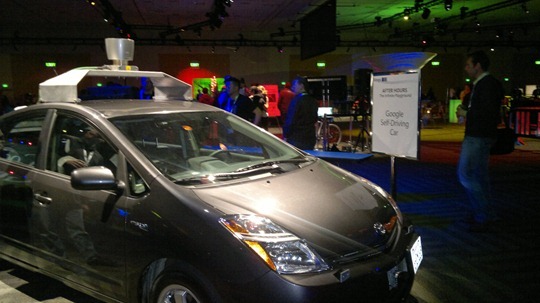
Google self-driving car on display – photo by Mac Morrison
The powerful 2008 documentary film Zeitgeist 2: Addendum suggests that our monetary system based on fractional reserves is the fundamental root cause of all of our social ills in our present day society.
Part III of the film focuses on the use of technology to contribute to the greater good of people and promotes a resource-based economy over a profit-based economy based on Venus project creator Jacque Fresco’s vision for the future of the world.
Fresco’s philosophy is that technology can be used to eventually eliminate all laws. On transportation, Fresco has a vision of technology being applied to increase safety to benefit all people:
Instead of putting up a sign, “Drive carefully, slippery when wet”, put abrasive in the highway so it’s not slippery when wet. And if a person gets in the car when they’re drunk, and the car oscillates a great deal, there’s a little pendulum that swings up and back, and that will pull the car over to the side. It’s not a law, it’s a solution. Put sonar and radar on automobiles so that they can’t hit one another.
Man made laws are attempts to deal with occurring problems, and not knowing how to solve them, they make a law.
Imagine a world where technology could ensure a motorist never puts a bicyclist in danger. A world where separated bike lanes would be unnecessary because even a child could use the roads without the fear of automobiles.
It’s an interesting concept that isn’t as far off as you might think.
Google Inc. has invested significant resources into testing robotic automated vehicles, and research for automated vehicles dates back to the 1960’s.
As of October 2010, Google had logged 140,000 miles of automated driving in California. To test the concept, Google hired more than a dozen people with clean driving records and had them sit in the driver’s seat ready to take control in case something goes awry. An engineer sits in the passenger seat to monitor the computer systems that guide the car.
Google has experienced just one collision while testing this concept and it happened when another driver rear-ended one of the automated test cars at a red light. Human error.
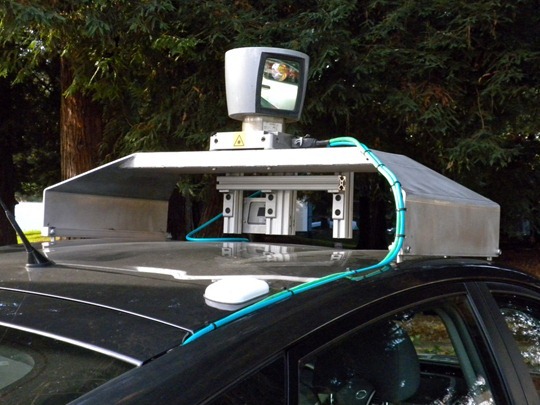
Google self-driving car – photo by Jennifer Boriss
Mass production of automated driving is still many years away, and automated cars pose significant legal questions regarding liability. And although automated vehicles can help improve safety on our streets, they don’t do anything to solve our traffic congestion or pollution problems (sure, automated cars will make more efficient use of the road space, but without congestion tolls this will only serve to induce demand on our streets).
Thankfully, the world has changed significantly in the last 50 years, so one can only dream about how it will change in the next 50 years.
Could technology make bike infrastructure unnecessary? Will most of our traffic laws become redundant?
The possibilities are endless. Let’s just make sure we steer our government and our cities in the right direction so technology can be harnessed for the good of everyone and not just to benefit people who drive cars.
James D. Schwartz is the editor of The Urban Country. You can contact James at james.schwartz@theurbancountry.com.
Related Articles:
- The World Has Changed. So Can You (April 2011)
- Barriers to Cycling: Debunking the Myths (Nov 2009)
- Enough Excuses: Cars Cause Death (Dec 2010)
- Billboard Hijacking To Promote Urban Bicycling (March 2011)
- We Are Addicted To Automobiles (May 2011)
Actually, this is all a lot closer than you realize. There is already technology deployed to keep cyclists safe. That’s what the Dutch concept of sustainable safety is all about. These road designs, for drivers as well as for cyclists, are a form of technology which removes conflicts, makes roads and cycle paths mostly self-explaining, and keeps people safe.
Unlike your examples, this technology is proven to work. The Netherlands has the world’s safest roads.
This also is a technology which addresses your other concerns. The country has the highest level of cycling in the world, helping to solve congestion and pollution problems.
Actually, this is all a lot closer than you realize. There is already technology deployed to keep cyclists safe. That’s what the Dutch concept of sustainable safety is all about. These road designs, for drivers as well as for cyclists, are a form of technology which removes conflicts, makes roads and cycle paths mostly self-explaining, and keeps people safe.
Unlike your examples, this technology is proven to work. The Netherlands has the world’s safest roads.
This also is a technology which addresses your other concerns. The country has the highest level of cycling in the world, helping to solve congestion and pollution problems.
Yes, the Dutch have done a great job in engineering out conflict between motorists and bicyclists, but this isn’t the only reason Dutch streets are safer. The driving culture is much different in the Netherlands than in North America. You could rip out all of the infrastructure in the Netherlands, and the streets would still be safer than they are here. But that’s a different discussion altogether.
James, what do you base this opinion on ? Have you visited the Netherlands, cycled and driven here ?
If the infrastructure here was as it is in Canada, the US, the UK etc. the problems would be just about exactly the same.
Where the infrastructure here is less good, you have more problems. The only “road rage” I’ve experienced here was in a location where this was the case. It couldn’t have been elsewhere as the opportunity for it to arise doesn’t occur elsewhere.
Dutch drivers obey the law and observe what is written on signs and on markings on the road just as much and just as little as drivers anywhere else. They’re only human, after all, not different in any way.
Can’t speak to Holland, but here in Japan the infrastructure is worse and the pedestrian/cyclist deaths are a quarter (per capita). You could still say it is not cultural; it is due to decent policing and sentencing.
David, while it is certainly good to de-construct the “Dutch drivers are elves in regards to cycling” idea, is it totally untrue? I lived in the Czech Republic for seven years, and – do not feel that the lower quality of infrastructure there can account for how hugely more dangerous it is there for cyclists and pedestrians. Czech drivers are generally more aggressive and narrow-minded than most other Europeans, which is at least part of the reason why the country is continually near the bottom of the pile in terms of road deaths and injuries.
There ARE differences in culture, recent history, class issues, machismo and automobile quality in addition to ones in infrastructure.
Moreover, one could say that the high safety-quality of Dutch bike infra. is a direct outgrowth of a different safety culture, or just culture: It seems unlikely that a minority of Dutch experts are protecting the rest of the population from people who are “…just as much and just as little…”. In fact a recent posting of yours about those teen cyclists and the new driver in the truck and the community reaction says a great deal. This story would not play out the same in the Czech Republic and – if you pay any heed to people who make comments to various articles about cyclist and ped. deaths and injuries – in other countries as well, in particular the USA.
Related to that last point, there are general differences in cycling rates in NL from the more Catholic-south to the more Protestant-north. Curious about road casualty differences, too.
None of these technological fixes will mend the human tendency toward hierarchical relationships though. I kind of agree with Octavia Butler that human hierarchical society (I have more/am better&stronger/ and therefore am worth more/have more rights than you) is why we need laws.
None of these technological fixes will mend the human tendency toward hierarchical relationships though. I kind of agree with Octavia Butler that human hierarchical society (I have more/am better&stronger/ and therefore am worth more/have more rights than you) is why we need laws.
Technology is not the solution.
Better brakes, more airbags, and more effective crumple zones just give people a false sense of safety and security. This very real increase in safety is quickly overridden by ones desire to push the limits of these technologies, to take advantage of what you paid for in a way.
Car companies have been working hard for decades to market the dangerous out of driving. All these technologies do little to secure pedestrians and cyclists (street users) in their rightful place in the urban landscape.
That $80k Lexus has no trouble plowing into those BIXI bikes the other day. Active radar anyone? no thanks. I would rather have competence and respect behind the wheel. But this, sadly, erodes with the introduction of new technologies that serve to sanitize the driving experience.
If we introduced impaling-prone steering wheels to all cars, and really marketed these as deadly, I’m sure people would slow down and take driving a little more seriously. All this techno junk just eliminates the impetus to do well to fellow citizens, it coupes one up in a make believe bubble of safety.
My grandfathers, who proudly drove defensively in their 55′ Bel Airs can’t believe the way people drive now. I think we can blame technology (as well as shift into techno-topia culture) for this.
Interesting perspective. On the same line of thinking, I read something recently that sports (hockey in particular) has become more dangerous as better protective gear has become available. The technological advancements provide incentive for us to push our limits.
Have airbags in your car? Drive faster. Better protecting hockey helmet? Hit harder. The article compared hockey to rugby and I think there are more concussions in hockey, even though they wear helmets, whereas in rugby they don’t.
Definitely an interesting perspective, and indeed it would be great if drivers were more aware, cautious, and less distracted.
I know Mikael at Copenhagenize talks a lot about external airbags. But I wonder if these external airbags would only encourage drivers to go even faster? Good food for thought…
I read something like that in The Star. I play a bunch of hockey (few times I use a car- economic intensive sport isn’t it? lol) and have witnessed equipment get bigger and downright massive now. As an avid player, I do agree. I also played rugby in high school and witnessed a bit of a different culture in that sport, perhaps because of the equipment (i think so).
Wasn’t there a study, or maybe a news article, that said that drivers allow less room to cyclists when they see that they’re wearing helmets? I think this line of thinking is valid and I would adamantly discourage engineers to put exploding pockets of air around their vehicles, lol, the horror to witness people projectiles! okay, maybe not so funny.
I don’t think we can ever get rid of car, they have their uses, but the culture of automotive entitlement in the city is downright dangerous. Wanna blast that Honda with the lawnmower muffler through that McDonald’s drive through? -move to the suburbs.
Technology is not the solution.
Better brakes, more airbags, and more effective crumple zones just give people a false sense of safety and security. This very real increase in safety is quickly overridden by ones desire to push the limits of these technologies, to take advantage of what you paid for in a way.
Car companies have been working hard for decades to market the dangerous out of driving. All these technologies do little to secure pedestrians and cyclists (street users) in their rightful place in the urban landscape.
That $80k Lexus has no trouble plowing into those BIXI bikes the other day. Active radar anyone? no thanks. I would rather have competence and respect behind the wheel. But this, sadly, erodes with the introduction of new technologies that serve to sanitize the driving experience.
If we introduced impaling-prone steering wheels to all cars, and really marketed these as deadly, I’m sure people would slow down and take driving a little more seriously. All this techno junk just eliminates the impetus to do well to fellow citizens, it coupes one up in a make believe bubble of safety.
My grandfathers, who proudly drove defensively in their 55′ Bel Airs can’t believe the way people drive now. I think we can blame technology (as well as shift into techno-topia culture) for this.
Interesting perspective. On the same line of thinking, I read something recently that sports (hockey in particular) has become more dangerous as better protective gear has become available. The technological advancements provide incentive for us to push our limits.
Have airbags in your car? Drive faster. Better protecting hockey helmet? Hit harder. The article compared hockey to rugby and I think there are more concussions in hockey, even though they wear helmets, whereas in rugby they don’t.
Definitely an interesting perspective, and indeed it would be great if drivers were more aware, cautious, and less distracted.
I know Mikael at Copenhagenize talks a lot about external airbags. But I wonder if these external airbags would only encourage drivers to go even faster? Good food for thought…
Yes, the Dutch have done a great job in engineering out conflict between motorists and bicyclists, but this isn’t the only reason Dutch streets are safer. The driving culture is much different in the Netherlands than in North America. You could rip out all of the infrastructure in the Netherlands, and the streets would still be safer than they are here. But that’s a different discussion altogether.
James, what do you base this opinion on ? Have you visited the Netherlands, cycled and driven here ?
If the infrastructure here was as it is in Canada, the US, the UK etc. the problems would be just about exactly the same.
Where the infrastructure here is less good, you have more problems. The only “road rage” I’ve experienced here was in a location where this was the case. It couldn’t have been elsewhere as the opportunity for it to arise doesn’t occur elsewhere.
Dutch drivers obey the law and observe what is written on signs and on markings on the road just as much and just as little as drivers anywhere else. They’re only human, after all, not different in any way.
I read something like that in The Star. I play a bunch of hockey (few times I use a car- economic intensive sport isn’t it? lol) and have witnessed equipment get bigger and downright massive now. As an avid player, I do agree. I also played rugby in high school and witnessed a bit of a different culture in that sport, perhaps because of the equipment (i think so).
Wasn’t there a study, or maybe a news article, that said that drivers allow less room to cyclists when they see that they’re wearing helmets? I think this line of thinking is valid and I would adamantly discourage engineers to put exploding pockets of air around their vehicles, lol, the horror to witness people projectiles! okay, maybe not so funny.
I don’t think we can ever get rid of car, they have their uses, but the culture of automotive entitlement in the city is downright dangerous. Wanna blast that Honda with the lawnmower muffler through that McDonald’s drive through? -move to the suburbs.
How stupid (not your post)! Spend billions to automate a technology that runs on resources we will soon not be able to afford: billions on research and many billions more for the infrastructure. Or spend a fraction of that on decent transit and proper policing.
How stupid (not your post)! Spend billions to automate a technology that runs on resources we will soon not be able to afford: billions on research and many billions more for the infrastructure. Or spend a fraction of that on decent transit and proper policing.
Can’t speak to Holland, but here in Japan the infrastructure is worse and the pedestrian/cyclist deaths are a quarter (per capita). You could still say it is not cultural; it is due to decent policing and sentencing.
” . . .technology can be used to eventually eliminate all laws.”
This ought to be required by law.
” . . .automated driving is still many years away. . .”
And they call it “train.”
” . . .technology can be used to eventually eliminate all laws.”
This ought to be required by law.
” . . .automated driving is still many years away. . .”
And they call it “train.”
It’s funny and at the same time tragic, how the mind thinks that technology is the way to resolve problems that the mind (to a large degree) creates in the first place. Yes, technology can help with comfort and safety to some degree, but when the mind tries to compensate for a lack of intelligence by using technology, nothing good can come out of it.
It’s funny and at the same time tragic, how the mind thinks that technology is the way to resolve problems that the mind (to a large degree) creates in the first place. Yes, technology can help with comfort and safety to some degree, but when the mind tries to compensate for a lack of intelligence by using technology, nothing good can come out of it.
Technology to end laws? In fact, history shows quite the opposite happens – more technology leads to a more complex society, which means more laws. The West left lawlessness behind thousands of years ago. This is supposed to a GOOD thing…
What do the airplane, the radio, the atomic bomb and the Internet all have in common? All of them had supporters who believed they would end war.
Besides, this pro-gadget message is antithetical to the whole point of this website, isn’t it? Isn’t this site all about leaving the dirty, expensive, environmentally destructive car behind in favour of the light, simple, human-powered bicycle? Don’t bikes need fewer laws to make them safe than cars do?
In theory, yes – this website promotes bicycles which would eliminate the need for most of our traffic laws. In fact, one of our upcoming articles will be to show-case a car-free urban residential area that doesn’t have any traffic signals or stop signs (for good reason).
But at the same time we’re also pragmatic and realistic, and cars aren’t going away anytime soon. So if technology can help improve safety (either through bike infrastructure as David Hembrow points out, or through improving the external safety of automobiles), then we are all for it.
Technology to end laws? In fact, history shows quite the opposite happens – more technology leads to a more complex society, which means more laws. The West left lawlessness behind thousands of years ago. This is supposed to a GOOD thing…
What do the airplane, the radio, the atomic bomb and the Internet all have in common? All of them had supporters who believed they would end war.
Besides, this pro-gadget message is antithetical to the whole point of this website, isn’t it? Isn’t this site all about leaving the dirty, expensive, environmentally destructive car behind in favour of the light, simple, human-powered bicycle? Don’t bikes need fewer laws to make them safe than cars do?
In theory, yes – this website promotes bicycles which would eliminate the need for most of our traffic laws. In fact, one of our upcoming articles will be to show-case a car-free urban residential area that doesn’t have any traffic signals or stop signs (for good reason).
But at the same time we’re also pragmatic and realistic, and cars aren’t going away anytime soon. So if technology can help improve safety (either through bike infrastructure as David Hembrow points out, or through improving the external safety of automobiles), then we are all for it.
Actually the technology to avoid traffic collisions all together was invent– appeared millions of years ago: Feet. And actually the bike – as a populist thing – came next and still everything was fine but then people went completely nuts.
Actually the technology to avoid traffic collisions all together was invent– appeared millions of years ago: Feet. And actually the bike – as a populist thing – came next and still everything was fine but then people went completely nuts.