


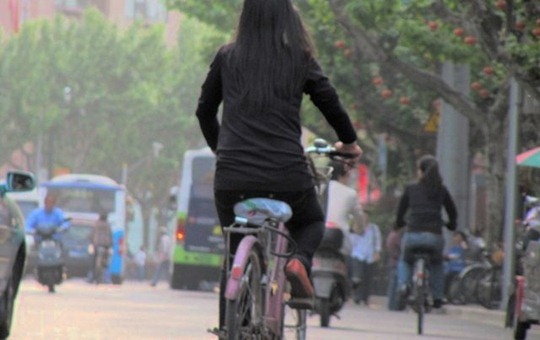
Cyclist in Shanghai – Photo by James Schwartz / The Urban Country (2010)
As a Canadian ex-pat currently residing in China, there are moments where my culture and values clash with Chinese culture. A recent situation at a dinner with my wife’s family and friends surfaced the importance placed on car ownership in Chinese culture. I will get to this.
Last week I had a friend drop by for 5 days after after he became stranded in Hong Kong when his work trip to the United States was cancelled. During those five days we spent at least 2-3 hours each day exploring the city by bicycle.
The Chinese tend to be very forward and blunt compared to people in North America, so there were several situations where locals blatantly laughed at us for riding bicycles.
In one such situation, a group of guys in their early twenties laughed when we were leaving a bar on our bicycles, and made a comment in Chinese which roughly translates to:
“haha, those foreigners have to rely on their bicycles to get to the bar”.
In another situation we ended up talking to two men who also laughed at us when they first saw us. When confronted about why they laughed at us when we pedaled past, they commented:
“Riding a bicycle in Beijing.. I could see that. That’s what people do in Beijing. But here in Haikou? Nobody rides a bicycle in Haikou”.
As someone who has visited China twice before, these situations are not unexpected, and don’t bother me insofar as it pertains to being embarrassed about riding a bicycle.
However, the part that bothers me is the fact that people’s first instinct here when they see someone on a bicycle is to presume that they are too poor to afford any other mode of transportation.
If the perception that “people who use bicycles are poor” prevails in China, bicycling will become extinct as a mode of transportation as China’s wealth increases.
There are two things that can save bicycles as a viable mode of transportation in China. The first, ironically, is car culture itself. Increased traffic congestion – in a country with more than 160 cities with populations exceeding 1 million people – will give people a reason to start using bicycles again (or electric scooters as is the case here in Haikou).
The second thing that can save bicycles is changing the perception that bicycles are just a mode of transportation for the poor. This is much harder to do, as I have found.
While eating dinner with my wife’s family, a prominent well-to-do friend of the family asked my wife how many cars we have back in Canada. The question was not, “Do you have a car in Canada?” or “What kind of car do you have in Canada?”.
The assumption was that we obviously owned a car. Thus, the question was, “how many cars do you own?”.
I felt not embarrassed for myself, but status and success (measured by wealth) is important in the Chinese culture, so if someone doesn’t own a car, they must not be very successful.
My wife’s father graciously and supportively explained our reasoning for getting rid of our car. I couldn’t ask for a more supportive father in law and I am grateful that he helped defend us. My inadequate Chinese language skills unfortunately prevented me from explaining my perspective.
Somehow I think the explanation was futile. The damage had been done. We had clearly disappointed the family friend and there was an awkward silent moment where it was obvious that he was disappointed.
Don’t get me wrong, the man who asked this question is an extremely kind and genuine man, and I don’t fault him whatsoever for asking this question. We are all just products of our culture and it’s easier to go along with the culture than to question it or rebel against the culture (as I have done within Canada’s car culture).
Had I been able to respond, I would have explained that we live close to work, we can walk to hundreds of restaurants in downtown Toronto, and we have access to five brand new cars on our doorstep that we can rent by the hour anytime we want to using Toronto’s Autoshare car sharing program. If we need to leave the city for a weekend, we have a number of rental car options.
I also would have explained that I can get to my destination by bike faster than driving a car 8 times out of 10 in downtown Toronto, and that I enjoy being outside and getting some exercise after sitting on a computer for 10-12 hours a day rather than being stuck in a car.
I might also have mentioned that by ridding ourselves of our car, we are saving $8,000 every year (~48,000RMB) that we can put towards our daughter’s education fund.
I would have also showed him video footage from the Netherlands to explain to him how liveable and pleasant so many European cities are because they went against car culture rather than embracing it.
One day China will evolve – especially after the car culture brings Chinese cities to a grinding halt – and the Chinese will have a better appreciation for a more humble, pragmatic, simple existence that holds less importance to status and material possessions.
In the meantime, I will continue to pedal around this Chinese city with a smile on my face, and perhaps I will convince just one Chinese person that bicycling is a great way to get around for both poor people and wealth people – and everyone in between.
James D. Schwartz is a Transportation Pragmatist and the Editor of The Urban Country. You can contact James at james.schwartz@theurbancountry.com or follow him on Twitter.

Related Articles:
- The Chinese Car Obsession (Nov 2011)
- Only the poor ride bicycles in Shanghai (Sept 2010)
- The Bicycle as a Status Symbol (Sept 2011)
- Sunday Afternoon Traffic in China (Jan 2012)
I suffered similar embarrassment when I moved to Spain from London (England) more than 20 years ago. People would point and stare as I cycled around the streets. Children would openly laugh. At that time, the Spanish were used to seeing tight groups of cyclists on racing bikes and team helmets, but they were very surprised to see a man in ordinary clothes using a bike to do some shopping. Most people assumed that I was very poor, in some way unwell, or that I had lost my driving license as a drunk driver. However, over the years the logic of utility cycling has become increasingly obvious and ‘normal’ cyclists are now a very common sight in Spanish cities. It must also be said that the current economic crisis has also helped boost the number of cyclists.
I suffered similar embarrassment when I moved to Spain from London (England) more than 20 years ago. People would point and stare as I cycled around the streets. Children would openly laugh. At that time, the Spanish were used to seeing tight groups of cyclists on racing bikes and team helmets, but they were very surprised to see a man in ordinary clothes using a bike to do some shopping. Most people assumed that I was very poor, in some way unwell, or that I had lost my driving license as a drunk driver. However, over the years the logic of utility cycling has become increasingly obvious and ‘normal’ cyclists are now a very common sight in Spanish cities. It must also be said that the current economic crisis has also helped boost the number of cyclists.
I’m increasingly finding the label “old-fashioned” to be effective. When they ask you how many cars you have, laugh at them and say, “Cars?! We’re not old-fashioned! We’re modern! China is still so far behind…” Whereefter you explain that bicycles are high status.
Neat, turn the tables on them. Maybe go on to say people who can afford to live in city centres find them more convenient. Only the people who have to live out in the suburbs use cars.
I’m increasingly finding the label “old-fashioned” to be effective. When they ask you how many cars you have, laugh at them and say, “Cars?! We’re not old-fashioned! We’re modern! China is still so far behind…” Whereefter you explain that bicycles are high status.
Neat, turn the tables on them. Maybe go on to say people who can afford to live in city centres find them more convenient. Only the people who have to live out in the suburbs use cars.
I enjoy reading about your encounters in China and I think you are right: adopting bicycle as a form of transportation for everyone, not just the poor, will not be easy. I will take generations. I think China will follow similar path as most Western countries did. First they will embrace cars only to realize that it is not the most efficient mode of transportation in the city center. Eventually, the will go back to bikes and scooters. The change will happen, but it will take time.
I enjoy reading about your encounters in China and I think you are right: adopting bicycle as a form of transportation for everyone, not just the poor, will not be easy. I will take generations. I think China will follow similar path as most Western countries did. First they will embrace cars only to realize that it is not the most efficient mode of transportation in the city center. Eventually, the will go back to bikes and scooters. The change will happen, but it will take time.
The people who have lived across the street for me for over 12 years now, were originally from China.
For the most part they keep to themselves, the one woman talks to me often mind you. One day I was working on my bike on the driveway (in November) and she came over to talk. She couldn’t figure out why I was still riding a bike that time of year.
The people who have lived across the street for me for over 12 years now, were originally from China.
For the most part they keep to themselves, the one woman talks to me often mind you. One day I was working on my bike on the driveway (in November) and she came over to talk. She couldn’t figure out why I was still riding a bike that time of year.
I wonder how the Chinese would react to finding out someone like Sir Alan Sugar and some of our MP’s cycle? Admittedly I’m not sure if Sir Sugar uses his bike for commuting but he is certainly a keen cyclist (with his garish Prince of Spain Pinarello, lovely bike, hideous paint job!).
There is also the fact that some mid range bikes can cost more then a crap 2nd hand car 😀
I wonder how the Chinese would react to finding out someone like Sir Alan Sugar and some of our MP’s cycle? Admittedly I’m not sure if Sir Sugar uses his bike for commuting but he is certainly a keen cyclist (with his garish Prince of Spain Pinarello, lovely bike, hideous paint job!).
There is also the fact that some mid range bikes can cost more then a crap 2nd hand car 😀
A wealthy man was impressed with himself when he could afford to dress really well and show off to others. When he became really wealthy he realized he could afford to dress any bloody way he pleased and everyone else could sod off! That’s the way I feel about car culture.
A wealthy man was impressed with himself when he could afford to dress really well and show off to others. When he became really wealthy he realized he could afford to dress any bloody way he pleased and everyone else could sod off! That’s the way I feel about car culture.
Well, it certainly cut both ways. The same disappointment the inquirer had on the carless state be evoked when reading this. Perhaps as a reaction to being ….. etc. Eh, what goes around comes around.
In Berlin there is a similar phenomenon, biking in immigrant communities such as the turks or arabs is still way behind, due to the fact, that they perceive cycling as low status. There even was the proposition to factor cycling rates among immigrants as an indicator for how integrated these communities are.
In Berlin there is a similar phenomenon, biking in immigrant communities such as the turks or arabs is still way behind, due to the fact, that they perceive cycling as low status. There even was the proposition to factor cycling rates among immigrants as an indicator for how integrated these communities are.
Interesting perspective, and I thought the US was behind the times!
Interesting perspective, and I thought the US was behind the times!
I think you’re too optimistic James. The only thing, in my opinion, that will change people’s minds is an/other economic crash. It’s simply human nature.
I know people in Romania (where I grew up) who own a Mercedes, but it sits in their yard because they can’t afford the car repairs or gas.
The Chinese will probably be super happy to have a car and sit in it during rush hour (all day), as long as they’re not perceived as poor because they ride a bike. I’m even willing to bet that China will be the first country to implement “working from your car” programs.
Seriously though, cars and other means of showing one’s wealth will be present in China for the forseeable future. They will be the ones to invent hover cars and sky-highways.
I think you’re too optimistic James. The only thing, in my opinion, that will change people’s minds is an/other economic crash. It’s simply human nature.
I know people in Romania (where I grew up) who own a Mercedes, but it sits in their yard because they can’t afford the car repairs or gas.
The Chinese will probably be super happy to have a car and sit in it during rush hour (all day), as long as they’re not perceived as poor because they ride a bike. I’m even willing to bet that China will be the first country to implement “working from your car” programs.
Seriously though, cars and other means of showing one’s wealth will be present in China for the forseeable future. They will be the ones to invent hover cars and sky-highways.
In Holland it has been possible for a while and people from all walks of life cycle And it’s true that recent immigrants haven’t got into the spirit of things on a large scale yet, preferring to waste their money on cars they very often don’t need. I got rid of my car about 18 months ago and haven’t really missed it yet. When my bike broke down it felt like the end of the world. Petrol is about € 1,80 a litre now and with some more unrest in the Middle East there’ll be more bikes on the road; we already have the necessary infrastructure.
In Holland it has been possible for a while and people from all walks of life cycle And it’s true that recent immigrants haven’t got into the spirit of things on a large scale yet, preferring to waste their money on cars they very often don’t need. I got rid of my car about 18 months ago and haven’t really missed it yet. When my bike broke down it felt like the end of the world. Petrol is about € 1,80 a litre now and with some more unrest in the Middle East there’ll be more bikes on the road; we already have the necessary infrastructure.
First of all, for certain to mock face to face relatives and friends in China as old fashioned is probably not a good idea.
With strangers, unless you’re spending an extra 15 min., the message/remark will be lost on them. They won’t give a damn to a remark like that. Come on, we as North Americans do not even have recent history of a military totalitarian state. We’re very cossetted in whatever trends we start in a rather naive, devil may care attitude.
I would like to respond and if the blog owner would be gracious enough to let my comments stand to be read.
I am Chinese-Canadian born with immigrant parents from mainland China (they came in 1950’s). Since my parents, we have had an exodus of relatives immigrating to Canada and now they live all over Metro Toronto. Many of these folks, yes, are car-seduced and got cars within 5 years of living in Canada. (Yes, same low–income restaurant and factory workers working their butt off and saving money. The Canadian dream.).
Who am I to question ie. a first cousin in Metro Toronto who was a seamstress, then worked for print press and now a publishing house on the production side, who went and bought her car to transport her 2 kids and aging parents (who died later in Canada after immigrating). This is the same cousin who worked in rice paddy communes in China before immigrating and told me stories of leeches attaching to her feet in the wet mud…
Some of these folks, actually deserve to experience part of their dream..no matter what I think. Yes, she’s in good health, because her diet was always good.
Rather than quizz, lecture (or worse gently, mock) folks in China or recent immigrants from the developing countries, is to address more how beneficial it is:
* for long term health
* to save money.
Personal health and saving lots of money are 2 universal big bonuses that cross all cultures and all languages.
So tell your relatives instead, how much money you’re saving for your daughter’s future education. This is better.
These are my calculations for myself:
http://thirdwavecyclingblog.wordpress.com/2011/06/08/30-car-free-years-cycling-pumps-money-into-my-wallet/
And tell any Chinese, about this blog post. 🙂 People just don’t see the cost factor until they add it up. But they have to see evidence of this in China of middle-class, car-free folks like myself…who are also university educated. They have to see proof of people liviing it and leading also a middle class life. (I’m sure there’s a great assumption, university educated professionals in China should have a car..for their “better” status.)
First of all, for certain to mock face to face relatives and friends in China as old fashioned is probably not a good idea.
With strangers, unless you’re spending an extra 15 min., the message/remark will be lost on them. They won’t give a damn to a remark like that. Come on, we as North Americans do not even have recent history of a military totalitarian state. We’re very cossetted in whatever trends we start in a rather naive, devil may care attitude.
I would like to respond and if the blog owner would be gracious enough to let my comments stand to be read.
I am Chinese-Canadian born with immigrant parents from mainland China (they came in 1950’s). Since my parents, we have had an exodus of relatives immigrating to Canada and now they live all over Metro Toronto. Many of these folks, yes, are car-seduced and got cars within 5 years of living in Canada. (Yes, same low–income restaurant and factory workers working their butt off and saving money. The Canadian dream.).
Who am I to question ie. a first cousin in Metro Toronto who was a seamstress, then worked for print press and now a publishing house on the production side, who went and bought her car to transport her 2 kids and aging parents (who died later in Canada after immigrating). This is the same cousin who worked in rice paddy communes in China before immigrating and told me stories of leeches attaching to her feet in the wet mud…
Some of these folks, actually deserve to experience part of their dream..no matter what I think. Yes, she’s in good health, because her diet was always good.
Rather than quizz, lecture (or worse gently, mock) folks in China or recent immigrants from the developing countries, is to address more how beneficial it is:
* for long term health
* to save money.
Personal health and saving lots of money are 2 universal big bonuses that cross all cultures and all languages.
So tell your relatives instead, how much money you’re saving for your daughter’s future education. This is better.
These are my calculations for myself:
http://thirdwavecyclingblog.wordpress.com/2011/06/08/30-car-free-years-cycling-pumps-money-into-my-wallet/
And tell any Chinese, about this blog post. 🙂 People just don’t see the cost factor until they add it up. But they have to see evidence of this in China of middle-class, car-free folks like myself…who are also university educated. They have to see proof of people liviing it and leading also a middle class life. (I’m sure there’s a great assumption, university educated professionals in China should have a car..for their “better” status.)
I loved reading about this. Yes, we really are just products of our culture. In a place where cars are considered status symbols, it’s only natural for people to be partial to motor vehicles.
I loved reading about this. Yes, we really are just products of our culture. In a place where cars are considered status symbols, it’s only natural for people to be partial to motor vehicles.
In China, there are more and more cars. The pollution of air is due to this. It is highly recommended that Chinese ride the bicycle to work and to hang around for the short trip. You know that in Holland, Amsterdam, bikes are everywhere and the air and environment there are far better than that in China.
In China, there are more and more cars. The pollution of air is due to this. It is highly recommended that Chinese ride the bicycle to work and to hang around for the short trip. You know that in Holland, Amsterdam, bikes are everywhere and the air and environment there are far better than that in China.
If China can develop more environment friendly and energy saving cars, cars will again appearing on the road. http://www.daxueconsulting.com gives detailed analyze of Chinese car market, Chinese environment, etc.
If China can develop more environment friendly and energy saving cars, cars will again appearing on the road. http://www.daxueconsulting.com gives detailed analyze of Chinese car market, Chinese environment, etc.
Bicycles are cool rides, in fact they lessen one’s carbon footprint ergo helping the environment be balanced again, well at least for clean air, but if one really wants to get to their destination faster, they can opt using
blunt scooters.
Bicycles are cool rides, in fact they lessen one’s carbon footprint ergo helping the environment be balanced again, well at least for clean air, but if one really wants to get to their destination faster, they can opt using
blunt scooters.
Bikes and blunt scooters got more appealing to me because they are very much easy to ride on, plus they don’t add to the traffic jam in the city. Hopefully China would still push this tradition.
Bikes and blunt scooters got more appealing to me because they are very much easy to ride on, plus they don’t add to the traffic jam in the city. Hopefully China would still push this tradition.
We’re a gaggle of volunteers and opening a brand new scheme in our community. Your site provided us with useful info to work on. You have performed a formidable task and our entire community will likely be grateful to you.