


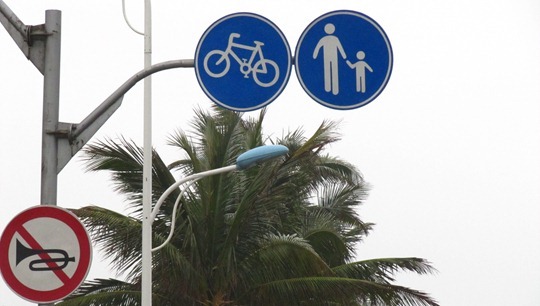
Traffic signs in China – Photo by James Schwartz / The Urban Country
Winston Churchill once said that it has been said that democracy is the worst form of government except all the others that have been tried. Like all other good things, democracy certainly has its flaws.
In North American democracy, transportation policy often caters to the majority instead of considering the best interests of everyone. For example, if 51% of citizens in a North American city commute using motor vehicles, 29% take public transit, 15% walk and 5% ride bicycles, then in our current “democratic” system will usually cater to the majority (drivers) at the expense of the 49% of the population who don’t drive cars.
Today is the fourth day since I arrived in China – on Hainan island in the South China Sea. Although most would say the Chinese government is “undemocratic”, when it comes to transportation, the government often looks at the best interests of everyone rather than catering to a single group. One could possibly even argue that this is more democratic than North American transportation policy which plays favourites with the largest group of voters.
To be sure, China is no saint on many issues. But when it comes to transportation, China’s commitment to looking out for the greater good is evident by the vast expenditures invested in public transit in its cities, its world-class bicycle infrastructure, and regulation on the number of motor vehicles allowed to be registered in major cities. All three of these initiatives have helped to reduce pollution and traffic congestion in Chinese cities as well as providing affordable alternative means of transportation for its citizens.
Democracy has failed us in North America. Our government has catered to drivers without considering the consequences or working toward the greater good of everyone.
The result of our “democracy” is that we end up with little bits of inadequate bike lanes neighbourhoods represented by “bicycle-friendly” elected officials, but then those bike lanes end when they reach neighbourhoods with anti-bike officials.
Our democratic process rewards polarization to win votes by isolating groups of people – the “divide and conquer” approach. We thus end up with an us vs. them attitude when it comes to allocating the limited space on our streets. You are either “for” cars, or “for” bicycles. There doesn’t seem to be a middle ground, even though most people who use bicycles in North America also drive cars.
The result is that it becomes inconvenient and uncomfortable to ride a bicycle in North American cities. This leads more people to resort to motor vehicles as they are sole mode of transportation.
Here in Haikou – Hainan’s capital city of ~2 million people – virtually all new roads are constructed to include bicycle infrastructure. The decision to include bicycle infrastructure cannot be blocked by a particular car-loving neighbourhood. Bike infrastructure is included with standard road design, just like we do with sidewalks in North America.
Further, the bike lanes here aren’t just a painted line on the shoulder of a road or located directly in the door zone of a row of parked cars. Bike lanes here are wide and physically separated, making riding a pleasurable and safe experience instead of a stressful and dangerous one.
Below is a photo of a new road that hasn’t yet been built. The street signs have preceded the road itself. Each of these new roads come equipped with a sign that is so common across China to indicate which lane is dedicated to bicycles:
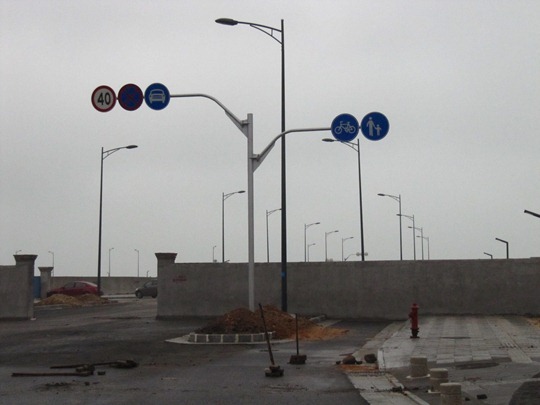
China bike infrastructure – Photo by James Schwartz / The Urban Country
You can see in the photo above the physical separation between the motor vehicles and bicycles. These physically separated lanes are everywhere (when not prohibited by lack of space), and extremely comfortable to ride.
Here is a photo on a new road in a brand new development zone in Haikou:
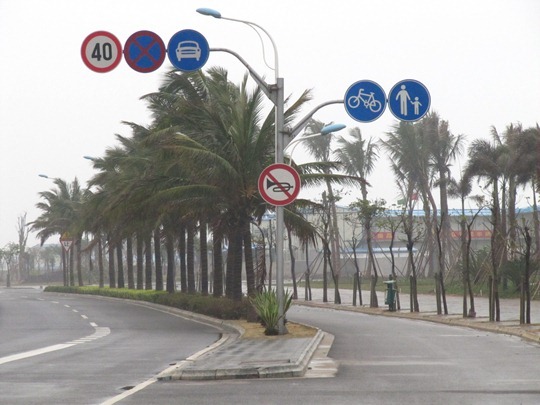
China bike infrastructure – Photo by James Schwartz / The Urban Country
Some bike lanes are shared with motor vehicles. But vehicles drive much slower in this lane and only enter this lane when they are parking or entering a driveway. These are also common in the Netherlands, but they are virtually nonexistent in North America:
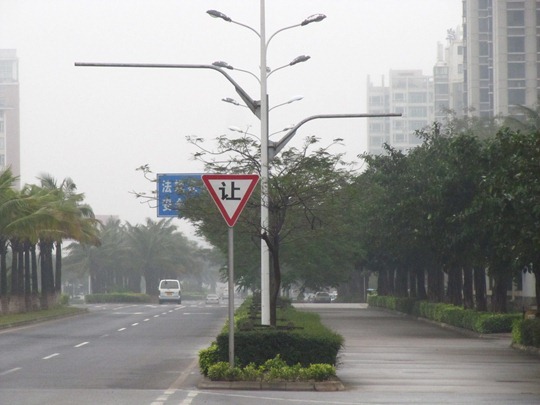
China bike infrastructure – Photo by James Schwartz / The Urban Country
Including properly-designed bicycle infrastructure as standard planning in North America would provide what many North Americans crave: a comfortable alternative to driving cars. A way to avoid traffic jams. A way to get daily exercise without even thinking about it. A way to know exactly how long it will take to get to your destination – regardless of traffic.
But until we include bicycle infrastructure as a key aspect of road design we will always be fighting for short patches of bike lanes that seem to end even before they begin.
James D. Schwartz is a Transportation Pragmatist and the Editor of The Urban Country. You can contact James at james.schwartz@theurbancountry.com or follow him on Twitter.

Related Articles:
Not sure this is uniformly true — Beijing was famously polluted before the 2008 Olympics, and there’s also news of gigantic traffic jams from time to time. On the other hand, a lot of that is supposed to come from motor scooters, and those are increasingly restricted in favor of electric scooters.
What we’ve got is a dictatorship that is in this instance, benevolent. It hasn’t always been (T Square?), nor is it guaranteed to be in so in all cases.
Not sure how you’re going to be able to edit/approve this from China, either, at least not for long as soon as more critical comments show up.
Not sure this is uniformly true — Beijing was famously polluted before the 2008 Olympics, and there’s also news of gigantic traffic jams from time to time. On the other hand, a lot of that is supposed to come from motor scooters, and those are increasingly restricted in favor of electric scooters.
What we’ve got is a dictatorship that is in this instance, benevolent. It hasn’t always been (T Square?), nor is it guaranteed to be in so in all cases.
Not sure how you’re going to be able to edit/approve this from China, either, at least not for long as soon as more critical comments show up.
I think you’re grasping at straws James.
First of all, Canada and the US (North America as you so put it) are not democracies in the true sense of the word. Canada’s government is a representative democracy, while the US’s is a representative republic, the key word there being representative. A true democracy would work in the way you described, but the last true democracy was Greece back in the olden days.
A true democracy is plagued by the follies you mentioned, but when you toss in representation, the theory is that all people have equal rights despite what the majority want. For instance. in the case of a true democracy, a majority of the population can vote that it’s ok to discriminate against a race, and that decision becomes law. Greece was well known for such silly public opinion laws. In a representative democracy the vote may take place, but the rights of that particular race are not nullified because they have equal rights despite what the majority think.
The best example of this is a famous saying attributed to Benjamin Franklin, though it probably wasn’t him who said it: “Democracy is two wolves and a lamb voting on what to have for lunch. Liberty is a well-armed lamb contesting the vote.”
In practice, and related to transportation, the systems here work the way you described, unfortunately. There are other systems that should also be fixed, but let’s take it one step at a time.
PS I’ll also have to agree with David’s comment in that China has a very poor track record when it comes to pollution and human rights. To say they’re good guys because they built some bike lanes is ridiculous.
Speaking as someone who grew up in the South, I wouldn’t get too excited about the ability of a representative Democracy or Republic to protect minority rights. Even now, we have one party working on creative ways to disenfranchise a people (poor, black) that they think are less likely to vote for them. Just by accidents of history, electoral timing, and silly Supreme Court decisions, some groups of people wield disproportionate influence in this country. There’s popular stuff (single-payer health care, tax increase on the wealthiest) that also is probably good (based on statistics from other countries, based on historical economic performance and a study of the Laffer curve) does not get passed because a few small, powerful minorities do not want it.
Ideally, it should work the way I put it. In reality it doesn’t for different reasons. I wouldn’t get too excited about your assertion about the “one party” that is trying to put minorities down. Not so long ago it was the “other party” doing the same thing. Though if you look deeper, it’s people from “both parties” engaging in this activity, of putting other people “in their place”. It’s not really a black and white issue (pun intended) when it comes to politics and party affiliations.
I think you’re grasping at straws James.
First of all, Canada and the US (North America as you so put it) are not democracies in the true sense of the word. Canada’s government is a representative democracy, while the US’s is a representative republic, the key word there being representative. A true democracy would work in the way you described, but the last true democracy was Greece back in the olden days.
A true democracy is plagued by the follies you mentioned, but when you toss in representation, the theory is that all people have equal rights despite what the majority want. For instance. in the case of a true democracy, a majority of the population can vote that it’s ok to discriminate against a race. In a representative democracy the vote may take place, but the rights of that particular race are not nullified because they have equal rights despite what the majority think.
The best example of this is a famous saying attributed to Benjamin Franklin, though it probably wasn’t him who said it: “Democracy is two wolves and a lamb voting on what to have for lunch. Liberty is a well-armed lamb contesting the vote.”
In practice, and related to transportation, the systems here work the way you described, unfortunately. There are other systems that should also be fixed, but let’s take it one step at a time.
PS I’ll also have to agree with David’s comment in that China has a very poor track record when it comes to pollution and human rights. To say they’re good guys because they built some bike lanes is ridiculous.
Octavian & David, nowhere did I say it that the Chinese are uniformly the “good guys” just because they have good bike infrastructure. This post wasn’t intended to cover internet censorship, free speech, or human rights in general. As someone who is currently living in China and unable to access many of the websites I frequent, I think I am in a good position to see the many negative sides of China.
This post however is specifically discussing transportation planning & road design and some of the good decisions the Chinese have made that are inherently prohibited in North America due to our car culture & elected representatives.
Indeed. Just pointing out the difference between “democracy” and “representation” and how they (should) work in theory.
Octavian & David, nowhere did I say it that the Chinese are uniformly the “good guys” just because they have good bike infrastructure. This post wasn’t intended to cover internet censorship, free speech, or human rights in general. As someone who is currently living in China and unable to access many of the websites I frequent, I think I am in a good position to see the many negative sides of China.
This post however is specifically discussing transportation planning & road design and some of the good decisions the Chinese have made that are inherently prohibited in North America due to our car culture & elected representatives.
Speaking as someone who grew up in the South, I wouldn’t get too excited about the ability of a representative Democracy or Republic to protect minority rights. Even now, we have one party working on creative ways to disenfranchise a people (poor, black) that they think are less likely to vote for them. Just by accidents of history, electoral timing, and silly Supreme Court decisions, some groups of people wield disproportionate influence in this country. There’s popular stuff (single-payer health care, tax increase on the wealthiest) that also is probably good (based on statistics from other countries, based on historical economic performance and a study of the Laffer curve) does not get passed because a few small, powerful minorities do not want it.
Ideally, it should work the way I put it. In reality it doesn’t for different reasons. I wouldn’t get too excited about your assertion about the “one party” that is trying to put minorities down. Not so long ago it was the “other party” doing the same thing. Though if you look deeper, it’s people from “both parties” engaging in this activity, of putting other people “in their place”. It’s not really a black and white issue (pun intended) when it comes to politics and party affiliations.
Indeed. Just pointing out the difference between “democracy” and “representation” and how they (should) work in theory.
I don’t want to write an essay here, so I’m going to try and keep it short.
I agree and disagree with you at the same time.
Cultural hegemony is a tricky thing to navigate, and there are upsides and downsides to cars. We can’t just undo the suburbs – so that means, for now, we can’t get of rid of cars. “Democracy”, as you put it, is serving people with cars fairly well for the most part; despite obvious problems. I find it very interesting that we don’t think of road network and automobile traffic as mass transit, because it is mass transit. But you’re right, we need more bike infrastructure and mass transit.
There are some places in The Staes that have solid bike infrastructure. New York and LA are installing bike lanes etc (they’re doing some good stuff in LA right now), and more well known places like Portland, San Francisco, Minneapolis, etc. etc. are all doing well too. And in in Toronto, Bike lanes are one of the major sites of civic debate. Things are going backwards right now, its true, but things are happening. It’s not that bad.
I also suspect there are more complicated social/class/economic reasons for bikes lanes in China. But I don’t want to speculate about those because I don’t know. And no trumpets? That would be a very somber critical mass. And does your second picture have a few lanes leading into a wall? Also, why isn’t there any traffic on the roads in your pictures?
I’m tempted to make a grand statement about the goodness of democracy, but I wont, instead I will say that it is slow and cumbersome, and a generally a good thing.
Hi Ian, I agree that we can’t undo the suburbs. My suggestion is that instead of allocating 99% of the space to motor vehicles, we allocate some space for bicycles just like we put sidewalks in the suburbs. We still need to accommodate motor vehicles no doubt, but we can be a bit smarter about it by providing some alternatives.
I agree that positive change is happening in North America, but the quality is lacking and the resistance to it is strong. We don’t have resistance to sidewalks because they are part of standard planning practices. If we installed sidewalks using our “democratic” process, we would see the same thing happen – some areas would have them, and they would be ripped out in other areas.
The first three photos in the article were taken in a brand new development that is largely under construction, so there isn’t a lot of traffic here yet (be it cars or scooters or bicycles). The wall in the second photo exists because that entire area is under construction and closed to the public. When the construction is nearing completion, the wall will be taken down.
The reason I posted photos taken in the new development is because I wanted to highlight that bike infrastructure is built by default over here (even in an area that is largely being developed for the wealthy).
I also could have mentioned that in this area there is also a waterfront recreational path on this same road. The government could have decided that since there’s a recreational trail there is no need for on-street bicycle infrastructure. But they look at two wheel transportation as a standard mode of transportation that should be accommodate even if there is a recreational trail nearby. This is far different from the view that our planners largely have in North America that bicycles should be treated as recreational only.
“If we installed sidewalks using our “democratic” process, we would see the same thing happen – some areas would have them, and they would be ripped out in other areas.”
That actually happens, although it is more common for some areas to decide not to install them in the first place and those who wish them installed face massive resistance.
They are not standard, the decision has to be made and I know entire villages that have decided to go without.
PS: I also covered bike infrastructure in the city in a previous article in 2010: https://www.theurbancountry.com/2010/11/complete-streets-in-china.html
The bike lanes in the photos in that article are well used because those photos were taken in the city. The photos in this article would be considered the suburbs (roughly 7km from the city centre).
As you can see from the 2010 article however, most people use electric scooters here rather than pedalling. A different topic for a different article 😉
Ian, you say it yourself: democracy serves people with cars very well. Those without cars, not so much. And a lot of people increasingly find car ownership too financially burdensome to say they are being served well. For many others, it is simply not an option. I’m saying this as a middle class person, with a job and a car. What would I have to sacrifice in terms of freedom and democracy if I suddenly had to make a car payment – or even pay for a major car repair? For me, it would like be medication and much needed dental care. Further, what do the real majority have to sacrifice when we choose to fund auto-only infrastructure (which never truly gets paid for when you consider the cost of on-going maintenance for which the tax payer is forever on the hook) at the expense of mass transit, bicycling and pedestrian infrastructure?
I don’t want to write an essay here, so I’m going to try and keep it short.
I agree and disagree with you at the same time.
Cultural hegemony is a tricky thing to navigate, and there are upsides and downsides to cars. We can’t just undo the suburbs – so that means, for now, we can’t get of rid of cars. “Democracy”, as you put it, is serving people with cars fairly well for the most part; despite obvious problems. I find it very interesting that we don’t think of road network and automobile traffic as mass transit, because it is mass transit. But you’re right, we need more bike infrastructure and mass transit.
There are some places in The Staes that have solid bike infrastructure. New York and LA are installing bike lanes etc (they’re doing some good stuff in LA right now), and more well known places like Portland, San Francisco, Minneapolis, etc. etc. are all doing well too. And in in Toronto, Bike lanes are one of the major sites of civic debate. Things are going backwards right now, its true, but things are happening. It’s not that bad.
I also suspect there are more complicated social/class/economic reasons for bikes lanes in China. But I don’t want to speculate about those because I don’t know. And no trumpets? That would be a very somber critical mass. And does your second picture have a few lanes leading into a wall? Also, why isn’t there any traffic on the roads in your pictures?
I’m tempted to make a grand statement about the goodness of democracy, but I wont, instead I will say that it is slow and cumbersome, and a generally a good thing.
James, thanks for this post.
I was recently in China (Shanghai) and apart from the cool bike infrastructure you mention, what struck me is that they seem to have figured out wayfinding a lot better than us in Canada.
I was very impressed at how they manage to convey required traffic patterns (for all modes of transportation) with much less sign clutter than us.
I think that helps everyone get around more easily and with less confusion (ergo less nervousness and anxiety, ergo more peace).
Thanks Agustin. Most of the traffic signs I’ve seen here resemble that of the Netherlands. I suspect there is some sort of consulting/collaboration between China and Europe in this respect. Thank goodness the Chinese didn’t look to North America for advice.
On a related note, my wife’s father works in the transportation planning department here in China. I wish I could talk to him about it, but I still need to learn to speak the language… 🙂
I’ve got to get my ass to the Netherlands!
Cheers and good luck in your travels!
James, thanks for this post.
I was recently in China (Shanghai) and apart from the cool bike infrastructure you mention, what struck me is that they seem to have figured out wayfinding a lot better than us in Canada.
I was very impressed at how they manage to convey required traffic patterns (for all modes of transportation) with much less sign clutter than us.
I think that helps everyone get around more easily and with less confusion (ergo less nervousness and anxiety, ergo more peace).
Interesting to see infrastructure somewhere other than the Netherlands and Denmark!! Where I live, I think it’s part of a new law that any new roads need to have bike lanes, and any road that’s being repaved needs to be able to accommodate bikes as well. It’s a slow process getting everything changed over though. In the meantime, I get around on my folding bike which lets me ride when I can and when it’s safe, but I can take the bus through the areas that don’t have bike lanes yet.
Interesting to see infrastructure somewhere other than the Netherlands and Denmark!! Where I live, I think it’s part of a new law that any new roads need to have bike lanes, and any road that’s being repaved needs to be able to accommodate bikes as well. It’s a slow process getting everything changed over though. In the meantime, I get around on my folding bike which lets me ride when I can and when it’s safe, but I can take the bus through the areas that don’t have bike lanes yet.
Hi Ian, I agree that we can’t undo the suburbs. My suggestion is that instead of allocating 99% of the space to motor vehicles, we allocate some space for bicycles just like we put sidewalks in the suburbs. We still need to accommodate motor vehicles no doubt, but we can be a bit smarter about it by providing some alternatives.
I agree that positive change is happening in North America, but the quality is lacking and the resistance to it is strong. We don’t have resistance to sidewalks because they are part of standard planning practices. If we installed sidewalks using our “democratic” process, we would see the same thing happen – some areas would have them, and they would be ripped out in other areas.
The first three photos in the article were taken in a brand new development that is largely under construction, so there isn’t a lot of traffic here yet (be it cars or scooters or bicycles). The wall in the second photo exists because that entire area is under construction and closed to the public. When the construction is nearing completion, the wall will be taken down.
The reason I posted photos taken in the new development is because I wanted to highlight that bike infrastructure is built by default over here (even in an area that is largely being developed for the wealthy).
I also could have mentioned that in this area there is also a waterfront recreational path on this same road. The government could have decided that since there’s a recreational trail there is no need for on-street bicycle infrastructure. But they look at two wheel transportation as a standard mode of transportation that should be accommodate even if there is a recreational trail nearby. This is far different from the view that our planners largely have in North America that bicycles should be treated as recreational only.
PS: I also covered bike infrastructure in the city in a previous article in 2010: https://www.theurbancountry.com/2010/11/complete-streets-in-china.html
The bike lanes in the photos in that article are well used because those photos were taken in the city. The photos in this article would be considered the suburbs (roughly 7km from the city centre).
As you can see from the 2010 article however, most people use electric scooters here rather than pedalling. A different topic for a different article 😉
Thanks Agustin. Most of the traffic signs I’ve seen here resemble that of the Netherlands. I suspect there is some sort of consulting/collaboration between China and Europe in this respect. Thank goodness the Chinese didn’t look to North America for advice.
On a related note, my wife’s father works in the transportation planning department here in China. I wish I could talk to him about it, but I still need to learn to speak the language… 🙂
Good stuff in LA? Really? If you mean bike lanes in door zones that end for no apparent reason. Or a bunch of sharrows painted on busy, dangerous streets, then I guess “good” stuff is happening in LA.
Good stuff in LA? Really? If you mean bike lanes in door zones that end for no apparent reason. Or a bunch of sharrows painted on busy, dangerous streets, then I guess “good” stuff is happening in LA.
I’ve got to get my ass to the Netherlands!
Cheers and good luck in your travels!
“We can’t just undo the suburbs – so that means, for now, we can’t get of rid of cars.”
When I was born most of the motor infrastructure you see around you did not exist. The first suburb, in the modern conception of such, was brand spanking new. When I was in college I first started warning people that the “Sleeping Dragon” was stirring in its sleep. It took another 10 years for it to awaken. Just look at it now.
When my mother was born there was not a single motorway in the entire world. She’s still young enough to ride her one speed uphill three miles to get her groceries.
We “just did” the suburbs in only a handful of decades. We can undo them even faster if we’ve a mind to, as undoing takes rather less work.
It takes no more than 20 years to transform an entire culture beyond the recognition of those who knew it before. There are those alive today, both in the Americas and in China, who have watched it happen; multiple times.
All that is needed is the cultural decision.
Agreed. We still have massive new development with new roads connecting new commerical to new residential neighborhoods. The roads are designed to acommodate a large amount of cars going at a high rate of speed. Sidewalks are very narrow and often start and stop without really connecting destinations in such a way as to encourage walking, even with a residential development is half a block away. And forget about bike lanes. Also an after thought that is not incorporated in the overall infrastructure in a meaningful way.
A perfect example in the US is Norton Commons in Louisville, KY. A really lovely, mixed-use, traditional neighborhood development that continues to expand in what was once farm land at the edge of the county. The development mimics the traditional old neighborhoods of 100 years ago and should ideally promote biking and walking – and it does WITHIN THE DEVELOPMENT ONLY!. NC is surrounded by other residential and commerical developments (all relatively new) that are unconnected by almost nothing but wide roads for fast traffic. You can’t walk to the high-end lifestyle center nearby, which does include sidewalks, because there are no sidewalk connecting NC to the life style center. And of course, no bike lanes. Public transportation doesn’t visit Norton Commons either – low paid housekeepers, cooks and home healthcare aids serving the wealthy residents just have to drive their own unreliable autos or walk in the road,from the neares bus stop (probably a mile a way) to the majority that drive cars but we cater to the those with the most money (aka “key stakeholders”).
“We can’t just undo the suburbs – so that means, for now, we can’t get of rid of cars.”
When I was born most of the motor infrastructure you see around you did not exist. The first suburb, in the modern conception of such, was brand spanking new. When I was in college I first started warning people that the “Sleeping Dragon” was stirring in its sleep. It took another 10 years for it to awaken. Just look at it now.
When my mother was born there was not a single motorway in the entire world. She’s still young enough to ride her one speed uphill three miles to get her groceries.
We “just did” the suburbs in only a handful of decades. We can undo them even faster if we’ve a mind to, as undoing takes rather less work.
It takes no more than 20 years to transform an entire culture beyond the recognition of those who knew it before. There are those alive today, both in the Americas and in China, who have watched it happen; multiple times.
All that is needed is the cultural decision.
Agreed. We still have massive new development with new roads connecting new commerical to new residential neighborhoods. The roads are designed to acommodate a large amount of cars going at a high rate of speed. Sidewalks are very narrow and often start and stop without really connecting destinations in such a way as to encourage walking, even with a residential development is half a block away. And forget about bike lanes. Also an after thought that is not incorporated in the overall infrastructure in a meaningful way.
A perfect example in the US is Norton Commons in Louisville, KY. A really lovely, mixed-use, traditional neighborhood development that continues to expand in what was once farm land at the edge of the county. The development mimics the traditional old neighborhoods of 100 years ago and should ideally promote biking and walking – and it does WITHIN THE DEVELOPMENT ONLY!. NC is surrounded by other residential and commerical developments (all relatively new) that are unconnected by almost nothing but wide roads for fast traffic. You can’t walk to the high-end lifestyle center nearby, which does include sidewalks, because there are no sidewalk connecting NC to the life style center. And of course, no bike lanes. Public transportation doesn’t visit Norton Commons either – low paid housekeepers, cooks and home healthcare aids serving the wealthy residents just have to drive their own unreliable autos or walk in the road,from the neares bus stop (probably a mile a way) to the majority that drive cars but we cater to the those with the most money (aka “key stakeholders”).
Ian, you say it yourself: democracy serves people with cars very well. Those without cars, not so much. And a lot of people increasingly find car ownership too financially burdensome to say they are being served well. For many others, it is simply not an option. I’m saying this as a middle class person, with a job and a car. What would I have to sacrifice in terms of freedom and democracy if I suddenly had to make a car payment – or even pay for a major car repair? For me, it would like be medication and much needed dental care. Further, what do the real majority have to sacrifice when we choose to fund auto-only infrastructure (which never truly gets paid for when you consider the cost of on-going maintenance for which the tax payer is forever on the hook) at the expense of mass transit, bicycling and pedestrian infrastructure?
It seems to me that some of the comments highlight the very reason North America (I’d say the U.S. most specifically since we don’t think Canada has anything to teach us either) is so reluctant to learn from other cultures. Discussion devolves from consideration of increasing alternative transport infrastructure to the completely unrelated question of censorship in China. If we really want to go in that direction, my experience as a government worker is that professional staff (including transportation and community planners) are censored pretty routinely when data and facts go undiscussed or dismissed in favor of the unsubstantiated opinions/preferences of “key stakerholders” who have a financial or electoral investment in the outcome of policy decisions.
Is it really that horrible to consider that another country, perhaps a long time foe, might have a good idea once in a while? Since I’ve never heard anyone sigh “I just wish I could spend more time on the LA Freeway!” or “My, the traffic conjestion in Atlanta is just delightful; more time to admire at the Big Chicken!” why waste time debating whether or not China (or Denmark) has it all over us on transportation infrastructure?
It seems to me that some of the comments highlight the very reason North America (I’d say the U.S. most specifically since we don’t think Canada has anything to teach us either) is so reluctant to learn from other cultures. Discussion devolves from consideration of increasing alternative transport infrastructure to the completely unrelated question of censorship in China. If we really want to go in that direction, my experience as a government worker is that professional staff (including transportation and community planners) are censored pretty routinely when data and facts go undiscussed or dismissed in favor of the unsubstantiated opinions/preferences of “key stakerholders” who have a financial or electoral investment in the outcome of policy decisions.
Is it really that horrible to consider that another country, perhaps a long time foe, might have a good idea once in a while? Since I’ve never heard anyone sigh “I just wish I could spend more time on the LA Freeway!” or “My, the traffic conjestion in Atlanta is just delightful; more time to admire at the Big Chicken!” why waste time debating whether or not China (or Denmark) has it all over us on transportation infrastructure?
“If we installed sidewalks using our “democratic” process, we would see the same thing happen – some areas would have them, and they would be ripped out in other areas.”
That actually happens, although it is more common for some areas to decide not to install them in the first place and those who wish them installed face massive resistance.
They are not standard, the decision has to be made and I know entire villages that have decided to go without.
Pingback: Paris Cyclists Allowed To Run Red Lights ← The Urban Country
Pingback: Bicycle Transportation Should Be Taken Seriously ← The Urban Country
Pingback: Want to Get Rich? Open a Gas Station in China ← The Urban Country
Pingback: Sunday Afternoon Traffic in China ← The Urban Country
Pingback: Sunday Afternoon Ride in China ← The Urban Country